
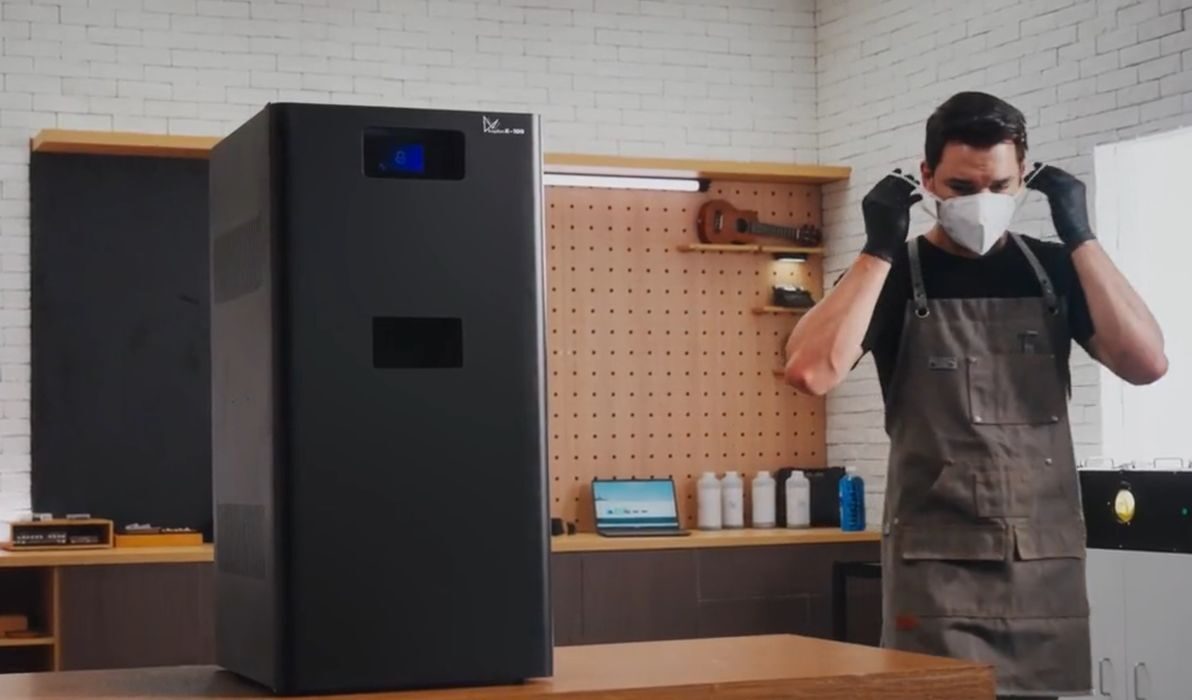
Surprise! There’s a new 3D printer on Kickstarter, but this one uses SLS, not FFF.
The days of seeing new FFF devices from startup companies on Kickstarter are long past, but is there still room for different types of 3D printers? Here we have a new SLS 3D printer called the “LoopZizo K-100”.
If you’re not familiar with SLS, it is a different 3D printing process that involves firing a powerful laser at a flat bed of polymer powder. The laser selectively melts some of the powder, and a new layer is spread on top. The process repeats until complete. Then you have your objects buried in a block of powder.
There are some terrific advantages to SLS:
- No support structures are required because the loose powder provides support
- Minimal post processing is required because all surfaces are smooth
- Build chambers can be filled in three dimensions, instead of filling a plate as is done with FFF
- Strong parts can be made with materials like PA or TPU
There are a bunch of drawbacks as well:
- SLS equipment tends to be expensive, mostly due to needing a powerful laser
- Powder handling can be quite messy, particularly because unused powder can sometimes be recycled
- With low power lasers, material colors are severely limited
What’s the K-100 all about then?
It is a “compact” SLS 3D printer with a build volume of 140 x 140 x 140 mm, and a resolution (the laser dot size) of 0.1mm. You should be able to produce high detail prints with the K-100.
The machine itself has a relatively small footprint at only 400 x 420 mm, but it is 820mm tall. You could put it on a desk, but the top will be pretty high up.
While not included in the base offering, the system really does require their H1 Powder Recovery Station. This is a similarly sized unit where you insert completed build chambers — with their block of powder. The station has a sealed chamber where you can dig prints out of the powder, blow off stray bits with an air hose, and hopefully recover some of that expensive powder. I would not consider buying one of these without the powder handling station.
One more specification to be aware of: all of their promotional material shows prints made in black (or a very, very dark gray color). There is a reason for this: white powder reflects laser energy, while dark powder absorbs more. By using dark material you can get away with a lower power laser than the really expensive ones used in big commercial SLS systems.
The early bird price for the pair (I’m not even going to mention the standalone machine price) is US$6,399. This is far more expensive than not only FFF equipment, but also somewhat more expensive than some SLA equipment. However, it is vastly less than the cost of big-time commercial SLS solutions.
The competition here would be from two others:
- Formlabs Fuse 1+ (around US$45,000)
- Sinterit Suzy (around US$20,000)
So you can see that the K-100 is easily less expensive than either of those systems.
But these machines are not the same at all. While they have similar build volumes, the competition both use 30W lasers, while the K-100’s laser is a puny 5W. This is how LoopZizo is able to lower the price: they compromised on the laser.
The lower power laser certainly means print speeds will be vastly slower than either of the other machines. You might think that it wouldn’t matter, just run the job overnight, but that really doesn’t apply here.
While LoopZizo mentions that the machine is intended to be used in home or business, it is really far too expensive for home and casual use. Its cost demands that it be run as much as possible to recoup the cost. In other words, it should be making production parts all day long.
But hold on, how many parts will it produce if the laser is only 5W? In theory the competing machines would be 6X faster due to laser power alone. If so, you would need six K-100’s to match the throughput of either competing machine. Six times US$6400 is around US$40,000, and well, we are in the same price range again.
I am also concerned that the 5W might be far too small to be practical. The competing machines already lowered the laser power to what they believed would be the best compromise between speed and cost, while LoopZizo suddenly goes way, way lower. The competition are best when using dark powders, so there is absolutely no chance that the K-100 could ever tackle white powder.
Note: white powder is highly desirable because it can be dyed to any color in post processing. Dark material just stays dark.
All Kickstarters should be considered at least somewhat risky, as there have been countless launch failures in the past. Could this be the case with the K-100? I took a long look at the campaign and more concerns arose.
The Kickstarter campaign clearly states that the project is based in “New York, NY”. However, the company’s website (which I had to find separately because it does not appear on the campaign page) shows this address:
“Chinese Company
Room 01-1, 6th Floor, Office Building, No. 123, Baiyunkeng Inner Ring Road, Danshui, Huiyang District, Huizhou”
Yes, their address actually says “Chinese Company”. There are also phone numbers with China country codes. Why not mention this clearly on the campaign page? Why does it say New York? Do they want to hide this information?
Their website states that the company was founded in 2024, only a year ago. This means they are quite new. However, their website also mentions two other 3D printers that must have been previously released. Both are SLS systems that are likely far more expensive, and I’ve never heard of them.
Their website has all kinds of unusual features, and some are totally unclear. There is a list of icons labeled “Qualification an Honors”, which I presume would be patents or awards. However, the icons simply scroll by with no mention of anything specific. Do they actually have any qualifications or honors?
The About page also lists several counters with impressive totals. However, they do not say what these numbers represent.
They say their mission is to “transform industrial machines into desktop machines”, which seems to be what they are doing with the K-100.
The campaign states that the K-100 is multimaterial capable, including PA and TPU. On their website they show only two materials, black PA12 and dark grey TPU. I guess two would count as multimaterial, would you agree?
Note that only one type of powder can be used at a time. They don’t mention how much effort is required to swap materials on the K-100. Depending on the system design, this could be considerable. Or perhaps you need to buy separate build chambers for each material. We just don’t know.
If you travel through their website you might get the same feeling I did: it is all a very standard setup that seems thrown together with stock elements. There is even a “Skype” icon on the side, even though Skype was discontinued months ago.
I don’t know about you, but I see a number of suspicious red flags about this project that would make me hesitant to consider a purchase. If you are willing to sink at least US$6400 into this project with those risks, perhaps your business might consider a Suzy or a Fuse 1+ instead.
Via Kickstarter and LoopZizo
