
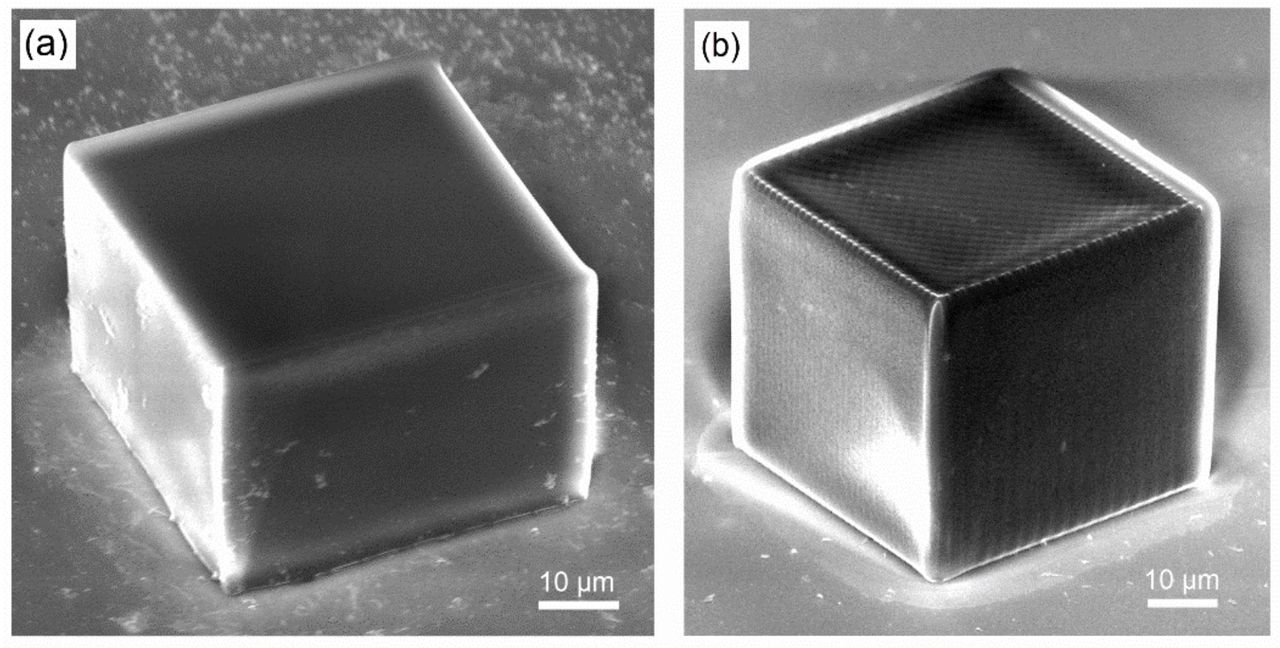
Researchers have demonstrated 3D printed cubic microbubbles with enclosed, ultra-thin walls and extreme aspect ratios.
Microbubbles typically are made from microfluidic generation or foaming, and they are almost always spherical. Additive manufacturing has struggled to produce fully enclosed microcavities with thin shells because trapped resin must somehow be removed and thin roofs tend to collapse during solvent wash and UV curing. This new method claims to create box-shaped, sealed microcavities — essentially “cubic bubbles” — with walls thin enough to act as acoustic or mechanical resonators.
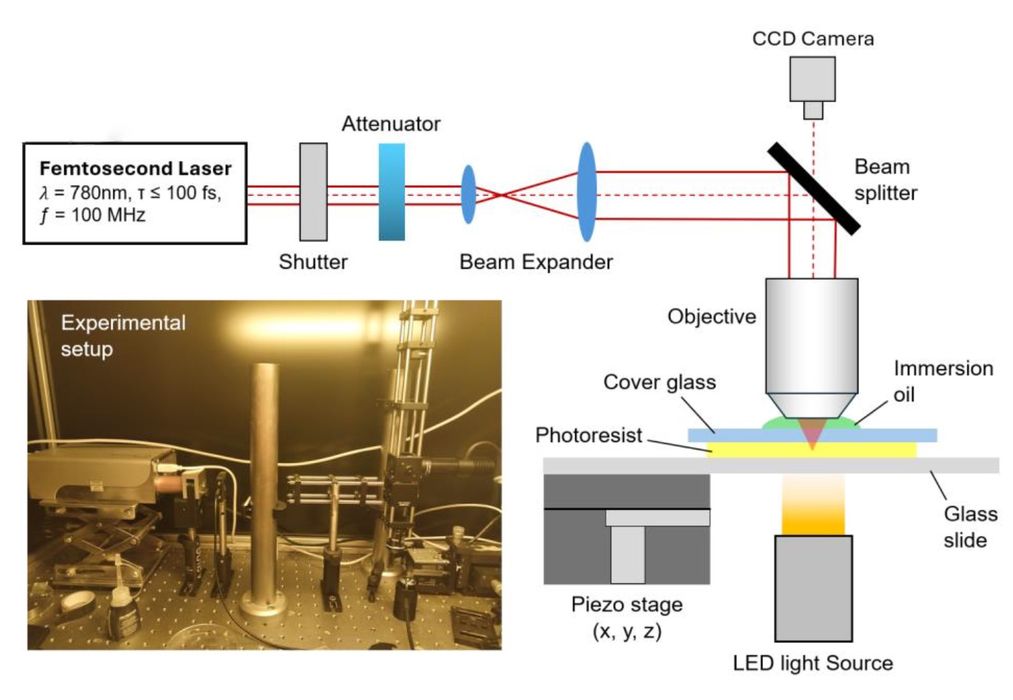
The most likely tool for this process is two-photon polymerization (2PP) direct laser writing, which can create submicron features with high fidelity inside a photopolymer resin. Commercial 2PP systems from vendors like Nanoscribe and UpNano already produce microlattices and microfluidic components; adding true, thin-walled, fully enclosed voids would expand that design space in a meaningful way.
Why Enclosed Microcavities Are Hard To Print
Creating a hollow, sealed shell at the microscale confronts two big issues: fluid removal and structural stability. During printing, any internal resin must either be prevented from entering the cavity or be drained out through vents that later need sealing without deforming the part. Even if drainage succeeds, capillary forces during solvent rinse and drying can crumple thin roofs or bend walls. At these scales, a even a small amount of pressure differential can buckle a microstructure.
Several groups have tried developing workarounds, including sacrificial porogens, temporary vent channels closed by a secondary exposure, and supercritical drying to avoid meniscus forces. The claim of “fully enclosed thin-walled microcavities with ultra-high aspect ratios” implies the authors have a method that balances print parameters, shell topology, and post-processing to preserve geometry while evacuating uncured material. The paper’s title also suggests reliable sealing of long, slender cavities, which is especially difficult because misalignment or thermal stress tends to propagate along the length of the part.
If the researchers can reliably produce submicron to low-micron walls over lengths tens to hundreds of microns long, that is a big change for microacoustic devices, microreactors, and optical or fluidic resonators.
Throughput is a constraint. 2PP is precise but very slow, with build volume and scan speed limiting part count. Arrays of cubic microbubbles could be tiled on a substrate, but writing millions of units would be extremely time consuming unless there is significant automation or multi-beam exposure. Material choice is also quite narrow; most 2PP photopolymers have modest thermal and chemical resistance, and certification for biomedical use requires much more data than a compelling micrograph.
Despite those challenges, the process is interesting. Acoustics researchers want non-spherical, high-Q microresonators for tunable filters and ultrasound manipulation, for example. Microfluidics designers could use enclosed cavities as valves, storage pods, or buoyant elements. Metamaterial architects might assemble periodic arrays of cubic bubbles to shape sound or refractive index in ways spherical pores cannot. Even lightweight micro-lattices could benefit from controllable, sealed voids that shift density without compromising stiffness too much.
Looking ahead, it will be interesting to see whether companies integrate a “microcavity mode” into their systems, with presets for exposure dose, scan strategy, and post-processing.
The future could be square bubbles.
Via OpenAlex
