
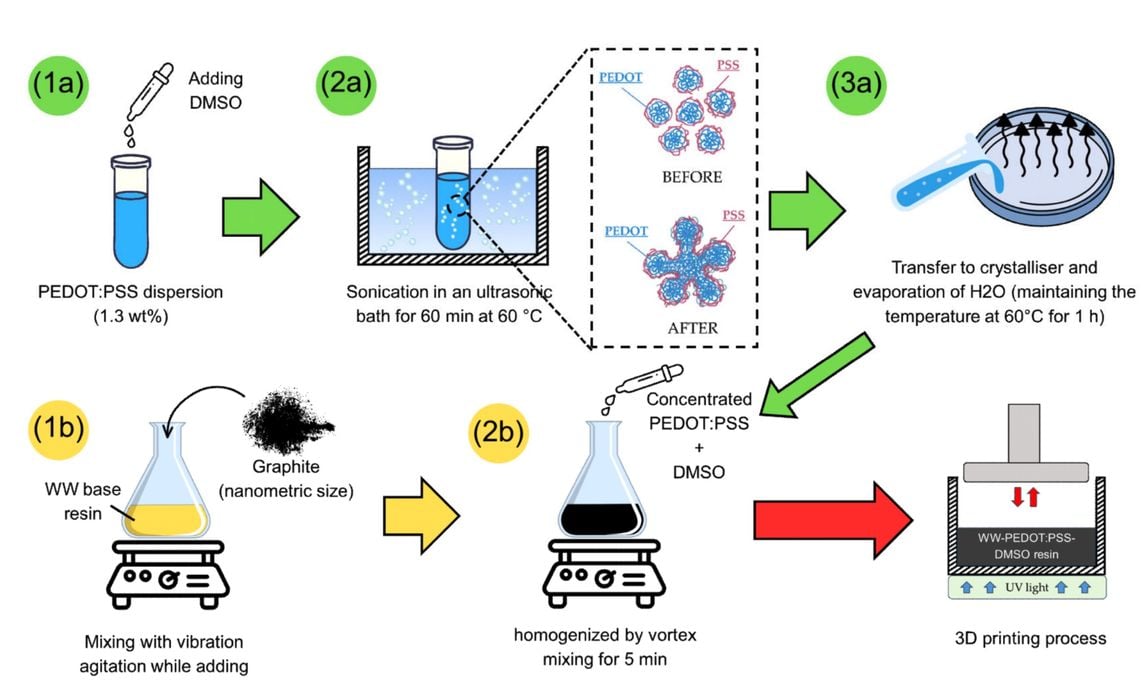
A research team designed a photopolymer resin loaded with PEDOT:PSS and nano-graphite to achieve 3D printable electrical conductivity.
Conductive photopolymers are a long standing gap in additive manufacturing. While fused filament fabrication (FFF) has offered carbon loaded and graphene filled filaments for years, photopolymer resins used in stereolithography (SLA) and digital light processing (DLP) remain mostly non-conductive. Some ESD resins exist, but they typically target static dissipation rather than true conduction. This work should advance SLA and DLP processes closer to functional electronics by modifying a UV curable resin with the conductive polymer PEDOT:PSS and nano-graphite.
Photopolymerization (SLA/DLP) delivers smooth surfaces, fine features and tight tolerances that are difficult to match with extrusion systems, which makes it ideal for microfluidics, lattices and intricate housings. If those parts can carry current it could unlocks compact sensor bodies, low ohmic interconnects for lab rigs, and jigs and fixtures that meet ESD requirements without post processing.
The problem is that conductive fillers typically absorb and scatter light, making the UV light cure less efficient, while also increasing viscosity, which slows down the printing process.
Mixing A Conductive Polymer With Nano-Graphite
The researchers combined PEDOT:PSS — a conductive polymer widely used in printed electronics — with nano-graphite. PEDOT:PSS can provide a conductive scaffold while nano-graphite helps complete paths for electrons. The resin chemistry, photoinitiator level and exposure settings must balance cure depth against the optical attenuation of these dark fillers. The paper reports successful printing of test coupons, suggesting they dialed in exposure enough to maintain layer adhesion and feature integrity.
Although the abstract and highlights emphasize conductivity, many critical measurements do not appear in the paper. The researchers state that resistivity drops orders of magnitude relative to the neat resin, indicating a transition from insulating behavior to measurable conductivity in the semiconductive range. They also indicate that printability is retained, which implies viscosity was kept within typical SLA/DLP process envelopes.
Compared to commercial ESD photopolymers from players like Formlabs and Henkel Loctite, a PEDOT:PSS and nano-graphite blend could move capabilties from dissipative toward truly conductive. That might enable applications like embedded strain or touch sensors, low-current routing, and EMI shielding in compact enclosures. Just as importantly, achieving this with the resin processes means small features and thin walls can be functional without a secondary metallization stage.
There are some questions. PEDOT:PSS is commonly supplied in water based mixes, but water contamination can inhibit curing and can outgas during post cure, so the team likely used some technique to overcome this. Long term stability of this loaded resin and its shelf life are a question, as would be the amount of sedimentation during multi hour prints.
The near term benefit would be for labs and service bureaus trying to make functional prototypes: ESD safe fixtures, soft electrodes for bio interfaces, etc.
If the conductivity and printability hold across different machines and build volumes, this approach could finally give resin 3D printing operators a method to produce truly functional electromechanical parts without any plating steps after printing.
