
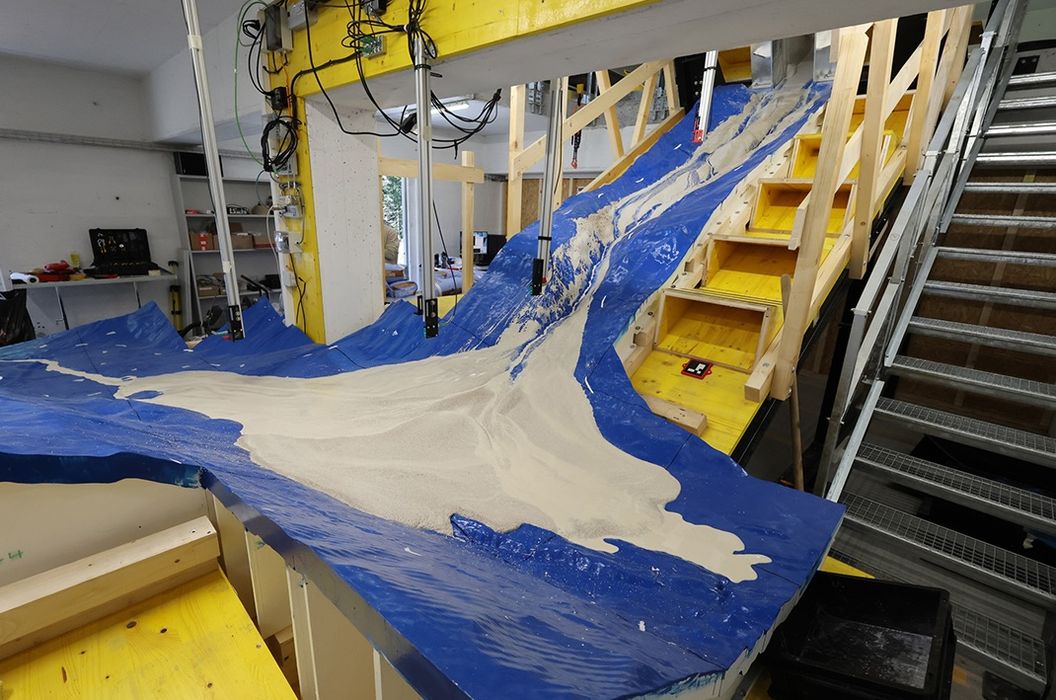
Some disasters are too large to study directly.
Researchers at ETH Zurich and the WSL Institute for Snow and Avalanche Research SLF have built a detailed physical model of the area around Blatten, Switzerland, where a 2025 rock avalanche almost completely destroyed and buried the village.
The model is not for display. It is actually a working test bed for miniature rock avalanches.
The researchers want to better understand how different mixtures of water, ice, rock, and other materials behave as they flow through real terrain.
The enormous 3D-printed model is being used along with computer simulations. Those simulations are intended to help authorities gauge whether settlements, roads, and other infrastructure might be at risk during future avalanche events.
The Blatten model is built at a scale of 1:577, which may sound pretty small, but remember we’re literally printing a mountain here. It covers the Lötschental valley area around Blatten, including the Birchchinn channel leading up toward Kleines Nesthorn.
To build the model, the research team used specially programmed software to select the landform, divide it into printable terrain sections, and then print each of those sections one by one. Each section is about 500 x 500 mm. After printing, the pieces were assembled, coated, and painted in a former military bunker near Davos.
The coating is actually quite important for the test. According to Johan Gaume, Professor of Alpine Mass Movements at ETH Zurich and head of the research group at SLF, it is needed to achieve the required surface roughness and optical properties.
If the model surface is too smooth, too reflective, or otherwise unlike the actual terrain, the experiment can be less representative of actual avalanche behavior.
The finished topographic model can measure up to 5400 x 4500 mm, with an incredible 12 m² of printed surface. It consists of 56 printed parts and apparently required about 100 days of 3D printing. The inclined flow channel measures 4500 x 2000 mm, followed by a horizontal runout area up to 6000mm long.
Researchers calculate the composition and proportions of the test material, blend it in a bucket, tip it into a box at the top of the model, and open a hatch. The messy mixture then flows down the 3D printed terrain, where cameras, lasers, sensors, and a 3D scanner record what happens.
The system measures runoff depth, speed, runout distance, deposition, and impact dynamics. It can also use force plates and pore pressure sensors. In other words, the researchers are collecting data about how it moves, what it hits, how far it travels, and where the material finally settles.
I can’t help but think that today’s easy access to desktop 3D printing technology makes this kind of experiment far more feasible than it once would have been.
A few decades ago, building a highly specific physical terrain model of a real disaster site would likely have required specialized model making, a massive amount of precision manual labour, and a budget that would basically prevent such experiments from ever happening at all.
Today, a research group can quickly turn 3D scanned terrain data into printable sections, let desktop 3D printers grind through the jobs, and end up with a physical test platform large enough to produce measurements.
One hundred days of printing is a major commitment regardless, and the assembled model still has a lot of work for coating, painting, instrumentation, and controlled test procedures. But the 3D printing step is no longer the impossible part.
The Blatten model is also intended as a reusable research platform. The substructure can support other areas and landforms in future projects, allowing the team to study erosion, impact against obstacles, runout distance, and how moving masses travel up counter slopes. Gaume says the group is especially interested right now in how terrain curvature affects flow dynamics.
For 3D printing, this is a reminder that desktop machines can make an experiment possible simply because nobody has to justify printing a mountain.
Via ETH Zurich
