
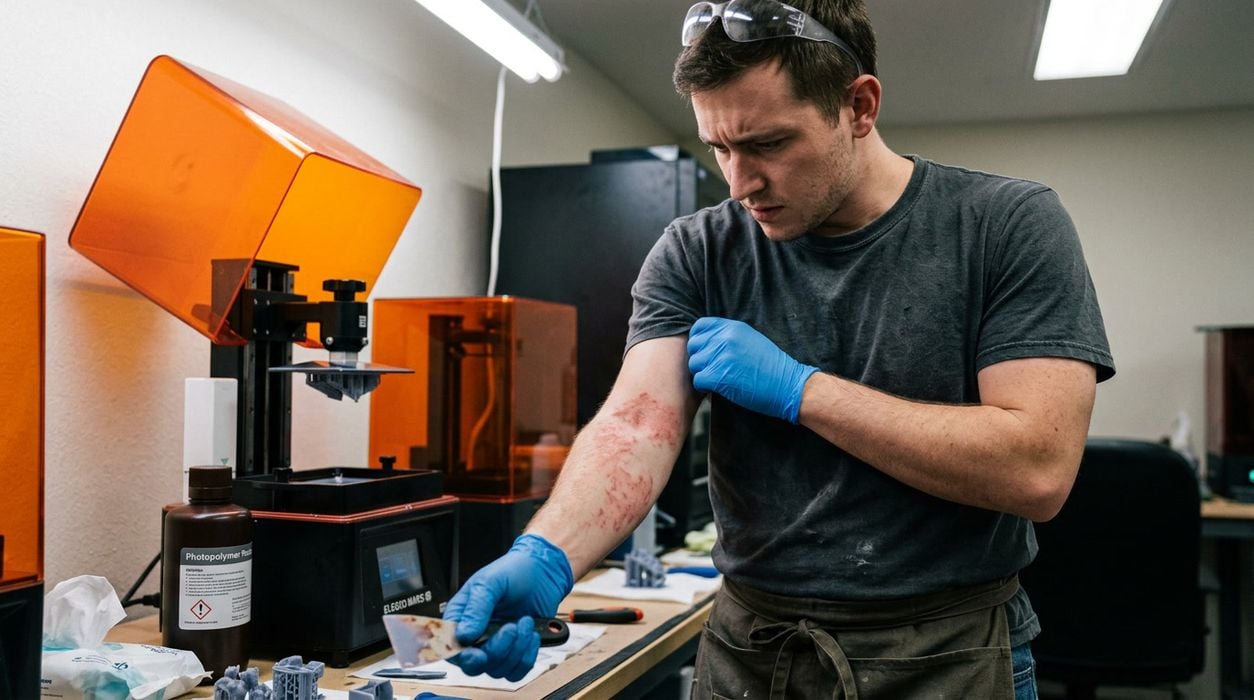
Resin 3D printing by consumers could be heading for a very serious problem.
I’ve been concerned about resin 3D printing for several years now, after using a variety of equipment ranging from cheap desktop units to industrial equipment. I’m not concerned about the output: resin 3D printers absolutely produce incredibly detailed prints that can’t be matched by other 3D print processes.
I am concerned about safety, and increasingly so.
Why the big concern? It is all about the toxicity of the resin. The chemistry of common 3D photopolymer resin just turns out to be a serious toxin, and therefore it requires very special handling for safety reasons.
That should not be a problem for industry, as the concept of safety procedures is well-understood and routine. The dangers of resin printing are just one of many safety hurdles that are easily overcome by the use of proper procedures and PPE (personal protective equipment).
However, it is a problem for consumers using resin 3D printers.
I constantly see videos of people using resin 3D printers in unsafe ways, even touching resin with bare skin. I see discussions online where some scoff at the dangers of resin and encourage others to engage in unsafe practices.
Last week I wrote a story about Ameralabs’ new 23-point discussion of resin 3D printing myths. I read through the document and while I knew most of the facts, I was surprised to discover a few that I hadn’t known about. If I learned things from this document after using resin printers for years, I suspect everyone could as well.
For example, many desktop resin 3D printers include a medical mask along with other tools like scrapers and wrenches. They do this because some operators “don’t like the smell of resin”. But after reading the 23 myths document, it’s clear that such masks are utterly useless to contain the toxins, which certainly will end up in the operator’s lungs.
I am quite certain that virtually all home resin 3D printer operators do not fully follow proper safety precautions when using their equipment. This bothered me greatly, because this is going to hurt a lot of people in the future.
I reached out to Ameralabs and discussed the situation with co-founder Andrius Darulis.
Fabbaloo: Why did Ameralabs decide to publish the guide?
Andrius Darulis: The guide came out of watching too many shortcuts in the community. Sometimes with consequences, sometimes without. The ones without are the dangerous ones because they convince people the risks are made up.
Fabbaloo: Many consumer-level resin 3D printers appear on the surface to be “safe” in the words of their manufacturers. But are they really as safe as implied by the messaging?
Andrius Darulis: The marketing does not help. Water-washable, bio-based, plant-based resin. These sound safer. They are not. New users have no chemical background and no reason to question what is on the label. Nobody is putting ‘still requires a respirator’ on the box.
Fabbaloo: There are many dark aspects to the situation, but what is the worst in your opinion?
Andrius Darulis: The thing with sensitization is that it does not warn you. People print for a year or two with minimal precautions, feel completely fine, and then suddenly they cannot be near uncured resin at all. Irreversible. And by the time that happens, they have already been telling everyone in their community it is safe. As the market keeps growing, I think this gets worse before it gets better.
Fabbaloo: But is it truly possible to use desktop resin 3D printers safely?
Andrius Darulis: On the positive side, most of the harm is preventable. Gloves, proper ventilation, a respirator with VOC filters. Simple measures that make a real difference. That is really what the guide is about. Education is the most powerful tool we have here.
I fear that at some point the larger community is going to realize that they’ve been put in severe danger by these machines. As the number of affected people increases and they begin to understand what happened, we will inevitably see legal action.
That’s what we might be looking at in the future: resin 3D printer manufacturers suddenly facing a series of lawsuits from severely affected operators that were misled into believing the equipment and materials were safe, when they actually were not.
Certainly there are people who do operate desktop resin 3D printers safely, but it’s clear that there are plenty who do not. They will eventually be the ones affected.
Could this be why Bambu Labs has not released a resin 3D printer, while all of their competitors do? Maybe they are thinking this through farther than other 3D printer manufacturers.
In the meantime, I am considering de-installing my resin 3D printers. The quality you can produce on today’s FFF 3D printers is almost as good, so why take the risk?
Via Ameralabs
