
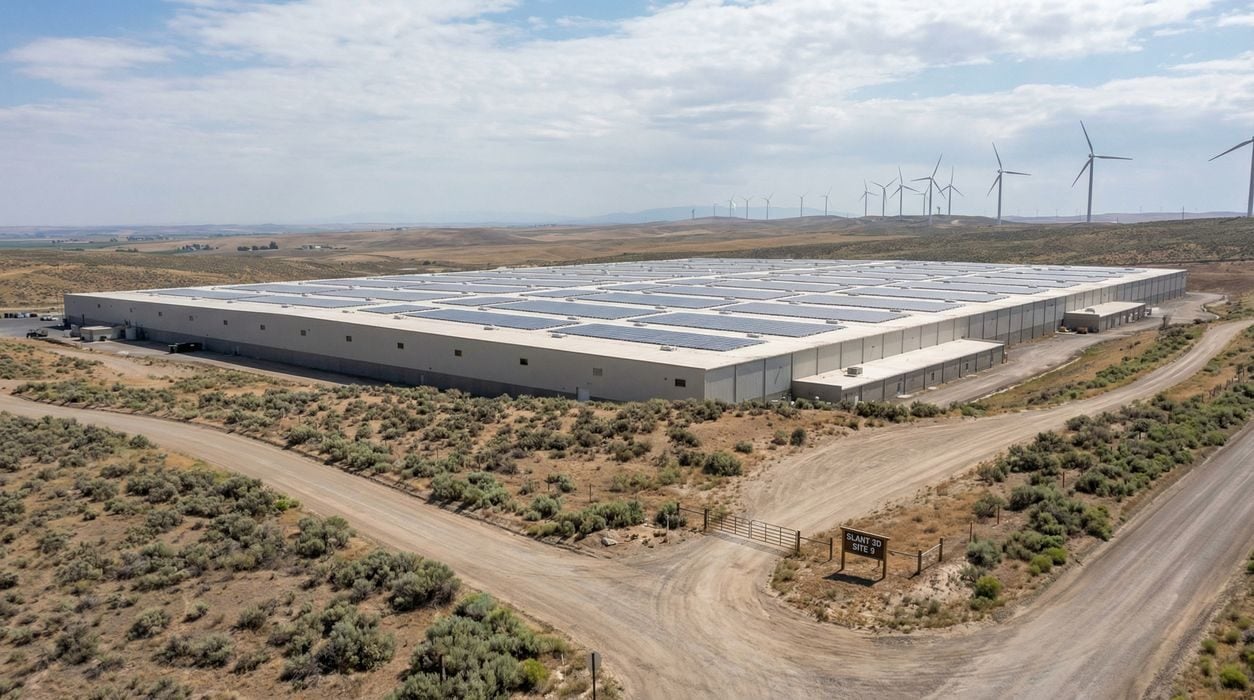
Slant 3D expects to operate 1.5 million 3D printers in the next ten years.
Slant 3D is a growing Idaho-based 3D print service that has been exploring a number of different business models. Their most recent launch was a new service called “Portals”, which allows anyone to near-instantly put 3D printable products on a website — with Slant 3D providing the production and shipping. From all accounts, it sounds like it has been quite successful.
The company already was quite large, apparently having “The Largest 3D Printing Farms in the United States”, with machine counts in the thousands.

Now we hear a pretty incredible statement from CEO and founder Gabe Bentz on the company’s video podcast:
“But here’s the thing. I know that for Slant 3D, our expectation is that we’re going to build 1.5 million 3D printers. In the next 10 years at least, um, at most. Um, the, uh, so that’s 1.5 million 3D printers.”
That is an astonishing number of 3D printers, far exceeding the annual production capacity of many individual 3D printer manufacturers. Only the very largest providers could possibly contemplate producing that number of machines.
Is Slant 3D going to build these machines themselves? Not exactly. Bentz believes that “consumer” 3D printers, while inexpensive, are not really optimized for print farm use. He believes that it would be possible to design a machine that is optimized for print farms, but have someone else do the manufacturing of them. He explains further:
“That’s a fairly big market segment. Uh, but we’re pretty sure that what’s going to end up with us is that we will design our machines as we intend and then we will take that design to a manufacturer and say, ‘You guys build out a line for building this because you know how to make printers. Here is our design. You’re going to run with this.’”
This would make sense, as Slant 3D is in the business of generating print requests, not building massive quantities of 3D printers.
But let’s take a deeper look at this forecast. How would 1.5 million 3D printers really work?
First, the forecast is for a ten year period, meaning the company would, on average, add “only” 150,000 machines per year. Since the machine growth would obviously be gradual, let’s go with that and see what the numbers tell us.
A custom designed machine for farm use would presumably be stripped down of most consumer-friendly features, and that could dramatically lower the price of each unit. I suspect it would require only automatic calibration and networking, as well as being able to competently print in the key materials.
The price of such a machine, at the scale of 150,000 units could be quite inexpensive. It might even be possible for Slant 3D to procure these machines for perhaps US$200-300 each. If so, the 150,000 machines in a year would cost in total something around US$38M.
That might sound like a lot of money, but if you’re putting those machines to work, they could pay off the machine fairly quickly. Think of it in this way: how many prints would it take to recover the ~US$250 price of the machine? I think it would not take very many weeks to do so. After that, the machine is making money. You would then add machines to match the growth in print requests, with Bentz forecasting 150,000 printers’ worth of business each year.
Physical space is another consideration. The machines would have to be racked vertically, so let’s figure out how much space these machines would occupy. Assumptions:
- Machine dimensions, including clearances: 80 x 80 x 80 cm
- Shelf height: 100cm
- Shelf depth: 100cm
- Rack vertical shelves: 8 (8 machines vertically, you’d need a room with a tall ceiling)
- Rack aisle space, one side only: 200cm
With these assumptions, what would 150,000 machines look like?
If on a single, very, very long rack, the 150,000 machines would be 15km in length. Accounting for the shelf and aisle width, it would be 3m wide, totalling 45,000sm (484,000sf).
Obviously you wouldn’t set up a site like that, as you’d want rows of racks. Let’s assume you put all these racks in a square configuration. How many rows of what length would be required?
This would be a square building of 220m (700f) on each side. That’s quite large. It is quite conceivable to do, however, as there are many examples of industrial buildings much larger than this. For example, Tesla’s Texas GigaFactory is just shy of 1M square meters, so 20X the size of this proposed 3D print farm.
Of more concern would be the power consumption of these machines. If each machine were optimized to use, say, 150kWh per month, the total power required each month to operate would be 23gWh. That likely requires a 40MW powerplant nearby, or a dozen or so wind turbines.
This is quite large, but eminently achievable. However, this would be added EACH YEAR in order to reach the 1.5m machine goal.
I suspect Bentz might be searching the rural real estate market for large plots of land that can accommodate both the manufacturing space and a gigantic solar / wind farm.
