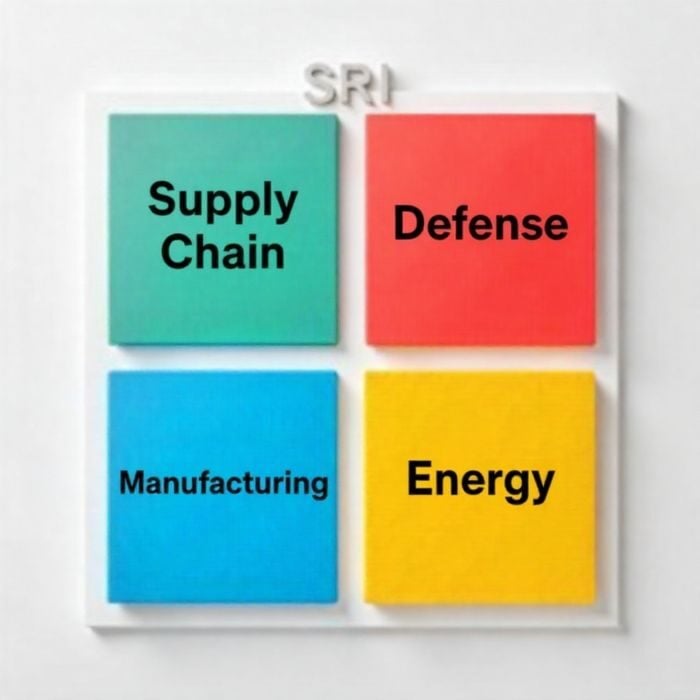
Charles R. Goulding and Preeti Sulibhavi analyze Jamie Dimon’s recent Security & Resiliency Initiative (SRI), which strategically funds US defense and innovation projects.
In one of the most ambitious private-sector moves of recent years, JPMorgan Chase has launched what it calls the Security & Resiliency Initiative (SRI) — a US$1.5 trillion, 10-year strategic plan to transform U.S. industrial strength and economic security. Announced by Chairman and CEO Jamie Dimon in late 2025, the initiative pledges vast resources — including corporate lending, financing, and direct capital — to industries critical to America’s supply chain independence, defense capability, and technological leadership.
At its core, the SRI represents more than a traditional investment program. JPMorgan frames it as a response to global economic and geopolitical pressures that have left the United States dependent on foreign suppliers for critical materials, advanced manufacturing, and strategic technologies. Dimon has repeatedly stressed that “our security is predicated on the strength and resiliency of America’s economy.”
The scale and ambition of the initiative are staggering. While not all US$1.5 trillion will be spent directly by JPMorgan itself, the bank plans to facilitate financing and investment commitments of that total value by its clients, partners, and capital markets networks over the next decade. Up to US$10 billion of that will be direct equity and venture capital deployed by a newly formed Strategic Investment Group within JPMorgan.
What the Security & Resiliency Initiative Actually Is
At its simplest, the SRI is:
- A 10-year commitment to invest in America’s industrial base.
- A pledge to finance, advise and support companies in high-priority sectors.
- A move to strengthen domestic supply chains for critical materials and durable goods.
- A push to accelerate innovation in defense, technology, manufacturing and energy.
JPMorgan isn’t a government — yet the scale closely resembles a national industrial policy. It combines private capital, banking services, investment expertise, and strategic planning to act as a force multiplier. The SRI will not only back existing leaders but will help scale smaller firms that are deemed strategically important.
Structurally, the initiative sits within JPMorgan’s Commercial & Investment Bank and Asset & Wealth Management divisions. It brings in new talent and expertise, both internal and external, to guide decisions and identify opportunities in cutting-edge fields.
Four Strategic Investment Pillars
The initiative’s investment focus is broad but organized around four major pillars, each with dozens of sub-sectors:
1. Supply Chain & Advanced Manufacturing
This includes reinvigorating domestic production of critical minerals, robotics, precision parts, pharmaceutical precursors and industrial automation. Rare earths and other strategic metals fall squarely here, with efforts to reduce dependence on foreign sources. We were pleasantly surprised to hear Dimon mention composite materials used for advanced manufacturing technology as part of this initiative.
2. Defense & Aerospace
Investments in military systems, defense technologies, secure communications, autonomous platforms, and aerospace manufacturing. This pillar also supports companies making advanced components for defense supply chains.
3. Energy Independence & Resilience
Focus here spans grid modernization, distributed energy resources, battery storage, and cleaner power generation capabilities that strengthen national energy security.
4. Frontier & Strategic Technologies
This includes artificial intelligence, cybersecurity, quantum computing, secure data infrastructure and other emerging tech fields seen as essential for economic competitiveness and security.
Within these pillars, there are 27 defined sub-areas — from shipbuilding and secure 6G connectivity to pharmaceutical supply resilience and nuclear energy — underscoring how comprehensive the initiative aims to be.
Leadership and Advisory Council
To execute such a bold agenda, Jamie Dimon has not attempted this alone. He has assembled an External Advisory Council of top executives, industrial leaders and former government officials to help steer SRI strategy and priorities.
Leading names include:
- Todd Combs – Appointed to lead the Strategic Investment Group; former Berkshire Hathaway investment manager and GEICO CEO, reporting directly to Dimon.
- Jeff Bezos – Executive Chairman of Amazon and founder of Blue Origin.
- Michael Dell – Chairman and CEO of Dell Technologies.
- Jim Farley – President and CEO of Ford Motor Company. We have covered the use of 3D printing for device mounts as well as for other Ford Bronco accessories.
- Alex Gorsky – Former Chairman and CEO of Johnson & Johnson.
- Phebe Novakovic – Chairman and CEO of General Dynamics.
Others on the council include retired generals, former senior national security officials, and leaders with deep operational experience. Their role is advisory — to help refine where capital flows and how strategies evolve — but the symbolic weight of this roster underlines the seriousness of the initiative.
According to Dimon, “With their help, we can ensure that our firm takes a holistic approach to addressing key issues facing the United States – supporting companies across all sizes and development stages through advice, financing, and equity capital.”
Why It Matters to Innovation and Supply Chains
For the advanced manufacturing and technology community — including Fabbaloo’s readership — this initiative could reshape how innovation is funded and scaled in the U.S.
Here’s how 3D printing and additive manufacturing intersect with the SRI’s core sectors:
Supply Chain & Advanced Manufacturing
- Metal 3D printing for critical part production: Additive manufacturing can produce complex, high-precision components for aerospace or industrial systems that would otherwise be slow and costly to source overseas.
- On-demand tooling and fixtures: 3D printing enables rapid creation of bespoke manufacturing tools, reducing lead times and boosting domestic factory agility.
Defense & Aerospace
- 3D printed turbine blades and structural parts: Defense and aerospace sectors increasingly rely on additive technologies to produce lightweight yet strong components that perform in extreme conditions.
- Rapid prototyping of defense systems: Additive manufacturing accelerates design iterations for new military technologies — from drones to secure communications hardware.
Energy Independence & Resilience
- Custom battery casings and cooling structures: 3D printing enables optimized geometries for next-gen energy storage systems, improving efficiency and reducing weight.
- Repair and refurbishment of power infrastructure: Spare parts for aging energy grids can be printed locally, reducing downtime and bolstering resilience.
Frontier & Strategic Technologies
- 3D printed hardware for AI and quantum computing: Additive processes can produce bespoke housings and heat-dissipating structures for cutting-edge computing modules.
- Secure hardware prototypes: Rapid production of secure hardware enclosures and integral components that are difficult for adversaries to reverse-engineer.
Context and Fabbaloo’s Previous Coverage
This isn’t the first time companies on the SRI council have intersected with Fabbaloo’s coverage. We’ve previously explored Amazon’s Fulfillment Robots and logistics automation (including drones), Johnson & Johnson’s (J&J) medical manufacturing innovations, and General Dynamics’ Electric Boat division, defense technologies — all fields ripe for additive manufacturing breakthroughs. These sectors now sit at the heart of JPMorgan’s reshaped investment priorities.
The Research and Development Tax Credit
The now permanent Research and Development (R&D) Tax Credit is available for companies developing new or improved products, processes, and/or software. 3D printing can help boost a company’s R&D Tax Credits. Wages for technical employees creating, testing, and revising 3D-printed prototypes can be included as a percentage of the eligible time spent on the R&D Tax Credit. Similarly, when used as a method of improving a process, time spent integrating 3D printing hardware and software counts as an eligible activity. Lastly, when used for modeling and preproduction, the costs of filaments consumed during the development process may also be recovered.
Whether it is used for creating and testing prototypes or for final production, 3D printing is a great indicator that R&D Credit-eligible activities are taking place. Companies implementing this technology at any point should consider taking advantage of R&D Tax Credits.
A New Era of Investment
The Security & Resiliency Initiative marks a major shift in how financial capital integrates with national and economic security. It blends private incentives with strategic objectives, traditionally the realm of government. While risks remain — including how effectively this capital is deployed and whether it can overcome entrenched global supply chains — the initiative signals a renewed focus on domestic capability and industrial innovation.
Whether the SRI leads to a renaissance in American manufacturing, accelerates adoption of additive technologies, or simply changes investor expectations, its ripple effects will be felt across industries that matter to Fabbaloo’s readers. As this story unfolds over the next decade, it may redefine how manufacturing, defense, energy and frontier tech are funded and scaled — and how 3D printing plays an integral role in America’s industrial resilience.