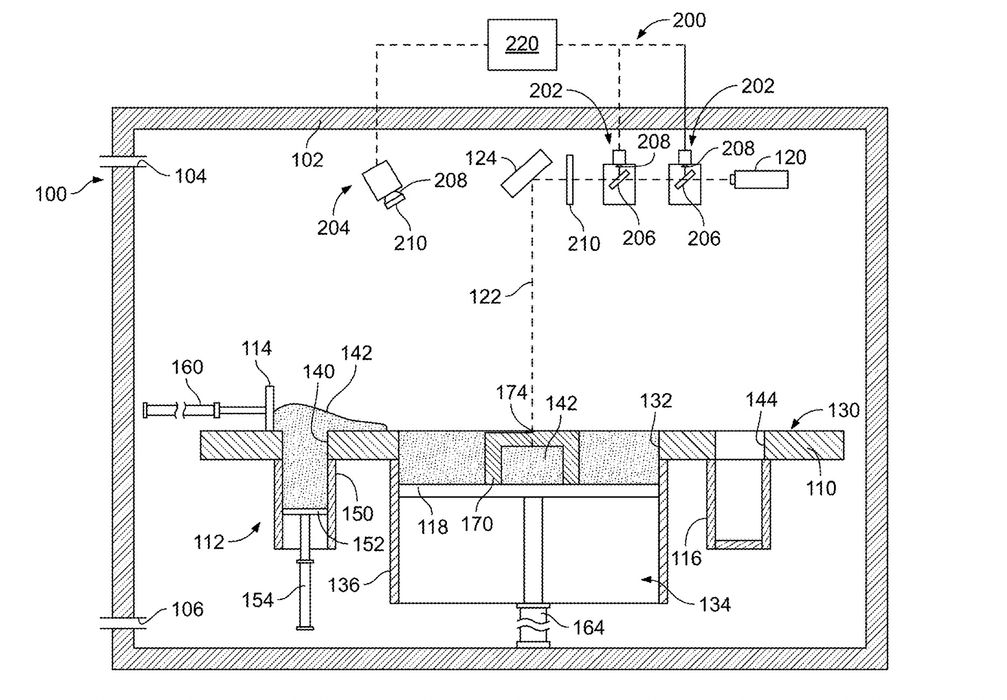
In metal LBPF, a laser can look perfectly healthy while the powder beneath it is not.
That is the problem General Electric Company is addressing in US20260295679A1, a patent application titled “Laser Powder Bed Fusion Additive Manufacturing Anomaly Detection.” Its idea is to pay close attention to the tiny, rapid fluctuations in light coming from the melt area.
Most LPBF monitoring systems already watch the energy interaction at the build surface. A photodiode can measure the light produced when a laser strikes the powder, producing a signal that changes over time. The obvious approach is to look for a large change in that signal: an unusually bright event, a dark region, or a value outside an expected range.
GE’s filing takes a more precise approach. The signal is split into at least low-frequency and high-frequency components. The low-frequency portion describes the wider change in the photodiode output. The high-frequency portion captures the rapid, fine-grained variation riding on top of it.
They describe a typical situation where this occurs. A single laser strike produces a fairly noisy photodiode trace over roughly 350 microseconds. Once that trace is decomposed, the low-frequency curve is relatively smooth, while the high-frequency component reveals the jitter that would otherwise be easy to ignore.
Why care about the jitter? Powder bed fusion is full of small, fast events. The laser can interact with powder in ways that affect melt-pool stability, vaporization, spatter, and the consistency of the resulting track. A simple average brightness value may hide those events. A rapid fluctuation pattern could provide another clue that something at the focal point is changing.
The proposed system gathers the electromagnetic emissions at a focal point on the powder layer, then computes spatiotemporal statistical values from the high-frequency signal. “Spatiotemporal” is the key word here: the system is asking where AND when signal behavior goes off the expected pattern.
A machine learning model then looks for perturbations exceeding a predetermined threshold and generates an alert. The application describes electromagnetic sensors positioned around the optical path, with the drawings showing photodiode-style detectors observing energy associated with the laser interaction.
This is anomaly detection, not necessarily automatic repair. The patent’s main method appears to cover collecting the time-series data, extracting the high-frequency variation, calculating the statistical features, identifying an abnormal event, and notifying the system or operator. It does not say that the machine will automatically change laser power, stop the build, or correct the defect, although those steps could be a next step.
However, an alert that arrives after a layer has gone wrong is important for traceability, but much more valuable if it arrives soon enough to prevent hundreds of later layers from being built on a bad foundation: that will substantially cut down on wasted material and machine time.
GE is extracting a particular slice of the signal where rapid physical changes may be easier to distinguish from normal variation, then letting a model identify unusual patterns. That could reduce the simplify image-based monitoring, especially inside a chamber where viewing conditions could be pretty terrible.
So this patent is about listening more carefully to the light already being generated, and treating the small fluctuations as process information instead of measurement noise. It turns out it’s not noise, it’s data!
Via Espacenet