
Charles G. Goulding looks at how 3D printing could deliver faster, more material-efficient construction for everything from wind-turbine bases and water tanks to bridges, seawalls and postwar rebuilding.
The Global Building Boom
Artificial intelligence may be attracting the most attention, but the construction associated with AI is only one part of a much larger global investment cycle. As recently detailed by Barron’s, new factories, power systems, ports, shipyards, bridges and renewable-energy projects are moving forward as governments and corporations attempt to strengthen supply chains, expand domestic manufacturing and modernize essential infrastructure.
The individual projects can be enormous. Novartis has begun developing a manufacturing hub in North Carolina that will encompass more than 700,000 square feet across new and existing facilities. The project forms part of the pharmaceutical company’s planned US$23 billion investment in U.S. manufacturing and research infrastructure. At the Philadelphia Navy Yard, South Korea’s Hanwha Group has announced a US$5 billion expansion that is expected to add docks, quays and other production capacity to the historic shipbuilding site. In western India, the Khavda renewable-energy park is spreading solar arrays, wind turbines and transmission infrastructure across a vast section of the Kutch desert.
Data centers represent the most visible portion of this construction wave. Global investment in them nearly doubled between 2022 and 2024, reaching approximately US$500 billion, according to the International Energy Agency (IEA). Their electricity consumption is projected to rise from about 485 terawatt-hours in 2025 to approximately 950 TWh by 2030. Meeting that demand will require more than server buildings. It will also require generation capacity, transmission lines, substations, cooling systems, utility buildings and the physical infrastructure needed to connect increasingly large computing campuses to surrounding communities.
This does not mean that every part of the construction market is booming simultaneously. The more significant development is the convergence of several capital-intensive building cycles. AI is driving data-center development. Geopolitical competition is encouraging domestic factories and more secure supply chains, just as electrification is requiring new generating capacity and expanded grids. Likewise, aging transportation systems still require investment in roads, bridges and ports. Meanwhile, developing countries continue to face large deficits in basic infrastructure. The World Bank estimates that closing infrastructure gaps in low- and middle-income countries would require roughly US$1.5 trillion in annual investment.
The resulting challenge is not simply how to finance all this construction. It is how to complete such an expansive collection of projects when skilled labor remains limited, conventional building processes are slow, and costs can rise sharply as multiple sectors compete for the same workers, materials and equipment. That pressure creates an opening for construction technologies capable of performing at greater speed, with fewer workers and less wasted material. Increasingly, 3D printing is being considered as one of them.
Construction’s Capacity Problem
Announcing and financing ambitious projects does not ensure that they can be built on time. Construction remains heavily dependent on skilled labor, and the available workforce is already stretched. In a 2025 survey by the Associated General Contractors of America (AGC), 92 percent of firms seeking craft workers reported difficulty filling positions, while 45 percent said workforce shortages affecting them or their subcontractors had delayed projects. The U.S. Bureau of Labor Statistics expects construction and extraction occupations to generate approximately 649,300 openings annually through 2034, many because existing workers will retire or leave the field. Similar constraints are affecting major construction markets elsewhere in the world.
Adding workers alone may not be enough. Construction productivity has improved much more slowly than productivity in manufacturing, leaving the industry vulnerable as multiple infrastructure programs compete for the same labor, equipment and materials. McKinsey has estimated that, without meaningful productivity gains, cumulative construction output could fall US$40 trillion short of global demand by 2040.
This imbalance increases the value of technologies that allow a smaller workforce to build more quickly and consistently. Construction 3D printing can automate portions of the building process that remain labor-intensive. At the very same time, COBOD’s increasingly large projects are demonstrating what that can mean in practice.
COBOD Moves Up in Scale
For much of its development, construction 3D printing went through individual houses and other relatively small structures. COBOD’s recent projects suggest that the technology is beginning to operate at a much higher scale.
In 2023, a COBOD BOD2 printer was used to construct a 10,105-square-foot equestrian facility in Wellington, Florida. At approximately 939 square meters, it was described at the time as the world’s largest 3D printed building. Only three years later, a public-school project in Qatar is approaching a scale that dwarfs that earlier record.
The larger development, commissioned by Qatar’s Public Works Authority and led by UCC Holding, includes 14 public schools, two of which are being constructed with COBOD technology. Each of the printed schools is designed as a two-story, 20,000-square-meter building on a 100-by-100-meter site. Together, they represent 40,000 square meters of planned construction. By July 2026, UCC reported that the operation had completed approximately 19,500 square meters of built area and more than 28,000 square meters of internal and external printed walls, with a final printing run still to come.
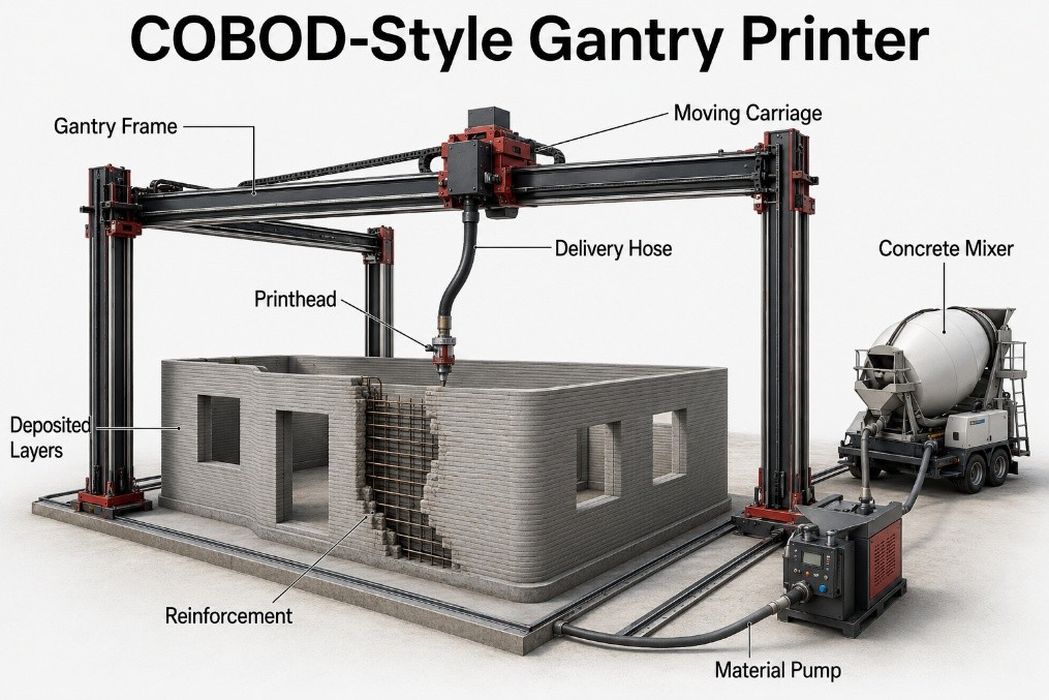
Executing a project this large required COBOD to produce two customized BODXL printers, each measuring 50 meters long, 30 meters wide and 15 meters high. Even machines of that size could not cover an entire school site from a single position. The printing systems and their supporting concrete-delivery equipment therefore had to be dismantled, moved, reassembled and recalibrated as work advanced. Fourteen such relocations had been completed by early July, with a fifteenth and final move in progress.
The project also illustrates the preparation required to move construction printing into unfamiliar climates and regulated public buildings. Before beginning the schools, the team conducted more than 100 full-scale test prints and developed a concrete mixture suited to Qatar’s extreme heat. Much of the printing was performed at night to improve material performance while reducing daytime noise and dust. The schools’ flowing walls, inspired by desert dunes, also take advantage of curved geometries that would be more complicated and expensive to construct using conventional formwork.
Meanwhile, smaller commercial projects are supplying evidence about speed and staffing. In Portugal, for example, a four-person team operating a COBOD BOD2 printed the walls of a 500-square-meter municipal recycling-center office in nine days.
Expanding Applications
The growth of construction 3D printing is not confined to housing. In Heidelberg, Germany, the Wave House demonstrates a direct connection between the technology and the data-center boom. The approximately 600-square-meter building houses an IT server facility with space for roughly 100 racks. Using a COBOD BOD2 printer, PERI 3D Construction completed its walls in approximately 140 hours. Its undulating façade also addresses an architectural problem common to data centers, namely that buildings with few windows and substantial blank walls can be difficult to integrate attractively into populated areas.
The printer did not fabricate the servers, electrical systems or cooling equipment that account for much of a data center’s complexity and cost. It did, however, automate construction of the building envelope. As data centers move closer to cities and are joined by substations, utility buildings and other supporting facilities, that narrower capability could still become valuable. Many such structures require durable enclosures but contain relatively simple layouts well suited to repeatable digital construction.
Other projects are testing the technology’s value. In Kuwait, two concrete water tanks measuring 4.5 meters high and seven meters in diameter were printed on-site in five days. Their walls tapered from 40 centimeters at the bottom to 20 centimeters at the top, placing more material where pressure was greatest rather than maintaining the same thickness throughout. According to COBOD, the resulting design used 25 percent less concrete and reinforcement than conventionally cast tanks.
The ability to vary a structure’s geometry may prove particularly useful in energy and transportation infrastructure. GE Renewable Energy, COBOD and Holcim have investigated printing wide concrete wind-turbine bases directly at wind farms. Conventional tower sections must fit beneath bridges and through tunnels while being transported from a factory. On-site printing could avoid some of those dimensional restrictions; further, it could support taller towers capable of reaching stronger and more consistent winds. The work remains developmental, but it shows how additive construction can address logistical constraints rather than merely substitute for masonry.
Bridges remain at an earlier stage. Holcim’s Phoenix project used 3D printing and ten tons of recycled material to produce a concrete masonry bridge without conventional reinforcement. Such projects have demonstrated structural possibilities, but most printed bridges remain pedestrian-scale prototypes rather than replacements for major highway spans. Their more immediate contribution may be printable components, optimized geometries and formwork that can eventually be incorporated into larger conventional projects.
Ports and shorelines offer another emerging application. Researchers at Florida International University recently installed 3D printed tiles on a Miami seawall to test whether textured, habitat-supporting surfaces can protect infrastructure while reducing reflected wave energy. Printed reefs, breakwaters and replacement seawall elements can be digitally shaped for local currents and ecological conditions in ways that standardized concrete blocks cannot.
Rebuilding After War
The wars of the past five years have damaged housing, schools, hospitals, power systems and transportation networks across Ukraine, parts of Russia and the Middle East. Although the full cost remains unknown, existing assessments place Ukraine’s recovery and reconstruction requirements at nearly US$588 billion, with Gaza and Lebanon adding more than US$80 billion.10,11 Rebuilding on this scale will strain construction workforces, materials and supply chains already under pressure.
Construction 3D printing could make portions of this work faster and more repeatable. Printers can be transported to affected regions, supplied with locally available materials and directed by digital models adaptable to different sites. Once a school, clinic, utility building or housing design has been approved, versions can be reproduced in multiple communities without constructing new formwork for every project. In Lviv, a COBOD printer has already been used to build a 370-square-meter primary school using printable-concrete ingredients sourced almost entirely within Ukraine.
Before construction begins, sites must be cleared, utilities restored, unexploded ordnance removed and property rights resolved. Gaza alone contains an estimated 61 million tons of rubble. Once land becomes buildable, however, mobile printers could help produce walls, formwork, storage tanks and standardized public buildings where labor and conventional manufacturing capacity are limited.
MIT Expands the Materials Palette
Recent work at MIT expands beyond the direct extrusion of concrete walls, exploring how 3D printing can use materials already available at or near a construction site. One team has demonstrated construction-grade floor trusses printed from recycled polyethylene terephthalate, or PET, reinforced with glass fiber. Four eight-foot trusses were printed in approximately 13 minutes each and assembled beneath a sheet of plywood to simulate a residential floor system.
The experiment points toward a different model for additive construction. Instead of transporting a building-scale concrete printer to every project, regional microfactories could convert plastic waste into relatively light structural components that are then carried to the site and assembled.
A separate MIT project, known as EarthWorks, uses one of the most readily available materials at almost any building site: soil. The process mixes lightly treated earth with materials such as straw and then prints it into complex “formwork” for reinforced concrete. Once the concrete has cured, the earthen mold can be broken down and reused.
MIT is also working to reconcile mathematically efficient designs with the practical limitations of printers. In 2026, researchers produced a 2.3-meter concrete bridge using an optimization system that accounts for elements like nozzle width and the need to deposit material along a continuous path. The approximately 900-pound bridge was printed in 30 minutes and supported more than 2,000 pounds during testing. The experiment revealed that printing hardware, rather than concrete strength, was the principal constraint on material efficiency.
Together, these projects suggest that construction printing is developing into a broader production system in which local soil and discarded plastic can become reusable. Those capabilities could become particularly valuable when construction must be performed rapidly in places where normal supply chains and manufacturing capacity are unavailable.
3D Printing Activities and IRC §41 Research and Development (R&D) Tax Credit
The 3D printing examples show how construction and building companies may be generating the kinds of facts that support IRC §41 R&D tax credit claims. To qualify, activities generally must meet the four-part framework: domestic R&E under IRC §174A, research that is technological in nature, work aimed at a new or improved business component, and a process of experimentation.
For example, the customized construction printers, repeated printer dismantling, reassembly, and recalibration, plus more than 100 full-scale test prints before printing large schools in Qatar may each improve R&D eligibility. That type of trial-and-error work can help demonstrate technological uncertainty and experimentation – especially where teams are testing print methods, equipment settings, or designs to improve performance, reliability, or quality.
Other examples also point to potential qualified research: heat-adapted concrete mixtures for extreme conditions, curved and geometrically complex printed walls, optimized tanks using less concrete and reinforcement, recycled or reusable materials such as PET trusses and earthen formwork, and designs constrained by printer nozzle width and continuous deposition paths. Prototypes involving bridges, seawalls, wind-turbine bases, and structural trusses further show efforts to develop improved building components and construction methods.
When properly documented, related employee wages, supplies, and qualifying contract research costs may be qualified research expenses. R&D Tax Savers has helped hundreds of companies avail themselves of these tax benefits for half a century, with savings of almost a billion USD.
Conclusion
As the global building boom and eventual postwar reconstruction create unprecedented demand for new infrastructure, 3D printing can help the construction industry build faster, use materials more efficiently and accomplish more with a limited workforce.
Charles G. Goulding is a practicing attorney.