
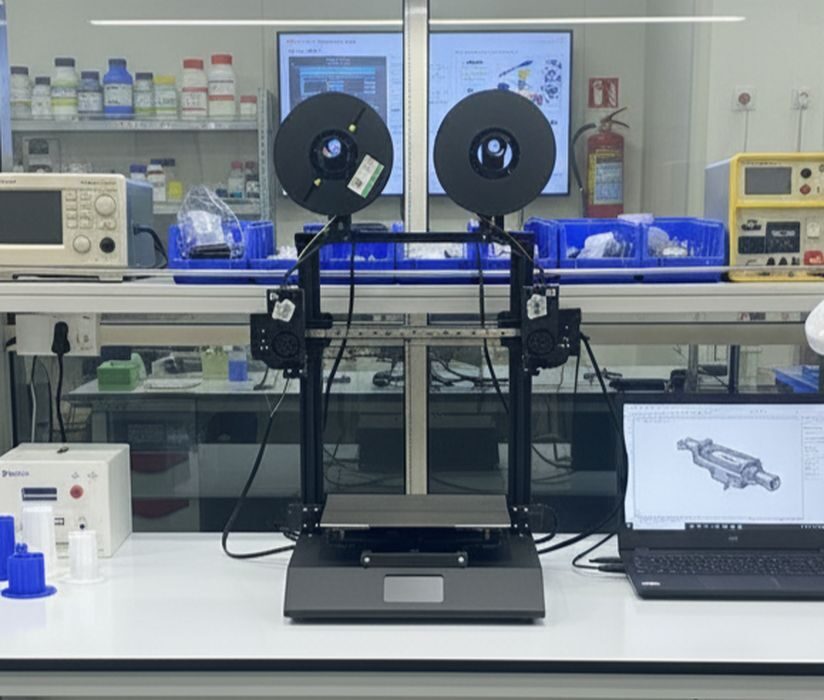
We’ve learned of a company developing a “true” independent extruder 3D printer.
Independent extruders, or “IDEX” as they are known, have been around for many years. They typically offer some benefits, including:
- Dual color prints with one color in each extruder
- Two copies, where each toolhead prints the same object simultaneously
- Mirror copies, where one toolhead prints a mirror image of the 3D model
Those capabilities have proven somewhat useful to some operators, but the holy grail has always been missing: the ability for both toolheads to work on the same object at the same time. This would, in theory, greatly speed up print jobs.
Metal 3D printing already does this. On the market you will find large LBPF systems that have two lasers, and each can work on the same print area. In fact, some systems have up to twelve independent lasers, vastly speeding up throughput.
But this has never been the case with desktop FFF 3D printers, even though some systems offer IDEX hardware.
This may change with developments from Qatar-based Anabolic Mechanics. It’s a new five-person startup company that formed only a year ago, and they’re working on something they call “T-IDEX”, for True Independent Extrusion. They said:
“Our T-IDEX (True – Independent Dual Extrusion) system utilizes two extruders that operate simultaneously on the same print, effectively doubling the throughput.”
How could this be done? It seems they have figured out how to slice very complex print jobs involved two toolheads and somehow ensure they do not collide while printing.
In practice it seems that one T-IDEX toolhead is dedicated to printing perimeters, while both can print infill. This would ensure excellent surfaces quality and lowering the chance of collisions. It would also speed up printing significantly, at least for certain objects.
For example, if you were printing something quite small it would be impossible to physically put two toolheads so close together, so only one could be used. On the other hand, a large object would provide lots of space where two toolheads could theoretically roam around and print simultaneously.
The smarts to do this would essentially be done mostly in the slicing software, which would have to determine the collisions and avoid them when plotting toolpaths. I’m therefore quite interested in the slicing software they have created.
Their slicer also features something they call “Categorical Layer Height Variation Technology”. I’ll let them describe it:
“Adjust layer heights for infill, bottom-fill, top-fill, floor-fill and contours independently, optimizing print speed and detail. This tailored approach allows for faster printing without sacrificing the structural integrity or aesthetic of your parts.”
Their slicer looks increasingly interesting.
But hold on, Anabolic Mechanics is also developing a T-IDEX 3D printer; this is not just a software project.
Their system, the Anabolic 01 T-IDEX, is currently a prototype, is an open gantry design that features two independent toolheads (obviously), 300 x 300 x 350 mm build volume, touchscreen, 120C build plate, 280C hot end, and some automated calibration.
They’re not yet at the point where they are ready to sell equipment and software, as they are still developing the tech. However, their target price for the Anabolic 01 is US$800, a reasonable price for a machine that can theoretically print twice as fast as single toolhead machines.
This project should be quite interesting as it unfolds.
