
A purge tower usually looks like a boring chunk of plastic beside the part. Stratasys is proposing something a lot more organized.
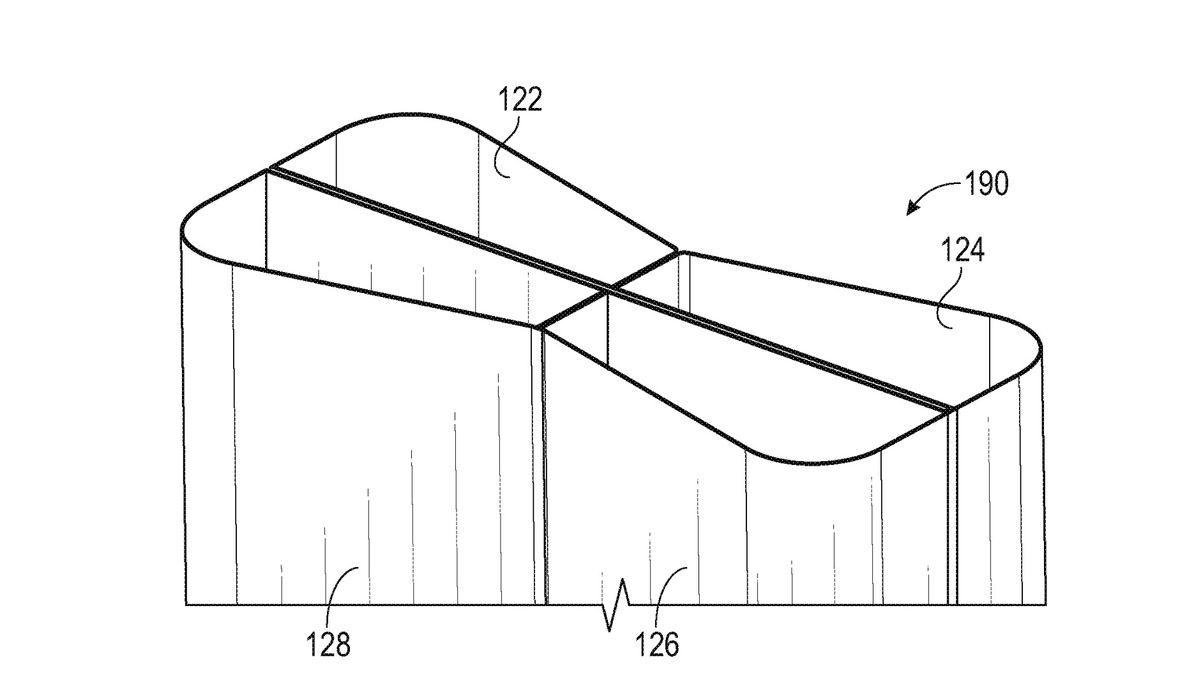
The company’s latest patent describes a multi-material purge tower divided into connected sections, or nodes. The unusual part is that the tower can change which nodes are printed in each layer, depending on which materials are actually needed by the part at that height.
Why bother? A multi-material FFF printer may have several print heads, each carrying a different material. When a head switches from standby to active operation, it needs to heat up and purge old or degraded material before it can print properly. Traditionally, every head gets its own part of a purge tower, even when that head is not needed for a particular layer.
That wastes material and build space. It also means an inactive head may have to perform a purge operation even though its material does not appear in the current layer.
Stratasys’ method starts by examining the sliced part layer by layer. It determines how many materials appear in each layer, then creates a matching cross-section for the purge tower. If four print heads are required in one layer, the tower can use four adjoining subdivisions. If only two materials appear in a later layer, the system can reassign the unused subdivisions to active heads, or otherwise print a simpler arrangement while maintaining the tower’s height.
This more complex purge tower has to remain stable as it is built. The patent therefore specifies closed toolpaths for each subdivision, with adjacent sections touching along interfaces so that extruded material bonds them together. The outer walls can remain straight or taper inward as the tower gets taller, avoiding the top-heavy shape that would make a tall, narrow purge tower prone to tipping. And that never happens, right?
The drawings show bow-tie, square, circular and cross-shaped versions. A four-node tower can be divided into four loops, for example, while a circular structure can be split into as many as eight sections. The exact shape seems less important than the rules: neighboring sections must contact one another, toolpaths must not collide, and each loop must be long enough to extrude sufficient material to bring its print head from standby to a usable operating condition.
The purge paths are designed so the print head starts and finishes near the same location, with the start and stop points preferably placed on an exterior wall. That keeps a startup extrusion error away from the interface holding two tower sections together.
The system can also handle a printer with more heads than materials used in a particular layer. In one example, a four-head machine prints a part whose layer needs only three materials. The inactive head’s tower section can be printed by a head that is active, preserving a continuous tower rather than leaving a missing slice in it.
That could make the purge tower smaller than a conventional one, although the patent does not provide a measured percentage reduction. The benefit is potentially twofold: less purge material and more usable room on the build platform. A compact tower also helps when several parts are packed into one build.
The complication is that slicing software now has another scheduling problem to solve. It must coordinate material usage in the part, heater state, purge volume, tower geometry and head assignments for every layer. If the tower is too small, a head may not purge enough. If it is too large, the material savings disappear.
Stratasys is treating the purge block structure as a dynamic, material-aware component of the build. That could become increasingly useful as industrial printers add more independently controlled materials and tools.
Their idea appears in Stratasys patent application publication US20260264335A1.
Via Espacenet
