
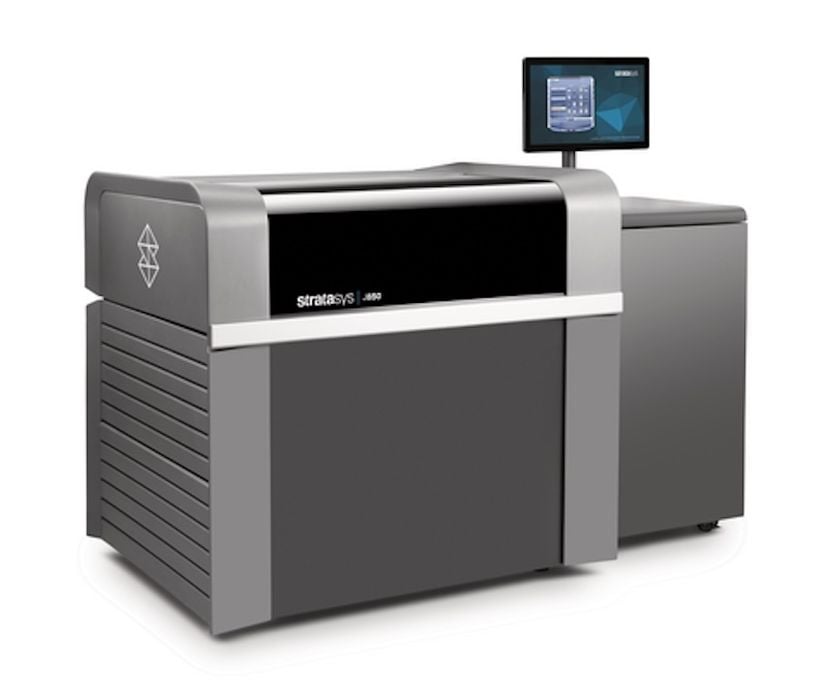
Stratasys has dropped a broad set of updates across PolyJet, FFF, P3, SLA, SAF, and GrabCAD, and the interesting part isn’t any particular announcement as the company’s attempt to remove several small adoption barriers all at once. 
Stratasys has long had a familiar problem: plenty of technologies, plenty of materials, and plenty of installed base, but a constant need to add more ingredients to enable more production work.
This week’s announcements are clearly part of that strategy. The company introduced the J850 Core, a lower-cost PolyJet system positioned for engineering teams that don’t need full color, while also adding new materials for F3300, Origin, J3/J5, Neo, and SAF platforms, plus new workflow software inside GrabCAD. 
PolyJet Without the Full-Color Cost
PolyJet has always been excellent at certain jobs: smooth surfaces, fine detail, mixed material parts, and prototypes that look close to finished products. But those capabilities often came bundled with features some teams simply don’t need, especially color-heavy presentation work. Full color has always been a niche 3D print capability.
Stratasys’ J850 Core is now focusing on a more practical option: keep the build volume, speed modes, and access to rigid, flexible, transparent, and ToughONE materials, but skip the premium tied to full-color capability found in more expensive J-series equipment. The system is planned to ready for order by the end of April, but Stratasys did not provide pricing. That omission is curious because the whole pitch depends on cost-accessibility. 
In other words, this new machine is not really a technical breakthrough but rather a packaging variation. Plenty of workshops want housings, jigs, fixtures, and fit-check parts, not glossy, full color demonstration models. If Stratasys priced the J850 Core aggressively enough, it could make PolyJet easier to justify against alternative prototyping routes, including resin systems and competing polymer platforms. But until there is an actual number attached, “practical price point” is just marketing. 
Reducing Workflow Friction
The software story may be more important than the hardware story here. Stratasys says its new Additive App Suite, built with trinckle, will embed automated design apps directly into GrabCAD Print and GrabCAD Print Pro, starting with ten apps later this summer and growing to fifteen by Formnext 2026. The idea is pretty straightforward: automate repeatable tooling design tasks such as clamping jaws, shadow boards, and drill guides so manufacturing engineers can move from problem to printable models much faster. 
That’s a sensible target. One of the bottlenecks in industrial 3D printing isn’t the printer at all, but the time required to design low-risk, high-value factory tools. If Stratasys can reduce that burden inside the software environment customers already use, adoption may increase.
The company also added Measurement-Based WAM to GrabCAD Print Pro for Origin systems, using measured dimensional data to automatically compensate for warping. That sounds genuinely useful for connectors, fixtures, and other tolerance-sensitive parts, although the release doesn’t say how much correction is possible in practice or how much measurement overhead the workflow adds. 
Materials Everywhere, But Not All Equally Important
The rest of the announcements are a materials expansion campaign. Stratasys added ULTEM 1010 filament to the F3300 and said larger spool support is planned this summer for F900 and Fortus 450mc Gen III systems via the Fortus FDC dryer. On the photopolymer side, it announced P3 Deflect 110, Loctite 3D IND3785 Low Migration, PolyJet ToughONE White for J3/J5, PolyJet ToughONE Black, and Somos WaterShed White for Neo printers. A second release added P3 MED Silicone 25A, positioned as the first biocompatible true silicone for patient-specific medical devices on Origin, and a new SAF PA12 from Evonik that Stratasys says can reduce total cost of ownership by up to 14 percent. 
Some of those materials will likely matter more than others. The silicone announcement may have the biggest application upside because true silicone remains a challenging material in additive manufacturing, and medical device needs can possibly enable tooling-free, patient-specific production. The SAF PA12 update also address a common industrial concern: cost per part. 
Taken together, this series of announcements is intended to broaden the potential market for Stratasys products by enabling more materials, more applications and more equipment affordability.
