
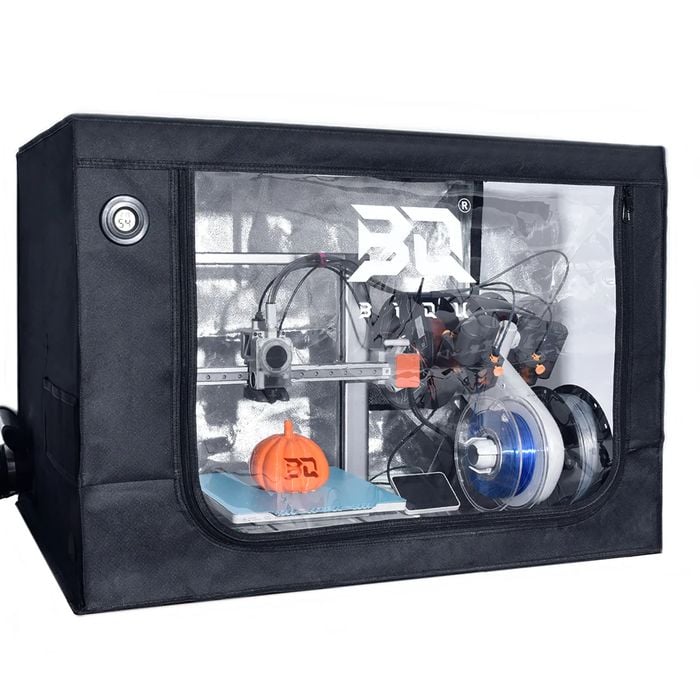
BIQU has come up with another fascinating Bambu Lab add-on: the Panda Shelter.
The shelter is designed to work with Bambu Lab’s A1 and A1 mini systems, both of which use the open gantry format. This means that the printing activity is exposed to the ambient air, which could be cool. This creates a thermal gradient between that air and the fresh, hot extrusion. The thermal gradient then can cause the print to warp.
This is why most new systems nowadays are fully enclosed: they capture the stray heat and raise the ambient air temperature. This reduces the thermal gradient, and in turn reduces the possibility of warping.
But the A1 and A1 mini are not enclosed. That’s where the BIQU Panda Shelter comes in.
It’s a pop-up “tent” that encloses not only the 3D printer, but also the AMS Lite unit that holds four spools of material.
There are a number of benefits you’d receive by using the Shelter:
- Lowered warping, as mentioned
- Reduced noise
- Capture of emissions and nanoparticles
- Dust protection
- Water protection, if that is a risk in your workshop
In addition, the Shelter includes several convenience features:
- Temperature and humidity indicators
- Large window for observing print operations
- Tool pockets on the sides
- Foldable design and portability if required
A word about the emissions and nanoparticles: FFF devices do emit both VOCs (chemicals) and nanoparticles. While the Shelter does nothing about the chemical emissions, it does prevent the nanoparticles from moving through your workshop’s air. However, there’s a trick you can do: after a print completes, you need only wait an hour or so, and the nanoparticles will have settled down inside the Shelter. Then when you open it up, you will have minimized your exposure to airborne nanoparticles.
Third-party enclosures have been around for many years, but they generally are not used. That’s because of the costs. In many cases, these enclosures cost more than the 3D printer itself.
The reason for the big cost is that vendors attempt to differentiate their products by adding more features. You can, for example, find third-party enclosures that are fire-rated, include smoke detection, include auto-power cut if temperatures are too high, and even fire suppression systems.
Those features add up in price, and these systems tend to be expensive. Because of that, many DIY 3D printer operators decide to build their own enclosures using cardboard, IKEA tables, or other random materials. You do what you can given the expenses involved.
The BIQU Panda Shelter breaks this by offering the accessory for US$95. That’s a decent price for a pretty useful item. It doesn’t have all those features, but honestly, most people won’t need them anyway. They just need an enclosure that works, and the Shelter appears to do it.
Via BIQU
