
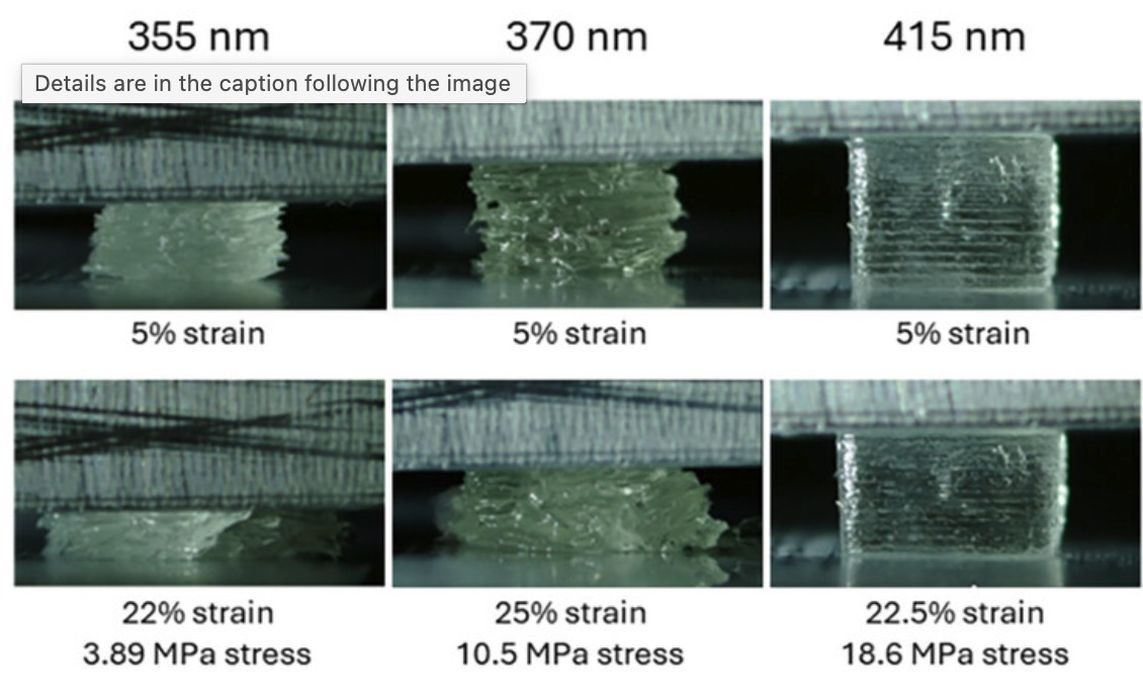
Researchers have introduced “3D printed action plots” to map how resin cure responds to different wavelengths, offering a new tool for dialing in vat photopolymerization.
Vat photopolymerization has been using dose to cure depth and critical energy, but those curves typically assume a single illumination wavelength. As desktop and industrial light engines shift from monochrome 405 nm to 385 nm — and sometimes add visible channels for specialty initiators — wavelength difference effects could become more important. The team behind a new Advanced Materials paper proposes turning that into something quite interesting: a 3D printed artifact that encodes a resin’s action spectrum directly into geometry.
If the concept sounds familiar to photochemists, that is because an action spectrum plots a process’s efficiency against wavelength. Translating that into 3D printing means exposing resin to controlled doses at selected wavelengths and then reading out the result as dimensions, pass or fail features, and surface quality. Instead of relying only on spreadsheets and tests, you can hold a physical plot that tells you which combinations will actually print.
Photoinitiators do not absorb light equally across the spectrum. Common resin systems use TPO and TPO-L that respond strongly at 385 nm, while many hobby printers light up at 405 nm; dental chemistries often add agents optimized near 470 nm. Pigments, fillers, and dyes further reshape the absorption profile, decreasing penetration depth and shifting cure times. The result is a moving target: a dose that cures cleanly at one wavelength may overcure or undercure at another, driving print defects, support scarring, or poor z-accuracy.
Some equipment manufacturers have responded with 385 nm projectors, higher power LEDs, and grayscale exposure control, but the calibration remains challenging. Labs typically measure critical exposure and penetration depth at a single wavelength, then compensate appropriately. A wavelength-dependent method can collapse that iteration cycle and reveal compatibility issues early, especially for ceramic-loaded, pigmented, or biocompatible resins that exhibit strong spectral selectivity.
The paper’s main idea is pretty straightforward: fabricate a standardized geometry that is exposed under known doses at different wavelengths and then use the surviving features as the action plot. Where the resin cures reliably, a strut stands; where it does not, a gap remains. The printed part becomes a map of cure efficiency versus wavelength and dose.
Parameters like minimum wall thickness, overhang fidelity, and surface roughness are captured directly. That can suggest slicer settings such as layer energy, grayscale compensation, and even per-layer wavelength selection if the hardware supports it.
Operators could validate new resins faster by matching spectral settings to pigmentation. Dental labs running 385 nm could quantify whether switching to a different initiator actually shortens exposure times without sacrificing accuracy. Research groups exploring visible-light or biocompatible systems would have a benchmark that complements other approaches..
It is possible that standards bodies like ASTM or ISO could eventually add spectral response artifacts into materials or machine qualification, but the evidence will need to show that a single coupon accurately predicts print outcomes across geometries and build volumes.
