
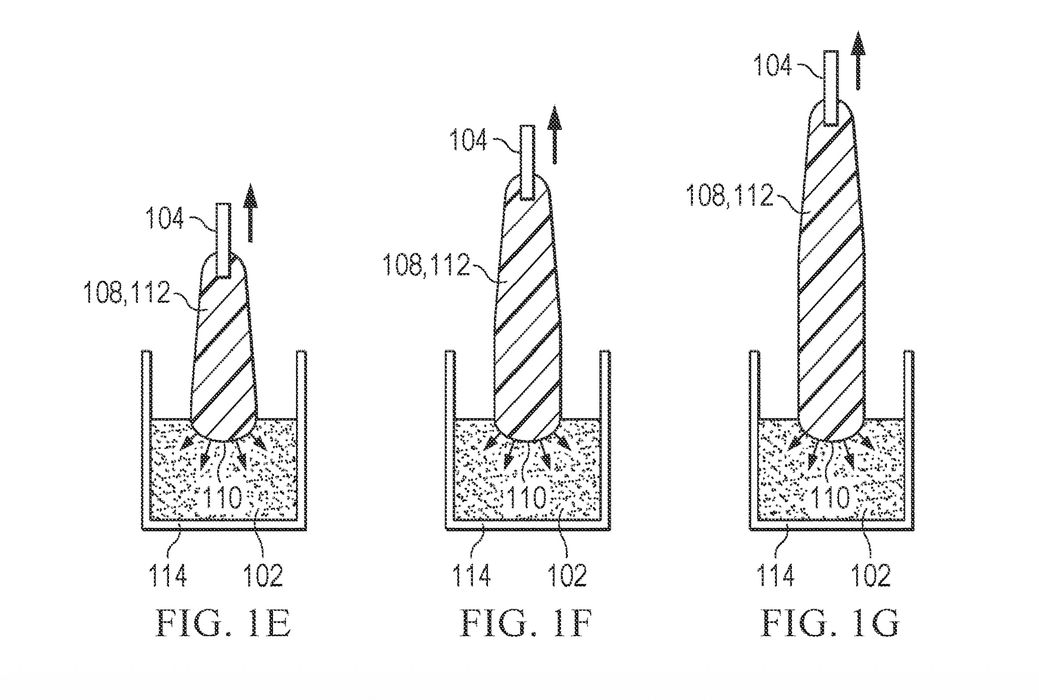
This process prints by pulling a reaction out of a vat.
A University of Illinois patent application describes “growth printing,” an unusual additive manufacturing method based on frontal ring-opening metathesis polymerization. Instead of depositing material or selectively exposing resin, it starts a self-propagating curing front in liquid dicyclopentadiene (DCPD), then moves the object that started it.
That object is a small heated initiator, essentially a metal rod mounted on a motion stage. Its tip is lowered into the resin at about 100C. Heat triggers an exothermic reaction that converts liquid into polyDCPD across a narrow front only 0.5–2mm thick.
The initiator then rises, pulling the newly solidified polymer with it. Fresh material continues curing at the bottom of the growing part, powered by heat from the reaction itself, a kind of chain reaction.
The really interesting aspect is the speed control.
If the initiator rises more slowly than the curing front expands, the part gets wider and forms a conventional cone. Move faster than the front and the shape narrows toward a point. Match the two speeds and the result approaches a straight cylinder.
Changing speed during the pull changes the profile. The inventors produced corrugations by alternating rapid movements with 3.8-second pauses. They also showed seven forms made with tip-to-front speed ratios ranging from 0.56 to 1.89. Longer initial pauses produced wider parts because the reaction had more time to spread sideways before the pull began.
This is quite different from familiar layer-by-layer 3D printing. There’s no nozzle tracing every contour and no light engine addressing pixels. A single motion command can influence the entire circumference of an axisymmetric part.
The experimental equipment was pretty straightforward: about 90g of resin in a 65mm glass beaker, held at 20C, with a 3.2mm cartridge heater on a motion stage. The heater used 5W and the movements were programmed in GCODE.
The team built more than basic cones. A numerical model worked backwards from the outlines of a pinecone, mini pumpkin, raspberry and acorn to calculate the initiator’s changing speed. The patent shows actual prints beside their target profiles. The matches are recognizable and generally close, although they’re still small, rounded objects with rotational symmetry.
This entirely new process is quite unusual. Traditional 3D printers dictate exactly where material goes. Growth printing instead triggers how quickly a reaction is allowed to outrun—or be outrun by—a moving seed.
Via Espacenet
