
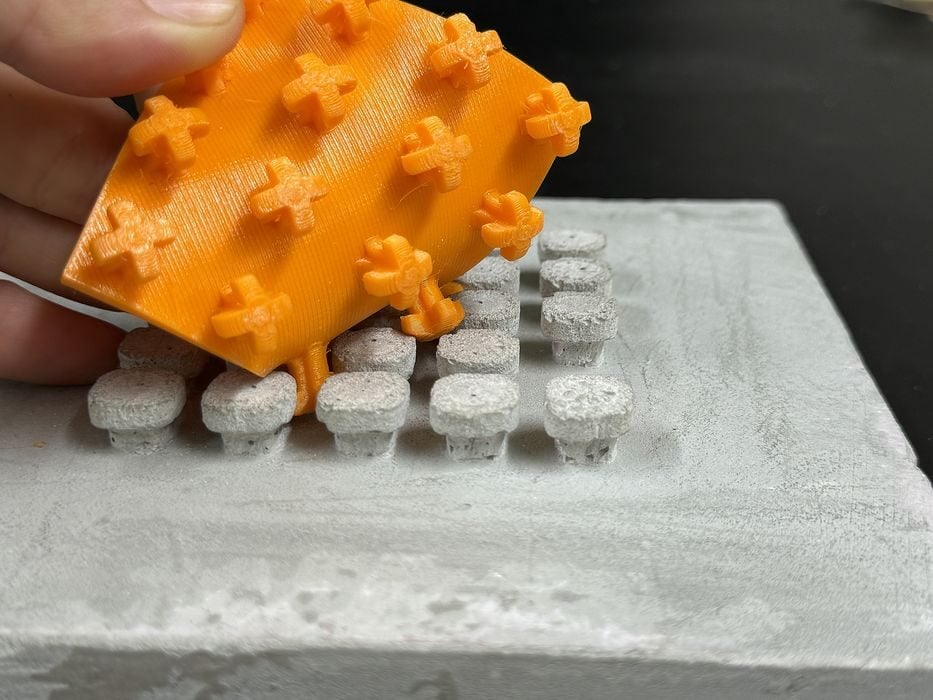
Researchers at TU Graz have developed a 3D printable “hook and loop” fastener for building components.
The researchers sought a way to both fasten and release building components. Today’s construction techniques are typically one-way: you destroy the component when you eventually remove it. In an age where recycling, reuse, and renovation is becoming more commonplace, this could be a desirable feature.
They created a system that resembles Velcro, yet can be scaled up to the size of typical construction parts. These parts would usually be interior features, such as paneling, flooring, non-weight-bearing walls, etc.
They 3D printed the hook and loop pattern for several components and performed a series of tests. They found their fastening system was at least equivalent to conventional fastening methods.
They believe the system could be made even stronger if they switched to injection molding or stamped metal from 3D printing.
I believe this could be of interest to future construction 3D print designs. Imagine if a structural design could include one half of the hook and loop pattern. If so, it would be a simple matter to apply a component to a 3D printed wall, for example. Even better, this approach might be quite amenable to an automated system, where a robot arm simply places components directly using the fastening system.
The researchers also developed two systems for digitally identifying the components. One approach was to embed an RFID chip into the fastener. This would enable future workers to determine the type, age, material, and installation date of a component. That could be extremely useful when reusing components.
An alternative approach tested was by pasting a QR code on the component. However, that would be usable only on components where the visual appearance does not matter.
I see this development as a hint of where we may see construction 3D printing go in the future. Today’s 3DCP prints are usually simple walls, sometimes with curves.
While the concrete portions are quickly 3D printed, the remainder of the building project must use traditional trades, which are inherently manual, requiring considerable labour.
Fastening systems of this type might become an incredibly important next step to enable significant automation of the non-concrete portions of building projects. If buildings were printed with standard component interfaces, it could dramatically speed up construction, lower costs, and possibly create a new industry segment providing standard components.
Via TU Graz
