
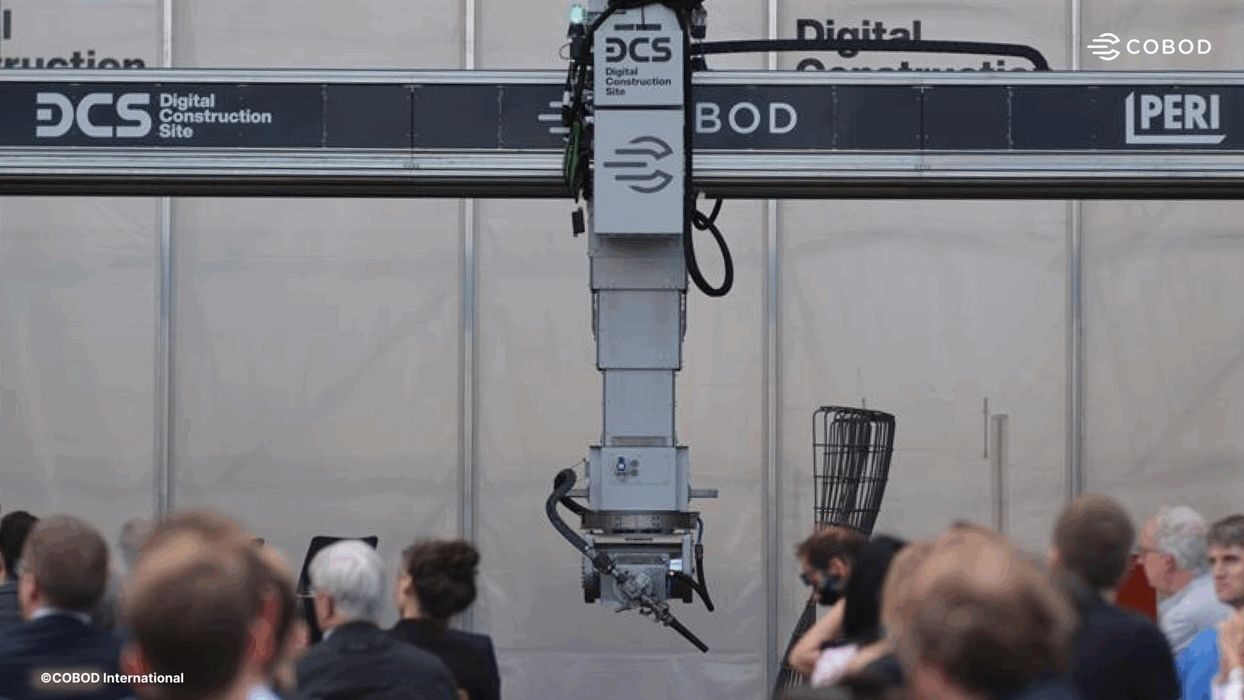
COBOD made a very significant announcement of a new feature for their 3DCP systems.
Up to now, virtually all 3DCP devices simply extrude concrete. Sometimes it’s done with a gantry system, like COBOD’s, but other companies might use robotic arms. In all cases, it’s simply extruding layers of concrete to build up into larger structures.
COBOD announced a multifunctional capability for their systems with what they call a “telescope unit”. The unit initially will be used for shotcrete. Shotcrete is the process of spraying concrete at high velocity toward a surface, quite unlike the slow extrusion methods traditionally used in 3DCP systems.
The ability to perform shotcrete processing during a normal 3DCP job provides quite a few potential advantages:
- Reinforcement: the shotcrete itself can reinforce weaker layers of extruded concrete, or can capture rebar laid on the surface before shotcrete is applied.
- Sealing: shotcrete could provide a better seal than the typical layered surface of traditional 3DCP approaches, particularly if there are sealing additives to the shotcrete.
- Surface Finishing: Traditional 3DCP results in coarse layers that are quite visible, but an application of shotcrete could provide a much smoother surface.
- Quality: voids or gaps in 3DCP extrusions could be filled with shotcrete.
- First Layer: Shotcrete could be used to build a flat print plane on an irregular build surface.
As you can see, all of these and likely more would be possible with this hybrid system.
COBOD said that the telescope unit could eventually be used with a sanding toolhead to smooth surfaces. This implies that the company might be considering even more toolheads.
This is quite a breakthrough because it opens the door to much more comprehensive construction 3D printing. Today’s devices can produce only certain concrete portions of a build project, while the remaining features, such as HVAC, plumbing, electrical, windows, surfaces, doors, etc., must all be done with traditional trades. The idea of a “home 3D printed in 24 hours” is quite incorrect: they’ve only printed the concrete portions in 24 hours, and the remaining steps take however long they take.
That equation might change. Imagine if the telescope unit concept is used to incrementally add more build capabilities. For example, could the unit pick and place pre-made windows into a structure as it is being printed? What else could be incorporated into the system?
Ultimately, this could lead to a system that is able to build an entire structure on its own, without the need for traditional trades at all.
That day is very far off, as there would be multiple functions that must be developed and added to the system. However, a long journey always starts with one step, and that step was just taken by COBOD.
Via COBOD
