
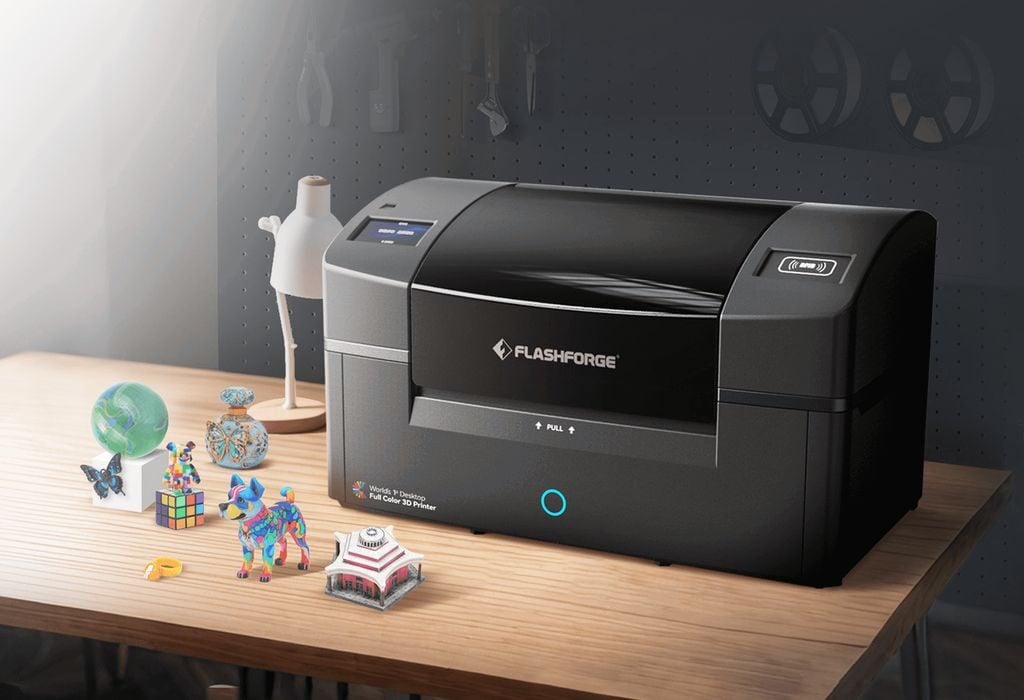
Where is the Flashforge full-color 3D printer?
Early this spring, Flashforge announced an upcoming 3D printer called the “CJ270”, said to be a full-colour 3D printer. This is quite different from the filament-swapping 3D printers commonly seen these days. Instead, this machine would be able to print colour gradients and textures, just like a photograph — except in 3D.
Full-colour 3D printers are rare in the industry today, and they are typically quite expensive. There are powerful systems from Stratasys, HP, and Mimaki, but their pricing and operational requirements are really only for high-end professional and industrial setups.
The reason for so few full-colour 3D printers is that there simply isn’t a big market for them in industry. Industry (and professionals) tend to print monocolour objects, and colour applications are pretty rare. Combine that with the expense of these systems, and you can see why there aren’t very many of them. In fact, there are multiple instances of full-colour 3D printer manufacturers going out of business, including MCOR and Rize.
That’s why it was pretty curious to see Flashforge leak news of an upcoming, presumably low-cost, desktop full-colour system, the CJ270.
Let’s take a look at the CJ270’s specifications:
- Small build volume of 180 x 120 x 100 mm
- 0.035mm pixel size
- 0.010mm layer size
- Seven printheads (for each CMYK base colour, support, clear, white)
- Prints 2.4mm height per hour, pretty slow
- Water-washable support material
- Heavy 38kg device
The product name, CJ270, suggests “J” for “Jetting”, and that’s likely the printing process used: inkjets selectively deposit drops of the seven materials on each layer, which is then cured with a UV light pass. This sounds suspiciously like Stratasys’ PolyJet process, which is also similar to Mimaki’s process. Both of those processes produce incredibly vibrant and realistic results.
In spite of a lengthy description page, Flashforge does not reveal either the release date nor pricing for the CJ270.
If the price is low, then it could be a game changer. For example, a price I found for the Mimaki 3DUJ-553 was a mere US$188,995. Granted, this machine has a larger build volume at 508 × 508 × 305 mm, but you get the idea: this machine is in a very different price category, just like Stratasys and HP’s options. The materials costs are also high.
If the CJ270 was priced at, say, US$5000, it would blow open the full colour market. But even at US$40,000, it would still be fantastically less expensive than other options on the market today.
Could Flashforge sell this device for only US$5000? The only other attempt at such pricing was done by 3D Systems about ten years ago, when they tried to adapt the ZCorp process into a less expensive platform, the CubeJet. After three years of trying, the product quietly disappeared before even hitting the market.
As of now, you can only sign up with Flashforge for notifications on the CJ270, so time will tell whether this product reaches the market, unlike the ill-fated CubeJet.
Via Flashforge
