
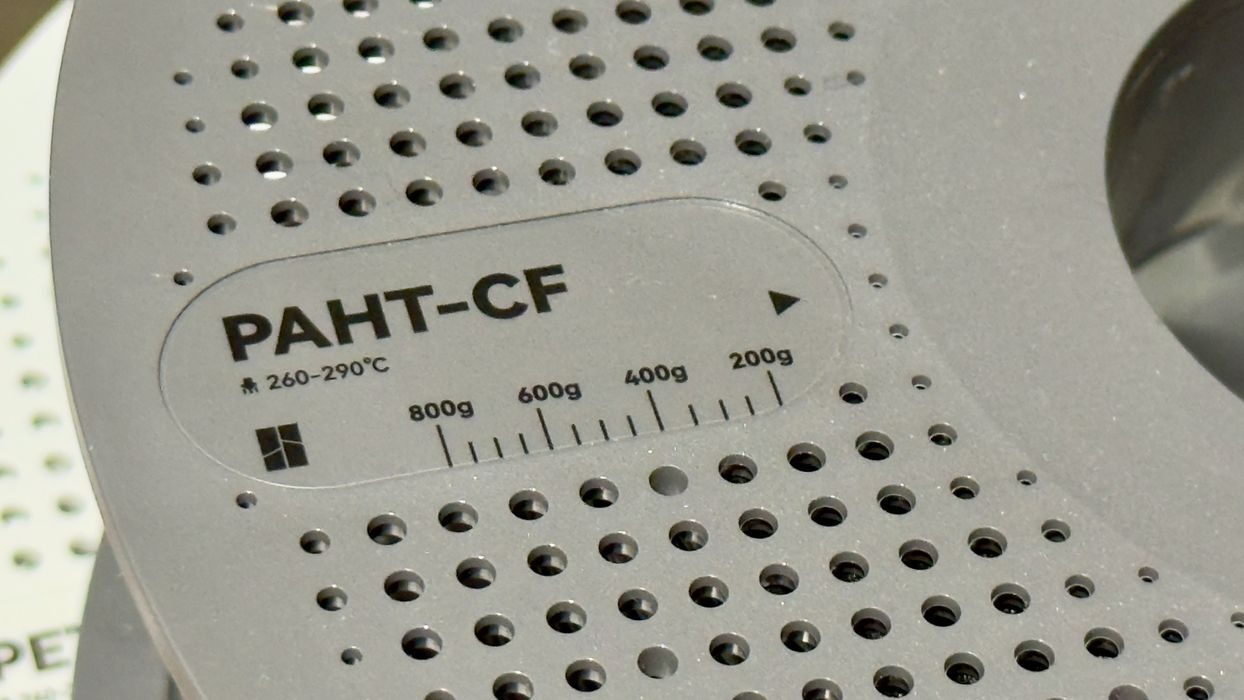
A new HI-AM study observes airborne carbon fiber particles during PA6-CF printing on a desktop FFF system.
Carbon fiber reinforced filaments have become a staple for stronger, stiffer parts without leaping to metal AM, but their handling quirks have always been clear to users. Drying nylon blends is mandatory, and anyone who has sanded a CF part knows the dust can be irritating. What has been less visible is what happens in the air during the actual print.
In a paper presented at HI-AM 2025, Dora Strelkova of the University of Windsor investigates fiber shedding with a PA6-CF filament printed on a Bambu Lab X1C. Prior studies have focused on ultrafine particle and VOC emissions from FFF; this work turns the spotlight on chopped fiber fragments that may detach from the composite matrix during extrusion or post-processing.
Carbon Fiber Filaments Come With Tradeoffs
Chopped carbon fiber in a nylon matrix boosts modulus and heat resistance, but it also introduces brittle, conductive fibers that can appear at cut edges and abraded surfaces. The study reports a simple but telling observation: microscopic inspection of fingertips after handling printed PA6-CF parts showed significant fiber transfer. If fibers readily move to skin, it is reasonable to ask what fraction becomes airborne while the hot end shears the material, the nozzle wipes, and the part cools under airflow.
To probe that, the team designed a custom capture rig with a filter placed near the build environment during print runs. After printing, the used filters were examined for fiber content. While the abstract does not provide counts or size distributions, the approach is practical for a desktop lab and it squarely addresses the question hobbyists and prosumers ask: are fibers floating around my workspace during CF prints?
Practical Safety Takeaways And Open Questions
The paper’s core contribution is directional evidence that airborne carbon fiber particulates are present during PA6-CF printing, complemented by surface transfer seen on fingertips. The author recommends safety precautions and even proposes an alternative slicing method intended to reduce fiber transfer from final parts. The abstract does not detail that slicing strategy, but a likely explanation is that it reduces exposed chopped fiber at the outer surface, for example by adjusting shell strategy or finish passes.
For now, the actionable guidance is straightforward: use an enclosure with effective filtration, consider local exhaust with a HEPA-class filter, avoid aggressive dry sanding, and wear gloves when handling fresh prints. Many desktop printers include fans and carbon media primarily targeted at odors; capturing fibers typically demands higher efficiency filtration and disciplined airflow paths. The study’s custom filter apparatus underscores that pathway control matters as much as filter rating.
Unknowns remain. The work as summarized is qualitative; there are no emission rates, mass loading, or fiber length distributions reported in the abstract. Toxicology depends on aspect ratio, brittleness, and whether fragments are respirable. It is also unclear how much the printer’s built-in airflow, part geometry, and print speed influence shedding. Nor do we know how alternative CF materials, like PETG-CF or ABS-CF, compare to PA6-CF in this context.
Even with those gaps, this is highly relevant for service bureaus, education labs, and design studios that run composites all day. The cost to add enclosure sealing and a known HEPA solution is modest, especially when weighed against employee comfort and housekeeping. The proposed slicing tweak could further reduce touch time by mitigating itchy surfaces on finished parts.
The next step is quantification: fiber counts over time, size and morphology distributions, and capture efficiency benchmarks for common filters under realistic print conditions. Comparisons across materials, nozzles, and slicer settings would help separate process variables from intrinsic material behavior. Standardized test protocols for composite FFF emissions would accelerate vendor responses and guide buyers toward safer configurations.
Strong parts are great, but you do not want your air to be reinforced.
Via Proceedings of the Holistic Innovation in Additive Manufacturing (HI-AM) Conference
