
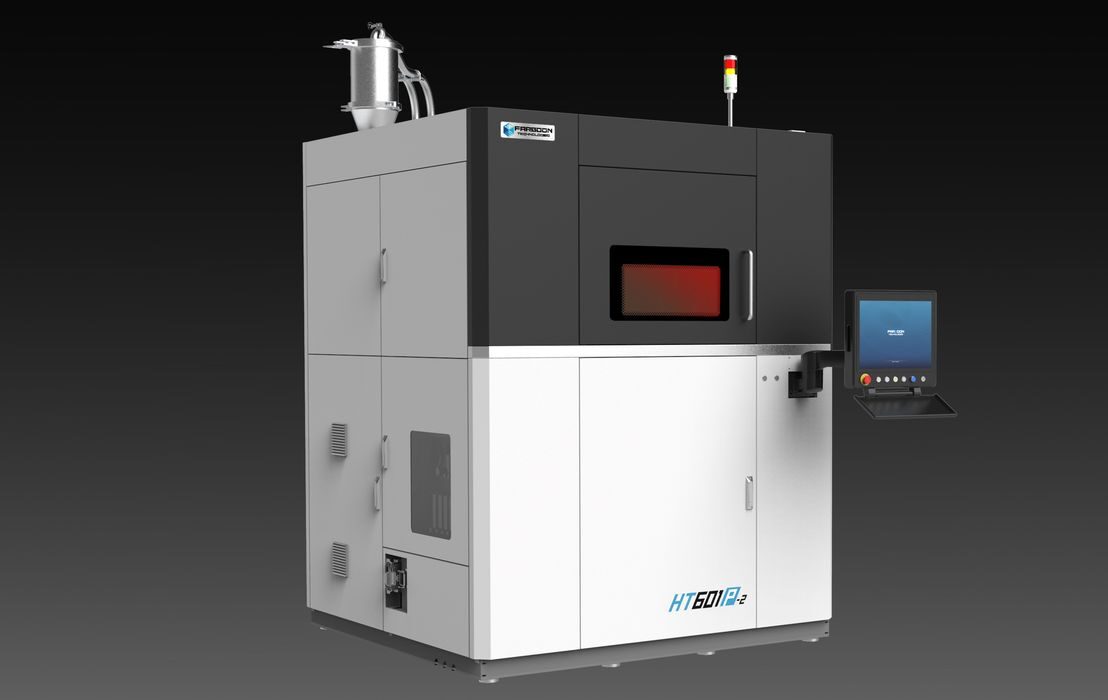
Farsoon introduced a new polymer 3D printer that fills a gap in their lineup.
The huge Chinese company, certainly one of the largest in the world, added the HT601P-2 system to their portfolio. While they may be slightly better known for their metal 3D printers, they also offer a considerable number of polymer devices as well.
This chart shows their polymer line up with temperature and build volume on the axes.
All of their machines use the LPBF process, and so does the new machine, the HT601P-2. On the chart you can see that the new device is placed similarly to the recently announced HT601P-4.
That device uses four separate 300W lasers to provide very fast production rates: the lasers share the build area, and can work on the same model all at once.
The new HT601P-2 has only two CO2 lasers, and they are lower powered at 100W each. Even though the -2 has much lower power delivery, it can still produce up to 12kg of parts per day when tightly nesting parts in a full build chamber.
Farsoon said the HT601P-2 offers “full field performance”, meaning that the laser dot properties are identical regardless of the location on the build area. This should ensure proper quality of parts, regardless of their location in the build.
How does Farsoon do this? They do use the standard galvanometric approach with a mirror that directs the beam to the powder surface, which typically distorts the laser dot towards the edges. Here, however, Farsoon uses a dynamic focus feature to ensure the laser dot is consistent.
The machine is designed for production purposes, and therefore includes a swappable build chamber (or cartridge, as they call it). As one job completes, it can be removed for post processing while a second is inserted for a subsequent job.
Farsoon said the HT601P-2 is compatible with PA6, PBT, PA11, PA12 and TPU powders, making it quite versatile. They did not explain how challenging it might be to swap materials in a machine, as it is in many other powder systems. Typically machines are dedicated to specific materials because of this.
We don’t know the cost of the HT601P-2, but it is certainly much less than its cousin, the HT601P-4. That’s because two 100W lasers are much less costly than four 300W lasers. It seems that Farsoon is targeting operations that require a lower priced alternative at this build volume, but are willing to have slower throughput.
For some this could be ideal, depending on the price of the parts being produced.
Via Farsoon
