
A new patent outlines a way to recycle fiber reinforced plastics waste into magnetically aligned, FFF-printed composites.
Fiber reinforced plastics (FRP) are notoriously hard to recycle without grinding fibers into short, weak fluff. The patent (CN121179733A) counters that reality with a multi-stage approach that tries to preserve fiber length, add magnetic responsiveness, and then actively orient the fibers during printing. If it works in practice, this could push recycled composites from filler-grade back into structural territory.
From Waste FRP To Printable Filament
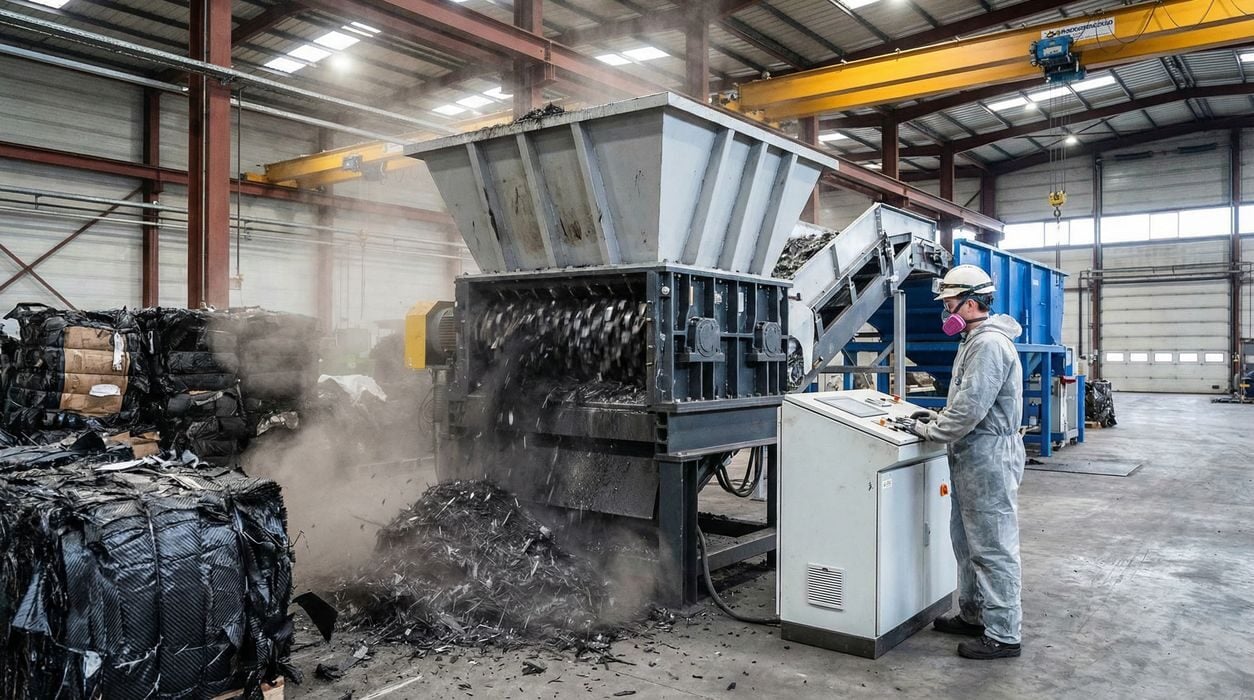
The method begins with gentle, staged dissociation. Large scrap is hydraulically sheared, then laser grooved in a grid to weaken the resin without cutting fibers. A low-energy roller mill with flexible media breaks up the matrix while keeping fiber lengths, followed by multi-deck sieving to sort fibers by length. That length grading matters because mechanical performance in short fiber composites tracks strongly with aspect ratio.
Next comes deep cleaning and surface activation. The team specifies microwave-assisted resin pyrolysis in a sealed vessel, ultrasonic cleaning, vacuum filtration and drying at 80-120 C. Plasma activation introduces reactive groups, and a silane coupling step co-deposits magnetic nanoparticles (the text cites Fe3O4) so each recycled fiber responds to a magnetic field. This chemical bridge is meant to strengthen the fiber-matrix interface and enable later alignment.
For filament making, the patent calls for a twin screw extruder with transport and distributive mixing elements to limit shear and preserve fiber length. A practical touch is closed-loop diameter control using a laser gauge and traction feedback to hold tolerance around ±0.03 mm. While the example matrix is PA6 at a 30:70 fiber-to-resin mass ratio, the approach should work with other thermoplastics commonly used in FFF.
Magnetically Aligning Recycled Fibers
The printing stage uses material extrusion, i.e. FFF, but with a twist. An array of electromagnets sits around the nozzle, driven by a controller synchronized to the toolpath. As the magnetized fibers exit the nozzle suspended in the melt, a programmed field orients them to a local target angle before solidification. The slicer passes orientation targets alongside standard G-code, enabling region-by-region reinforcement patterns.
This is an ambitious control problem. The alignment window is short, melt viscosity is high, and an electromagnet array near a hot nozzle must deliver strong, quickly changing fields without overheating. The patent acknowledges these constraints and leans on preserved fiber lengths and lower shear in extrusion to reduce the torque needed to turn fibers in situ. It stops short of quantitative claims for alignment fidelity, field strength, or the resulting mechanical uplift.
Compared with today’s chopped-fiber filaments, this approach promises better anisotropy on demand, closer to what continuous-fiber systems like Markforged and Anisoprint offer, but using recycled feedstock and standard pellet-to-filament infrastructure. If alignment is repeatable, service bureaus and labs could print structural ribs, skins and fixtures that turn waste into value, with less human touch time than layup or overmolding.
There are many unknowns. The inventors do not state throughput, compatible fiber types beyond generic FRP, or safety and emissions handling during microwave pyrolysis at scale. Hardware integration will not be plug-and-play: most desktop printers lack space, power and thermal management for an electromagnet ring, and slicer support for path-linked field vectors is not standard today. Cost is also unstated, both for processing scrap and for the orientation hardware.
What would prove the concept are side-by-side coupons showing fiber orientation histograms, tensile and flexural gains versus both random recycled fiber filament and virgin chopped fiber baselines, along with CT scans of printed corners and infill transitions. Pilot parts in transportation or construction would help clarify economics and durability. In the near term, expect research groups to prototype the electromagnet head and publish alignment metrics; commercialization, if it comes, likely rides on an OEM or retrofit partner.
Turning trash into tailored microstructures is a tall order, but if the magnets can keep up with the melt, the waste stream could become a design parameter.
Via Google Patents
