
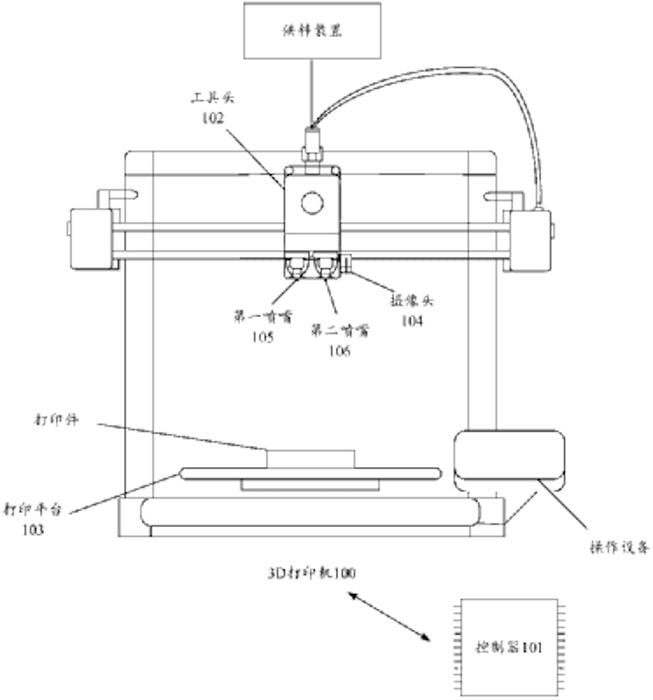
Bambu Lab was awarded a patent for what is not an unannounced A2 model.
Patent CN120096089, assigned to Shenzhen Tuozhu Technology Co., Ltd. (Bambu Lab’s corporate name), includes the diagram shown at the top. The patent was published way back in June 2025.
The diagram appears to show a desktop FFF 3D printer that is similar to the company’s A1 model. However, the A1 includes a single hot end, whereas the patent diagram sports two hot ends. The toolhead seems eerily similar to the company’s dual hot end devices, the H2D and H2C.
Would it make sense to use the same dual toolhead on a possible A2 model?
Speculation on forums runs on this angle, but it’s entirely incorrect.
The patent is in fact about a calibration method. In English, the translated title is “Method for determining toolhead offset, and a 3D printer”.
Aligning toolheads is actually quite important in multi-nozzle systems. If they are not precisely aligned, the two materials will be slightly offset when printing, resulting in gaps and blobs. Different systems use varying approaches for achieving this alignment, but here Bambu Lab seems to have developed a new approach, and they’ve patented it.
The diagram is simply to illustrate the problem of aligning nozzles, and an open gantry system would be easier to see than an enclosed 3D printer. I believe this is simply an explanatory diagram, and not an actual product.
But what is the new alignment method? It’s actually pretty interesting.
They have the printer print two parallel, non-collinear line segments, photograph them with an onboard camera, and compute the positional deviation (offset) in the direction perpendicular to those lines. Because the camera sees the actual deposited line, the system can estimate motion error more precisely than manual caliper measurements.
But it’s not quite that simple. The idea is to make the process highly reliable, and a great deal of the patent’s description is about how to do that. For example, the process involves first printing a base layer on which the test “strips” are printed. There’s also a requirement for using different colours for higher contrast, which would aid machine vision. They also talk about starting the test extrusions outside of the measurement area so that the initial and final parts of the extrusion, which are sometimes messed up, don’t confuse the measurement.
So what’s really going on here, then?
Bambu Lab is patenting a camera-based, automated calibration routine where the printer prints simple line patterns and uses vision + image processing to measure and compensate toolhead/nozzle motion and alignment errors more precisely than manual test-piece measurement.
They are not patenting a two-headed A2 model. In fact, machines are not patented; methods are patented, and this is a method of calibration. We may see this process appear in Bambu Lab’s dual extrusion systems at some point in the future.
As for the elusive A2, I’m not sure there would ever be such a thing. The A1 can already print in multiple materials with the AMS accessory, and the only advantages I can see are slightly decreased material use and the ability to mix TPU material in with rigid materials in a print job.
If you consider how many A1 owners would actually benefit from that capability, you’d realize there wouldn’t be that many. Bambu Lab likely wants to direct those folks toward an H2D or H2C instead.
Via PatentScope
