
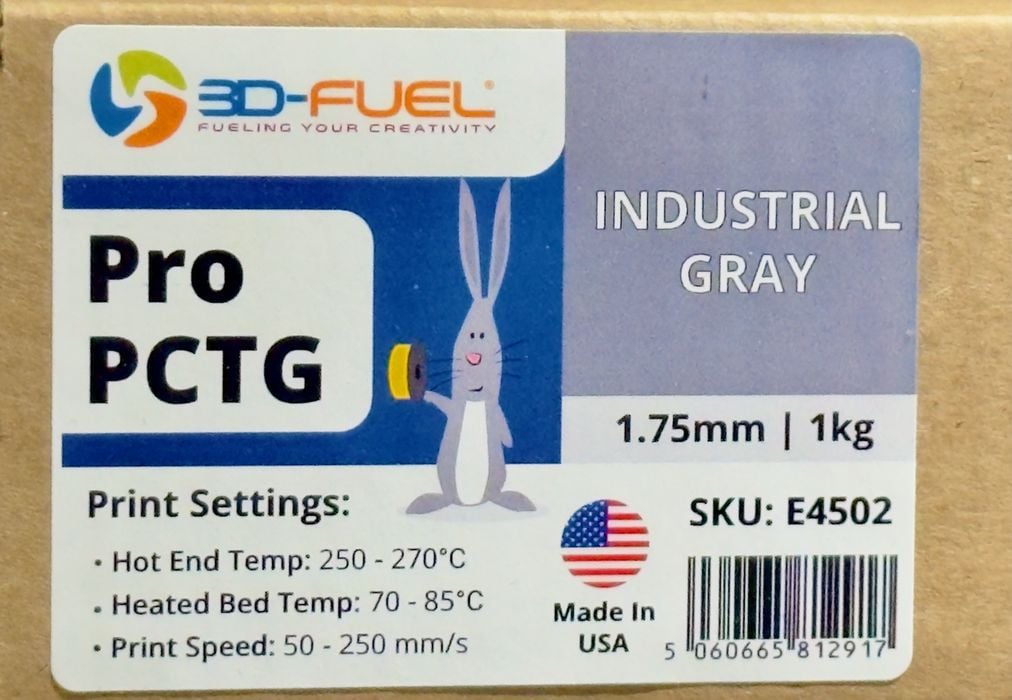
3D-Fuel and Helio Additive have partnered to enable the use of PCTG with Helio.
PCTG is an up-and-coming material for 3D printing that few have used yet. It’s chemically similar to PETG, but is a much superior material that warps less, has more strength, chemical and thermal resistance, and prints more easily. Once you try PCTG, you won’t go back.
Unfortunately, there are few providers of PCTG at this time, with the two major suppliers being Fiberlogy in Europe and 3D-Fuel in North America.
Helio Additive is a startup company that provides a very unusual service for 3D printer operators. They have developed a powerful simulation algorithm that analyzes 3D print builds voxel by voxel, simulating thermal flow as the print proceeds. By doing so, they are able to accurately predict many problems in the resulting parts. They can also adjust the print settings to overcome these problems, making for better quality parts and faster print speeds.
To achieve those results, Helio Additive has to delicately calibrate their software with machine-material pairs. In other words, they know precisely what’s going on when you print, say, Polymaker PPS-CF on a Bambu Lab H2S 3D printer — layer by layer. This is the key to Helio Additive’s secret algorithm.
This also means that they have a list of fully supported materials and machines. For these material-machine pairs, the system will provide outstanding results. I’ve seen several examples of this system’s uncanny ability to transform incredibly poor 3D prints into near-perfect results.
I should note that they do provide a way to handle “generic” materials they have not yet defined, but I’m pretty sure the results aren’t quite as perfect as the predefined materials.
Helio Additive has gradually been adding materials to their list, beginning with materials from Bambu Lab and Polymaker. By my count, they support 36 material types (more if you count different colours). Now they’ve added a third vendor, 3D-Fuel, with that company’s Pro PCTG material.
Helio Additive breaks down their service into two parts: Assess and Enhance. The Assess service simulates a print job with a given material and machine, and can reveal possible defects using “engineering-grade diagnosis”. The other service is Enhance, which uses the assessment to automatically tweak print parameters for optimal results.
If you want to try Helio Additive, you can! The Assess service is provided to everyone for no charge. You can receive a professional analysis of your print job and take action. If you want more, you can subscribe to their service to use Enhance. They do offer a free trial for this as well.
We are going to perform a test of Helio Additive’s full product set using 3D-Fuel’s PCTG materials to see what it can do. Stay tuned!
Via 3D-Fuel and Helio Additive
