
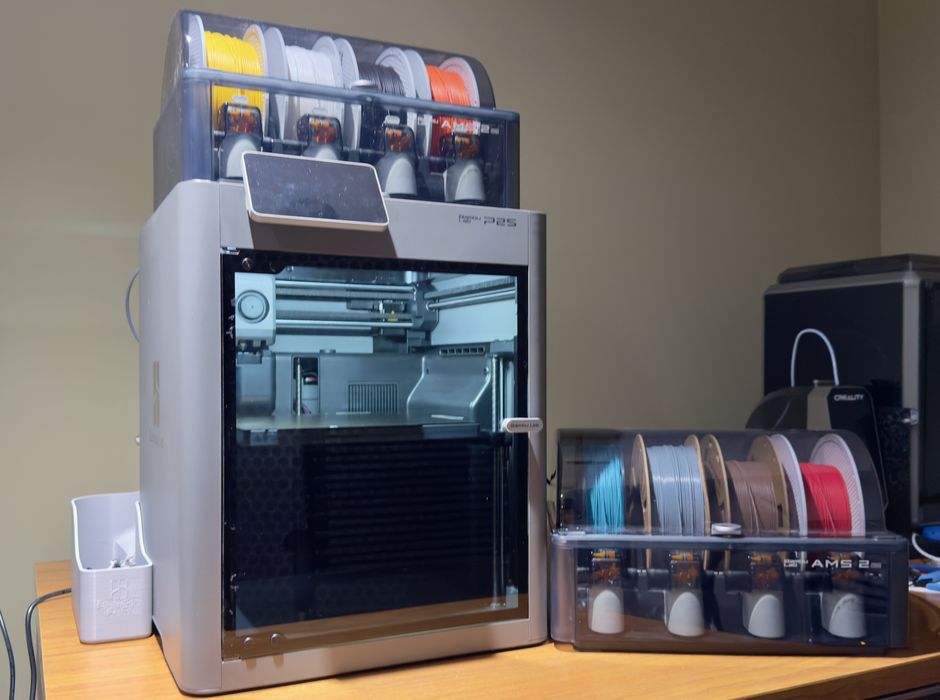
We’re a bit late to the party, but we’ve just completed a long test of the new Bambu Lab P2S desktop 3D printer.
This is part one of a four part series, please read parts two, three and four.
Bambu Lab Combo P2S Background
The P2S is Bambu Lab’s latest device, replacing the P1S that is still quite popular. The company began by releasing the X1C, and then provided two similar models that essentially removed some X1C features and sold at lower price points. One was the P1P (now discontinued) and the other was the P1S.
The X and P series all sport a 256 x 256 x 256 mm build volume, making them ideal for smaller desktop setups. While there are larger machines available from Bambu Lab (the H series), they occupy substantially more footprint than the P series.
With the introduction of the P2S, Bambu Lab dropped the price of the P1S, presumably to clear out inventory and move on to the new model. Due to a mysterious administrative delay in launching the P2S in the US, many buyers acquired P1S at discount prices. As you’ll see in this review, they may be missing out, as the P2S is quite an amazing machine.
Bambu Lab P2S Combo Specifications and Features
The P2S is somewhat similar visually to its predecessor, the P1S, but upon closer inspection there are plenty of differences. The system uses 1.75mm filament, is fully enclosed and uses the now de facto standard CoreXY motion system.
Made with a rigid steel frame to reduce vibrations, the P2S can operate at up to 600mm/s, although practical maximum print speeds are more near the 300mm/s range. The machine is rated for depositing up to 40 cubic mm per second, which is notably higher than the older P series models.
Other features of interest:
- Hardened steel nozzle
- Optional 0.2, 0.6, 0.8 mm nozzles
- Quick swap nozzle mechanism
- Maximum nozzle temperature of 300C
- Maximum print plate temperature of 110C
- Removable magnetic spring steel PEI plate
- Optional alternative build plates
- Air filtration
- Color touchscreen
- Closed loop fan control
- HD Webcam with AI monitoring
- Power out recovery
- Filament run out and tangle sensors
- Door open sensor
- Neural processing unit
- Ethernet, WiFi and USB connectivity
With all those features, the P2S supports printing PLA, PETG, ABS, ASA, TPU, PET, PA, PC, PVA, PLA-CF, PETG-CF, ABS-GF, ASA-CF, PA6-CF, PA6-GF, PAHT-CF, PPA-CF, PET-CF, Support for PLA, Support for PLA/PETG, and Support for ABS. In other words, you can print almost any non-high temperature material on the P2S.
You may notice the “Combo” in the product name. This means that in addition to the 3D printer itself, the product also includes an automated material system (AMS) for filament switching. The model shipped with the P2S is the AMS Pro 2, which also includes the ability to dry and store filament. This is an increasingly important feature, particularly with the more exotic materials that one can print on this system.
This is part one of a four part series, please read parts two, three and four.
Via Bambu Lab
