Charles R. Goulding and Preeti Sulibhavi examine the historical prestige of platinum and explain why additive manufacturing is accelerating its return to the jewelry spotlight.
Platinum Jewelry and 3D Printing: Forging the Future of Luxury
Precious metals and jewelry have always represented the height of craftsmanship and personal expression. From ancient signet rings to Art Deco brooches, metals like gold, silver and platinum have been shaped by centuries of evolving technique. Now, however, 3D printing is transforming how fine jewelry is made. While 3D printing in jewelry is nothing new, the ability to print platinum directly in metal form marks a breakthrough, combining luxury materials with next-generation fabrication.
In this article, we’ll explore how platinum has traditionally fit into jewelry, why it’s gaining attention in additive manufacturing, how several major jewelers are adopting advanced techniques, and what the future holds for this rare metal in a digitally driven market.
3D Printing Platinum: A New Manufacturing Frontier
Traditional jewelry fabrication involves casting, forging, milling and lengthy hand finishing. Additive manufacturing changes this paradigm by building objects directly from digital designs, layer by layer.
Pandora A/S
Headquartered in Copenhagen, Denmark, Pandora employs around 39,000 people worldwide and crafts its jewellery with care and precision. In 2025, it reported sales of US$965 million. In July 2025, Pandora conducted a large-scale consumer study with 23,000 participants, and 78% recognised platinum as a precious metal, compared to 69% for sterling silver.
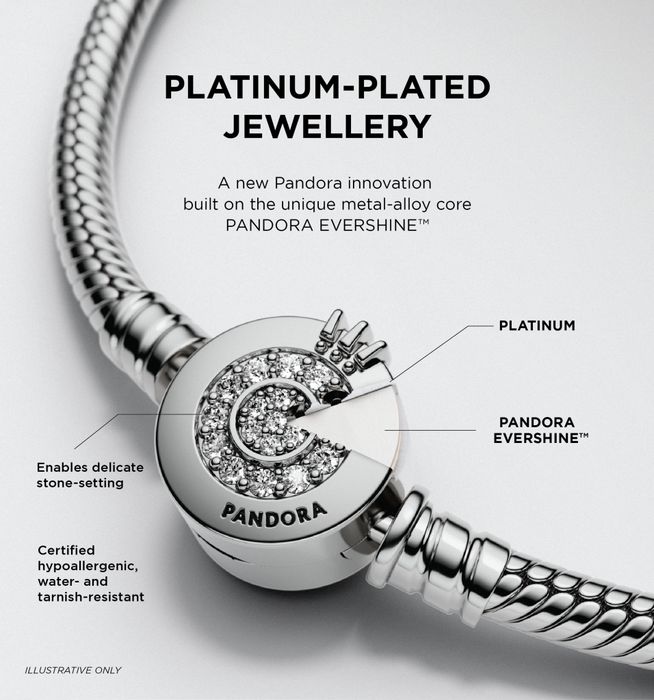
In Q1 2026, Pandora will introduce a curated selection of best-selling bracelets in a platinum-plated version across 30 stores and through e-commerce in Northern Europe. The pilot will inform a global launch in the second half of 2026, when Pandora will offer more platinum‑plated bracelets as well as a selection of charms.
Although not yet widely publicized as printing platinum directly, Pandora’s adoption of platinum-plated products hints at a broader material shift that could pave the way for digitally driven production methods, including potential use of 3D printed components for bespoke collections.
Since 2024, Pandora has crafted its jewellery using 100% recycled silver and gold. Over the coming years, the company will gradually shift more metals, including platinum, to recycled sources to further reduce its environmental footprint.
PANDORA EVERSHINE™ was introduced in 2015 and has been validated through years of commercial use in Pandora’s gold-plated products. Now, the process has been optimized for platinum-plated jewellery, which allows the company to build on the same crafting principles that have defined the brand since 1982.
For precious metals like platinum, 3D printing has historically presented challenges due to the high melting temperature and complex powder behavior. But recent technological advances — such as laser powder bed fusion (LPBF) and binder jet printing — are overcoming these hurdles.
For example:
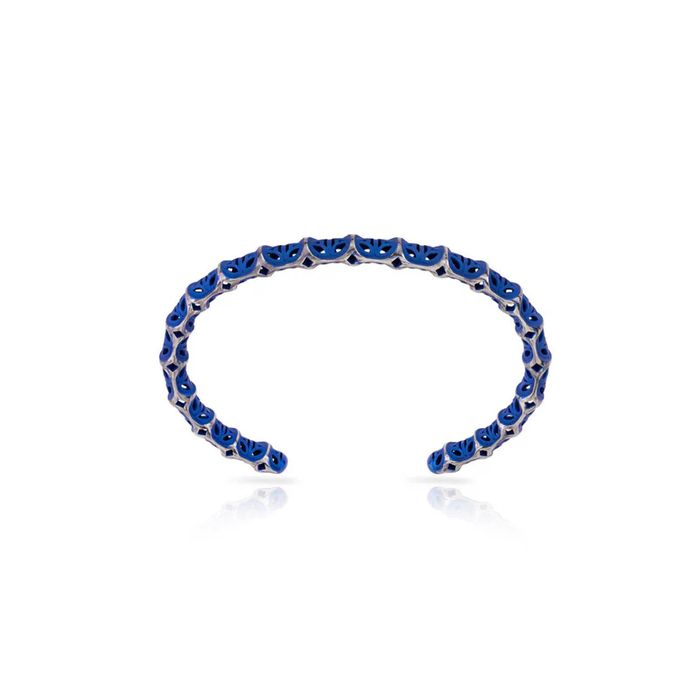
- The Tùsaire Collection, created by Platinum Guild International (PGI) and designer Maeve Gillies, is the first commercially available series of 3D printed platinum jewelry. These pieces showcase intricate, organic forms and geometric complexity that traditional casting would struggle to achieve, as well as the ability to craft lightweight hollow structures and interchangeable elements.
- Legor’s Powmet platinum powder has been qualified for binder jet 3D printing on Desktop Metal’s Production System P-1. This development simplifies the printing of platinum wedding bands, gemstone rings and elaborate earrings by eliminating molds and reducing waste.
These breakthroughs are not just engineering feats; they represent a practical shift. Additive manufacturing significantly reduces material waste, allows for highly personalized designs, and enables jewelry creators to produce objects that would be extremely costly or impossible with classical techniques.
Jewelers Embracing 3D Printing of Platinum
While 3D printing platinum jewelry is still in early phases of adoption, several brands and manufacturers are experimenting with or integrating advanced techniques:
• Stuller, Inc.
Stuller Inc., headquartered in Lafayette, Louisiana and has long been at the forefront of adopting CAD/CAM and 3D printing to serve the jewelry industry — including major brands like Cartier and Tiffany & Co. — by supplying highly customizable components and digital manufacturing workflows. Their Gemvision division and custom tools like MatrixGold and CounterSketch show how digital design and fabrication empower modern jewelry production.
• Tiffany & Co.
Tiffany, a historical platinum jeweler famous for classic settings, has been incorporating digital tools in design and prototyping. While specific 3D printed platinum lines are not yet widely reported, the company’s investment in digital design foreshadows future additive production. (Industry context suggests luxury houses like Tiffany are increasingly experimenting with 3D workflows but specific platinum printing work has yet to be widely documented.)
• High-End Independent Designers
Collections like the PGI-backed Tùsaire illustrate how independent designers and guilds use 3D printing to push creative boundaries, producing platinum pieces that celebrate both craft and digital innovation.
• Service Bureaus and Material Innovators Companies specializing in materials and printing services (like Legor and Desktop Metal) are making platinum more accessible to designers by reducing barriers to entry, enabling both large and small jewelers to experiment with direct metal printing.
History of Platinum Jewelry
Platinum’s story in jewelry began later than gold’s and silver’s. Although the metal was known to pre-Columbian civilizations, it wasn’t widely used in jewelry until the late 19th century. Platinum’s high melting point, dense molecular structure and resistance to oxidation made it difficult to work with using traditional casting techniques, so early jewelers favored more malleable metals like gold and silver.
That changed as industrial metalworking advanced. By the early 20th century, platinum became the sought-after metal for setting diamonds and gemstones because of its neutrality, strength and rarity. Unlike silver, which tarnishes, or gold, which requires alloys to harden, platinum usually maintains high purity — often 90–95% — and resists wear. This makes it ideal for heirloom pieces and settings where strength and longevity matter.
For decades, platinum was exclusively hand-crafted or cast in traditional foundries, requiring masterful skill and special tools. But the difficulty of working with the metal — from reaching its very high melting point to polishing dense, heavy pieces — limited the types of designs and increased costs.
The Future: Growth, Personalization, and Technology
Looking ahead, multiple forecasts point toward robust growth for the 3D printed jewelry market overall. A recent industry projection expects the global 3D printed jewelry segment to grow from about US$980 million in 2026 to over US$3 billion by 2034, at a compound annual growth rate exceeding 15% — driven by increasing consumer demand for customizable, intricate, and digitally enabled designs.
Within this broader market, platinum is poised to benefit from several trends:
- Digital customization — Consumers increasingly expect bespoke pieces that reflect personal identity and meaning. 3D printing paired with CAD tools supports this shift.
- Material innovation — New platinum alloys and qualified powders for additive processes are improving manufacturability and expanding design possibilities.
- Sustainability pressures — Additive manufacturing produces less waste than casting and reduces energy consumption, aligning with consumer and industry demands for environmentally responsible production.
At the same time, platinum’s demand in the jewelry market has increased as its price discount relative to gold has encouraged consumption, and jewelry demand in regions such as China has risen significantly following weak gold sales.
Why Platinum vs Silver? More Than Just Metal Prices
When jewelers choose between materials like silver and platinum, several factors come into play:
1. Durability & Longevity
Platinum’s dense structure allows it to endure daily wear and resist scratches better than silver. It also tolerates resizing and repair without losing structural integrity, meaning platinum pieces can last generations — a key reason it’s a staple for engagement and wedding rings.
2. Aesthetic Stability
Silver tarnishes over time and requires regular polishing. Platinum maintains its luster and patina without frequent maintenance, providing a lasting white finish that doesn’t dull as quickly.
3. Hypoallergenic Qualities
Because platinum is often purer than other jewelry metals, it is less likely to cause skin irritation, an advantage over silver alloys that can include reactive metals.
4. Rarity & Value Perception
Platinum is rarer than silver and typically positioned as a luxury material. While the commodity price of platinum can fluctuate (sometimes even trading below gold), its perceived value in jewelry and investment demand remains strong.
Some major brands are now rethinking their traditional reliance on silver. In early 2026, Pandora announced a shift from sterling silver to platinum-plated products, aiming to stabilize cost structures and improve margin stability amid volatile silver prices. The new pieces use a platinum plating over an alloy base, which — despite platinum’s higher price per ounce — can be cheaper to manufacture because less material is used and the supply is less volatile.
The Research & Development Tax Credit
The now permanent Research & Development Tax Credit (R&D) Tax Credit is available for companies developing new or improved products, processes and/or software.
3D printing can help boost a company’s R&D Tax Credits. Wages for technical employees creating, testing and revising 3D printed prototypes can be included as a percentage of eligible time spent for the R&D Tax Credit. Similarly, when used as a method of improving a process, time spent integrating 3D printing hardware and software counts as an eligible activity. Lastly, when used for modeling and preproduction, the costs of filaments consumed during the development process may also be recovered.
Whether it is used for creating and testing prototypes or for final production, 3D printing is a strong indicator that R&D-eligible activities are taking place. Companies implementing this technology at any point should consider taking advantage of R&D Tax Credits.
Platinum Meets Digital Craft
Platinum’s journey from hard-to-work noble metal to a material compatible with cutting-edge additive manufacturing reflects a broader evolution in jewelry craftsmanship. Where once platinum was reserved for classic solitaire rings and heirloom pieces crafted by master smiths, 3D printing is now enabling unprecedented design freedom, personalization, efficiency and sustainability.
As manufacturing technology advances and brands explore new ways to differentiate offerings, 3D printed platinum jewelry could become a hallmark of luxury’s digital age — marrying the timeless allure of one of the world’s rarest metals with the future of fabrication.