
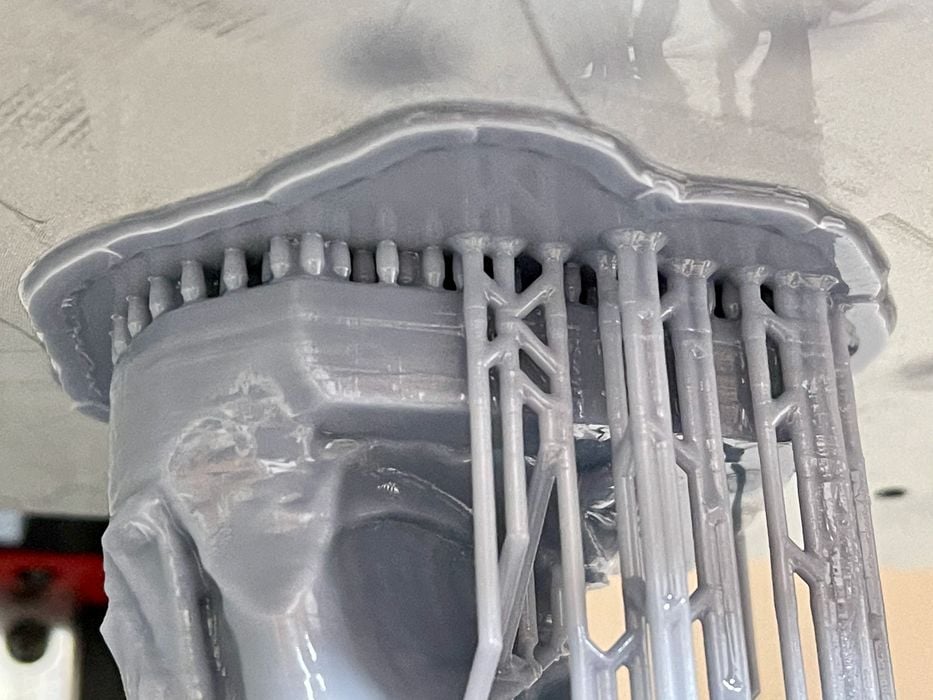
A new research paper proposes geometry adaptive reinforcement learning to reduce peel forces in Digital Light Processing (DLP) resin printing to save fragile features and increase lift success for resin workflows.
Anyone who runs vat photopolymerization knows the layer separation step can make or break a job. As each cured layer detaches from the resin tank, suction can snap thin walls, blow out lattice nodes, or delaminate long cantilevers. The usual countermeasures are blunt actions: add heavy supports, slow the lift, tilt the vat, or switch to a low force film. Those steps protect parts but slow down printing, waste material, increase post processing, and they are static presets that ignore the wide geometry swings layer to layer.
Closed loop control has transformed other corners of AM — think melt pool sensing in Laser Powder Bed Fusion (LPBF) or resonance compensation in FFF — but resin machines still rely mostly on pre tuned lift profiles. A geometry aware controller that adapts separation to each layer is an obvious next step, and reinforcement learning (RL) is a plausible way for it to work because it can optimize policies directly against a measured reward.
Why Peel Forces Break Fragile DLP Parts
Separation force is dominated by cured area and the volume of resin trapped under the part. Large cross sections form a strong vacuum pocket against the release film; as the build plate lifts, the force rises to a peak and then drops when the interface breaks. That transient shock can exceed the strength of thin features, especially when resin viscosity is high or when ambient temperature drifts. Shops can measure the force with a load cell under the build arm, or estimate it from stepper or servo current, and the signal clearly shows the spike-and-release pattern correlated with failures.
Because geometry changes across a print, optimal lift parameters also change. A small island layer might tolerate a fast separation and near zero dwell, while a full build-area layer needs a slow ramp, pause for resin flow, and a longer Z hop to reset the meniscus. Static profiles either waste time on easy layers or overload the hard ones. It’s a no-win situation we’ve been living in for years.
A Geometry Aware Control Policy
The paper’s title points to an RL agent that adapts separation based on geometry, which likely means extracting features from each slice — such as cured area, perimeter length, aspect ratios, and hollow regions — and mapping them to actions like lift speed, acceleration, dwell time, tilt angle or sequence, and Z hop distance. A reasonable reward would penalize peak measured force, sudden force rate changes, and failed separations, while crediting faster cycle times. Training could occur offline with recorded builds and then fine tune online with cautious exploration, though the authors’ exact method is not stated in the paper.
The paper does not indicate what sensor stack is used, what resins and release films were tested, or the magnitude of the reported improvement. It is also unclear whether the trained policy generalizes across printers, vat chemistries, and window wear, or if it must be re learned per machine. Compute requirements for on printer inference and any need for cloud training were not disclosed. Those choices will determine whether this is a basic lab demo or a practical control upgrade that could be commercialized.
If this approach works as intended, the implications are quite interesting.
Dental arches, hearing aid shells, microfluidic channels, and lightweight lattices should see fewer breakages and less over support. Shops could run faster lift phases on small area layers without touching presets, recovering minutes per hour and improving surface finish by avoiding repeated overstress. For OEMs, an adaptive separation stack would be a defensible differentiator that increases reliability at the most failure prone event in the cycle.
An adoption path could start with retrofit force sensing kits and a slicer plug in that annotates geometry features, followed by firmware level integration on new machines once policies prove stable and safe. Will slicing software attempt to use this new method?
