
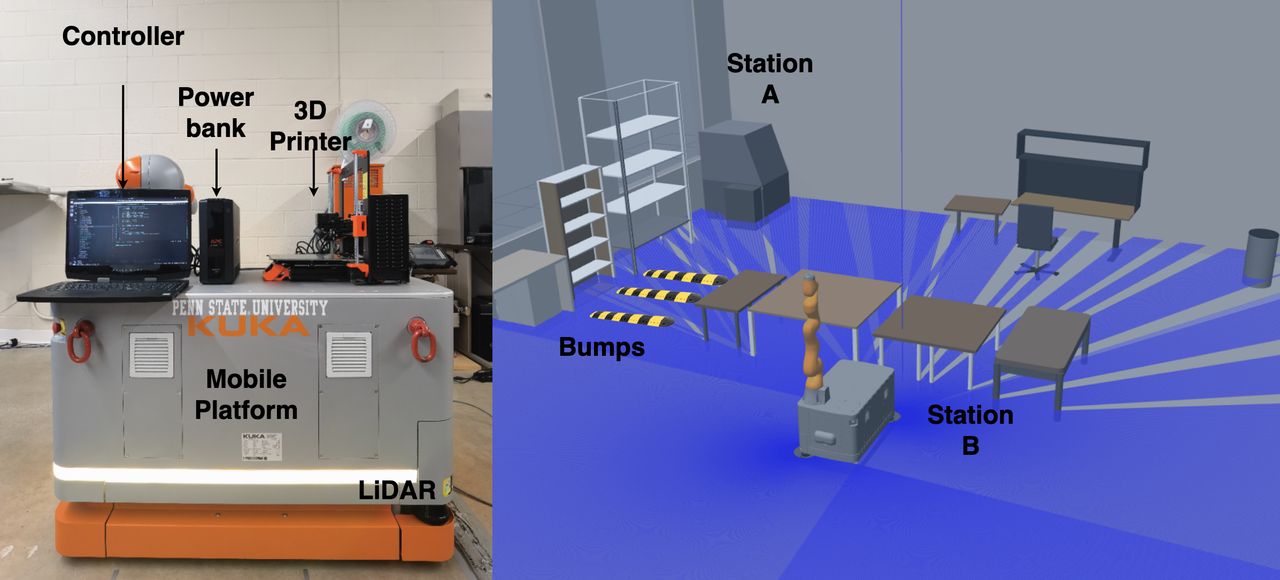
Researchers unveiled a closed loop, obstacle aware control framework that lets mobile additive manufacturing (AM) robots print while navigating dynamic factory floors.
The team positions this mobile additive manufacturing concept as a response to mass customization and the limits of fixed machine layouts. Stationary printers are terrific for repeatability, but they struggle when the job moves or when space is tight. Mobile AM Robots (MAMbots) promise to bring the tool to the workpiece, shuttle parts between cells, and adapt on the fly — if they can stay precise while moving.
Prior efforts often decoupled motion and deposition: navigate to a spot, stop and go, then move again. That avoids vibration induced defects but kills throughput and flexibility. When navigation disturbances do mess up deposition, the result can be poor layer registration, waviness, or scarred surfaces that defeat the promise of on demand fabrication.
Why Mobile AM Needs Smarter Navigation
The paper proposes a universal mobile printing and delivery platform that explicitly couples navigation and material deposition. A real time planning and control stack governs the robot’s motion for safety, obstacle avoidance, and path stability, while supervising deposition so the printed path stays within bounds. Closed loop sensing ties mobility and manufacturing together, with feedback driving both motion corrections and process adjustments.
Unlike frameworks that treat navigation and printing as separate threads, this approach tries to co optimize where the robot goes and how it lays down material. The authors validate the concept in simulation and in real world experiments that inject trajectory changes and external disturbances. They report that the system maintains print quality while adapting its path to avoid obstacles and preserve stability.
Potential Impact And Open Questions
Mechanically, the interesting bit is the unified controller: it seems designed to modulate speed, heading, and deposition in concert so that the bead lands where the slicer intended, even if the platform must deviate slightly to clear an obstacle. That is a step beyond use of fixed rails or stop and go automated guided vehicles, and it could reduce human labor by minimizing pauses and rework. If it holds up, service bureaus and factories could stage lightweight, reconfigurable AM cells that print and deliver parts without waiting for a fixed bay to free up.
The paper’s abstract does not specify materials, layer heights, speeds, or a build volume, and it does not share accuracy numbers. The method looks most compatible with material extrusion, where a moving nozzle can tolerate modest platform motion; powder bed fusion, resin processes or binder jetting would not benefit from mobility during a build. Any mobile platform must also tame vibration, maintain thermal consistency, and keep adhesion stable when the vehicle accelerates or turns. Precise spatial perception is essential too, because a false positive obstacle or a missed pallet could derail both the path and the part.
Regardless, the use cases are interesting. Factories could route a MAMbot to produce a jig near the line, then ferry it straight to assembly. Warehouses could print low volume spares next to maintenance bays. Education and research labs might explore print while move experiments without dedicating space to fixed gantries. Construction scale printing might also benefit from this approach, but the uneven terrain and environmental exposure raise all kinds of extra challenges that go way beyond what this paper addresses.
If this concept works, we might see a “warehouse” MAMbot be dispatched to the factory cell and deliver the part just as it finishes printing.
Via arXiv
