
A research team now claims your noisy workshop may be sabotaging print strength.
Researchers at the quietly named Acoustic Process Control Lab at the University of West Bohemia say they have developed a “silence enhanced” additive workflow that significantly improves interlayer bonding in FFF parts by reducing airborne vibration and pressure fluctuation during deposition. The group calls the method Quiet Phase Fabrication, or QPF, and says test coupons printed in near anechoic conditions showed tensile strength gains of up to 18% over identical parts made in a conventional lab environment.
That sounds absurd on first read, which usually means it is worth reading a second time.
The concept sits somewhere between process control, vibration isolation, and environmental conditioning. AM operators already know that thermal drift, belt resonance, frame wobble, and nearby machine vibration can leave visible artifacts on parts. Selective Laser Sintering (SLS) and Laser Powder Bed Fusion (LPBF) systems spend serious money managing gas flow, optics stability, and thermal consistency. FFF has usually taken a more casual approach, often running on a bench beside a compressor, a radio, and someone enthusiastically grinding something metal two meters away.
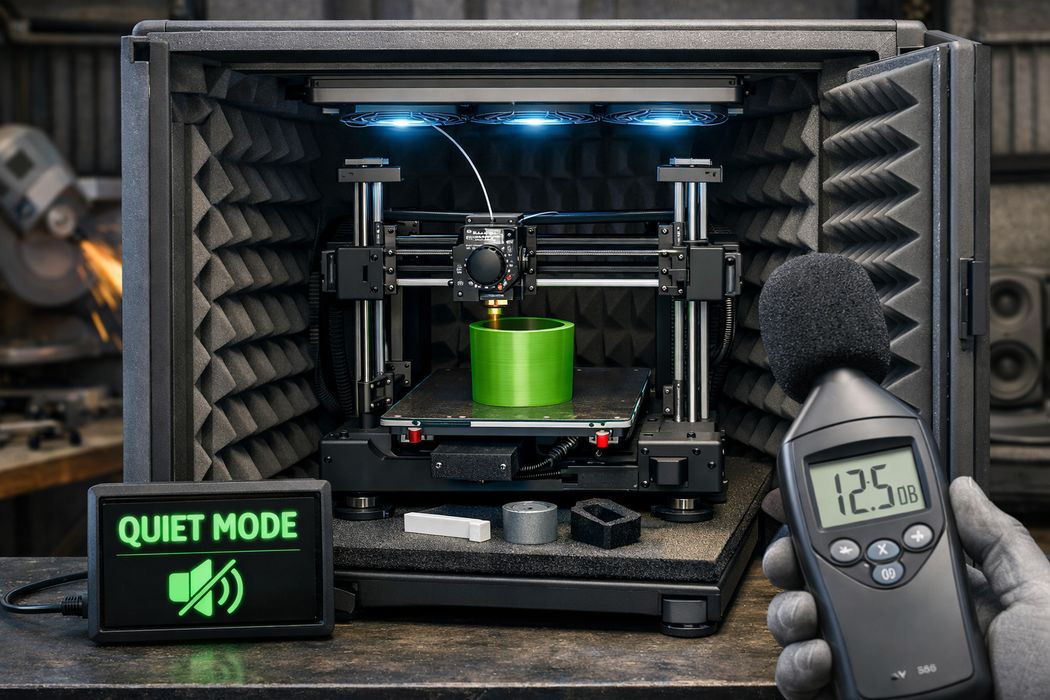
The research team argues that this casual setup may matter more than expected. Their paper describes a print enclosure lined with broadband acoustic damping foam, floating on elastomer mounts, with fans tuned to subsonic laminar flow and stepper drive profiles shifted away from resonant bands. In plain terms, they are trying to stop sound energy from becoming mechanical disturbance at the nozzle just as semi molten polymer roads are laid down.
Why Silence Might Matter
Their technical explanation is surprisingly plausible. When a hot filament strand exits the nozzle, it has only a short window in which it can wet the layer below before viscosity rises. If the toolhead, gantry, or surrounding air is vibrating at the wrong frequency, even by tiny amounts, the bead may oscillate microscopically rather than settle evenly. That could reduce true contact area, trap tiny voids, and encourage the familiar combination of poor layer fusion and surface ringing.
The team goes further, claiming that certain harmonic ranges in busy workshops can create cyclic pressure changes around open frame printers, especially tall machines with lightweight motion systems. Those pressure pulses apparently do not move much air in human terms, but may still perturb cooling symmetry around the nozzle. The result is not catastrophic failure, just slightly worse bonding and more brittle fracture behavior. Their wonderfully unnecessary term for this is “emotionally brittle polymer response,” which sounds like something a spool experiences after reading the news.
To test the idea, the researchers printed PLA, PETG, and nylon specimens in three environments: an anechoic chamber, a standard university lab, and a deliberately noisy fabrication shop with recorded industrial sound boosted to 95 dB. The quiet prints reportedly produced the best Z axis strength and the lowest ringing amplitude, with nylon showing the greatest improvement. Throughput, of course, did not change. Silence does not make the printer faster, only less confused.
Another Variable For Process Control
There are constraints everywhere. The paper does not show whether the gains persist on heavier, enclosed CoreXY machines or only on lighter open gantry systems. It also leaves material class somewhat open, beyond the initial trials. Resin systems might see little effect because the mechanism is different, while pellet extrusion and large format FGF could be even more sensitive given their greater bead mass and longer cooling windows. The researchers also did not provide enclosure cost, long term reliability data, or any indication that commercial vendors are about to adopt this.
Still, the idea is interesting because it reframes workshop noise as a measurable process variable instead of background annoyance. If the results hold, low cost desktop vendors like Bambu Lab, Prusa, Creality, and Anycubic could eventually market acoustically managed enclosures not just for user comfort, but for print quality. Service bureaus and education labs might also care, because reducing human touch time spent tuning ringing artifacts is worth real money.
It would be wonderfully on brand for desktop AM if the next major reliability breakthrough turned out not to be more artificial intelligence, but simply telling everyone in the shop to please be quiet.
