
A new research survey examined which FFF settings, materials and controls truly matter for the best part performance.
Researchers from Saveetha Institute of Medical and Technical Sciences and partners compiled a review of polymer additive manufacturing, specifically with a deep dive on FFF. The paper looks at one aspect familiar to every 3D print operator: how process variables and environment control strength, accuracy and consistency.
While everyone debates exotic filaments, the researchers focus on fundamentals. Infill density, layer height, raster angle, print speed, extrusion temperature and build orientation really control the outcomes, and the interactions between them are the main source of variance and anisotropy in printed polymers. The review also looks beyond parameters to examine thermal degradation, moisture management, post-processing, and the growing role of machine learning for defect detection and closed-loop control.
Porosity and Properties Linked
The most interesting part turns out to be the tight link between porosity and properties across PLA, ABS, and PETG. Micro-CT studies cited in the review report porosity as low as 0.2% for dense PLA versus 5.5% for PVA prints, with strength following those differences. In carbon fiber reinforced ABS, void fraction can rise from pellet form to extruded layers, then fall again with compaction, showing how extrusion geometry, overlap and pressure truly control pore formation.
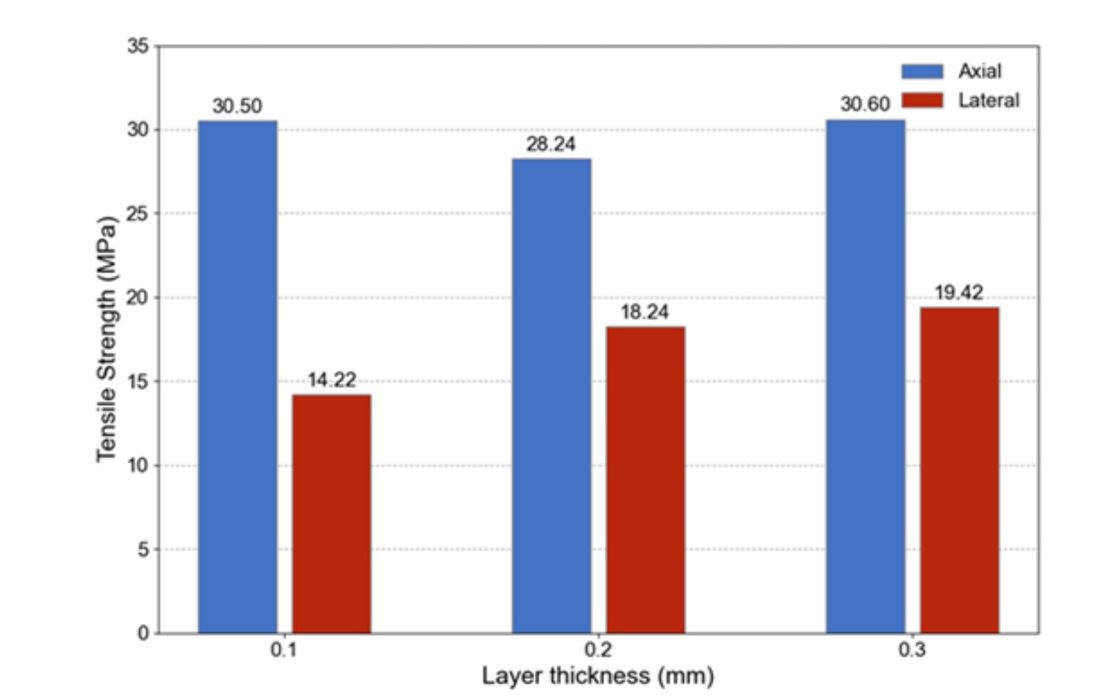
Speed and layer height also control the bonding quality. A tensile benchmark shown in the paper shows ABS achieving about 26 MPa at a slower 30 mm/s with 0.25 mm layers, and studies find that reducing layer height can raise tensile stress by ten to seventy percent, but at the cost of added job time. Orientation effects are also important: poor orientation can knock off tensile strength by forty to fifty percent compared to optimal orientations.
Moisture content is a very important reliability control, especially for hygroscopic filaments such as PA, PVA, TPU and high temperature polymers like PEI and PEEK. The review said that industry guidance around very low residual moisture — usually 0.02% for PEEK and below about 0.04% for common FFF thermoplastics — can avoid foamy extrusion, voids and weak interlayer bonds. Methods to mitigation moisture include sealed storage with desiccant, active dry boxes, enclosed feed paths and heated chambers to stabilize humidity and reduce warpage.
Monitoring, Materials And Thermal Windows
The researchers linked thermal history to degradation: repeated reheating of polymers in air increases molecular degradation in PLA and ABS, shifting the glass transition temperature. They recommend defining a safe processing window by combining DSC and TGA data with residence time control and sensible nozzle and bed temperatures.
The review also examined nanomaterial modifiers that promise stiffness and wear gains, along with use of machine learning for anomaly detection using thermal, vision and acoustic data. It also covered “4D” polymers, vitrimers for repair and recycling, and photopolymer advances in volumetric AM and continuous additive lithography.
Comparisons are challenging because datasets, geometries and atmospheres differ in all scenarios. Throughput, cost impacts and standardized quality control methods are not really specified in the paper, so we should treat the findings more as directionally instead of machine and material specific.
This all leads to some basic recommendations: integrate drying and enclosed filament as a standard approach, choose parameters that minimize porosity and orientation errors, and use basic sensing to catch defects before they happen. Service bureaus, labs and industrial users with strength-critical parts could benefit the most from this advice, but even education or hobby applications can improve outputs with better control of humidity.
If there is a single takeaway from this survey, it is that reliability in FFF depends much less on speed and materials, and a lot more on controlling pores, heat and water. Maybe we should all upgrades with a dry box and an enclosed build chamber.
