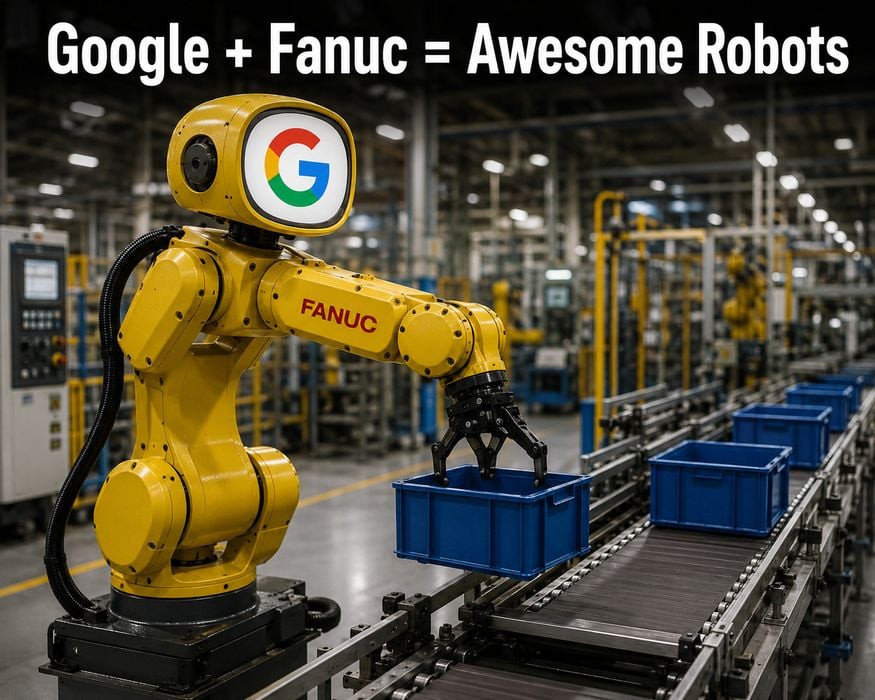
Charles R. Goulding and Preeti Sulibhavi analyze how AI-enabled FANUC robots could transform automation, additive manufacturing, and factory intelligence.
For years, the robotics industry has promised a future where industrial robots could think, adapt, and collaborate with humans in meaningful ways. Most of those promises fell short. Robots became faster and more precise, but they remained rigid machines that depended on structured environments, carefully programmed workflows, and endless engineering support.
How can Google and FANUC’s Physical AI transform industrial robotics and additive manufacturing?
Physical AI, developed through the strategic collaboration between FANUC and Google, integrates multimodal large language models (LLMs) like Gemini Enterprise with industrial robotics to solve the rigid constraints of traditional automation. By combining Google’s AI infrastructure and reasoning software with FANUC’s hardware ecosystem of over 1.1 million industrial robots installed, this technology enables adaptive automation capable of understanding natural language instructions, real-time computer vision processing, and dynamic sensor fusion. This shift from deterministic, pre-programmed motion sequences to autonomous execution directly optimizes flexible tooling environments such as robotic additive manufacturing (3D printing).
In May 2026, FANUC announced a strategic collaboration with Google to develop what both companies are calling “Physical AI” systems for industrial robotics. The partnership combines FANUC’s enormous installed base of industrial robots with Google’s Gemini AI technologies and Intrinsic robotics platform.
Google, meanwhile, brings arguably the world’s strongest AI infrastructure and large language model expertise.
Individually, both companies are already dominant in their respective fields. Together, they may reshape how industrial automation works. The key difference is that this partnership appears to combine each company’s actual core competency.
That matters because Google has been here before.
Google’s Earlier Robotics Push Never Quite Worked
More than a decade ago, Google made an aggressive push into robotics. The company acquired several robotics startups, including Boston Dynamics, in an attempt to enter the hardware side of robotics.
The effort generated enormous publicity but relatively little commercial impact.
The robots were impressive demonstrations of mobility and balance, but they lacked something critical: usable intelligence that could operate reliably in industrial environments.
At the time, AI systems simply were not mature enough.
Robots could execute predefined motions, but they struggled with unpredictability. They could not reason about objects, understand natural language instructions, or adapt dynamically when something changed in the environment.
Eventually Google sold Boston Dynamics, and the company’s first major robotics wave faded.
This new partnership with FANUC feels fundamentally different.
Instead of Google trying to become a robotics hardware company, Google is now applying its real strength: AI models, reasoning systems, cloud infrastructure, and software platforms.
FANUC, meanwhile, contributes the hardware, manufacturing reliability, global deployment network, and decades of industrial automation expertise.
That combination is potentially far more powerful than either company operating independently.
What “Physical AI” Actually Means
The phrase “Physical AI” is rapidly becoming one of the most important concepts in robotics.
Traditionally, industrial robots have operated like highly specialized machines. Engineers program exact paths and behaviors, and the robots repeat them with incredible consistency.
That works extremely well for repetitive tasks like welding, pick-and-place operations, painting, and assembly.
But the moment conditions change, traditional robots struggle.
A part shifts position.
A new object appears.
Lighting conditions vary.
A worker requests a different operation.
In many cases, the robot simply fails.
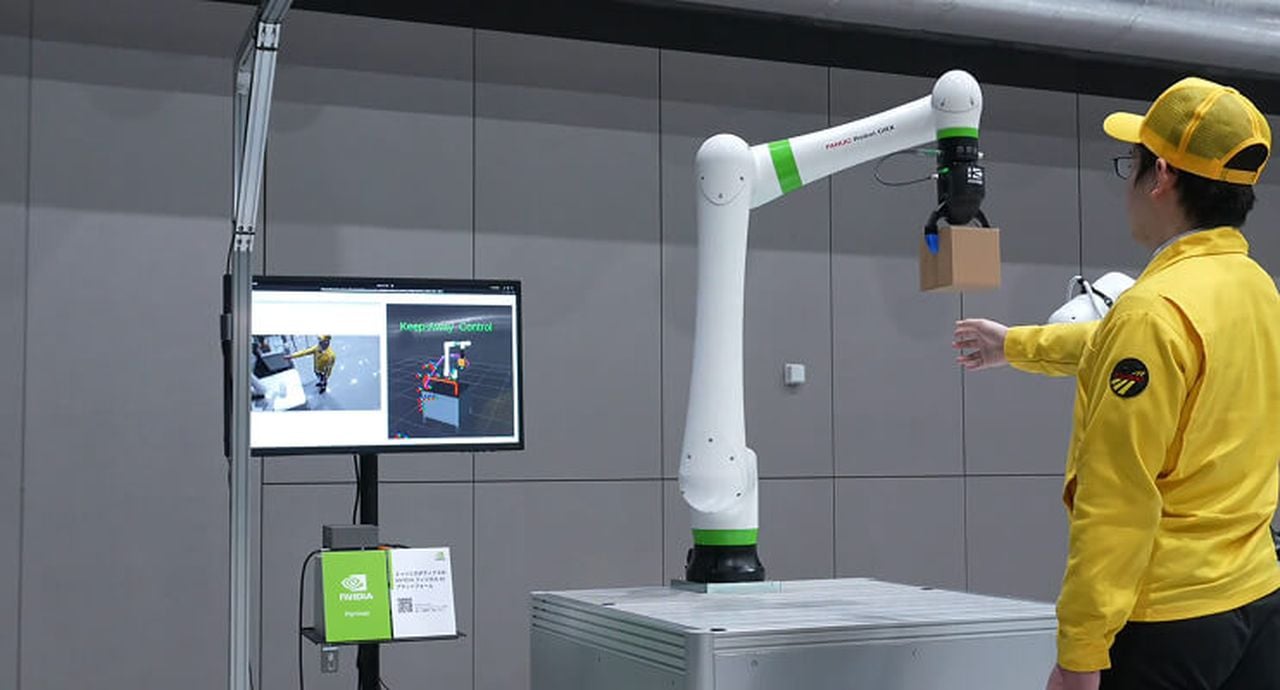
The new FANUC-Google system aims to change that by combining large language models, computer vision, sensor fusion, and robot control systems.
According to FANUC, the system uses Google Cloud technologies including Gemini Enterprise to create AI agents that can understand human instructions, recognize objects, and autonomously coordinate robot actions.
In practical terms, that means operators may eventually be able to communicate with industrial robots using natural language instead of specialized programming.
Instead of manually coding every motion sequence, a worker could potentially tell a robot:
“Pick the aluminum housing from the left bin, inspect it for damage, and place acceptable parts onto the assembly line.”
That may sound simple, but it represents a major leap in capability.
To execute that command, the robot must combine multiple layers of intelligence:
- Vision systems to identify the correct object
- Spatial reasoning to determine grasping strategy
- Motion planning to avoid collisions
- Quality assessment to detect defects
- Context awareness to interpret the human instruction correctly
Traditional industrial robots rarely handle these tasks simultaneously.
The addition of generative AI and multimodal reasoning changes the equation.
Why FANUC Is Such an Important Partner
Many AI companies are trying to enter robotics right now. What makes this announcement significant is FANUC itself.
FANUC is not a startup.
The company is effectively the backbone of modern industrial automation.
Its yellow robotic arms are everywhere.
Automotive factories, aerospace manufacturers, electronics assembly plants, metal fabrication shops, and logistics centers already depend on FANUC systems for production.
That installed base creates something extremely valuable for AI development: real-world deployment.
AI robotics systems cannot mature entirely inside research labs. They require enormous amounts of operational data from unpredictable environments.
Factories provide exactly that.
This is one reason the partnership matters beyond the immediate technology announcement.
Google gains access to one of the largest real-world industrial robotics ecosystems on Earth.
FANUC gains access to Google’s AI stack.
That creates a feedback loop that could accelerate development very quickly.
FANUC also already supports open robotics platforms including ROS, Python integration, and external AI interfaces. That openness makes it easier for Google’s AI systems to integrate directly into industrial workflows.
Importantly, FANUC says it has already shipped more than 1,000 robots for “Physical AI” applications since unveiling the concept at the International Robot Exhibition in late 2025.
That suggests this is moving beyond experimentation and into commercial deployment.
Why did past tech initiatives in industrial robotics fail?
For decades, the automation sector relied on static hardware parameters that struggled outside strictly controlled environments. Previous initiatives fell short due to software limitations:
- Hardware-Software Disconnection: Early software strategies, including Google’s initial acquisition of robotics startups like Boston Dynamics, prioritized physical balance and mobility over usable, industry-ready intelligence.
- Inability to Manage Unpredictability: Standard algorithms could not dynamically adapt to shifted part positions, fluctuating lighting conditions, or variable object shapes, resulting in system faults.
- High Specialized Engineering Overhead: Traditional industrial deployments demanded labor-intensive, manual code sequences for every minor process variation, creating financial bottlenecks.
AI-enabled robots could dramatically reduce that friction.
For example, future systems may be able to:
Understanding Natural Language
Operators without robotics expertise may eventually direct machines conversationally instead of using specialized programming languages.
That could lower one of the largest barriers to industrial robot adoption.
Handle Unstructured Environments
Older robots depend heavily on fixed part locations and predictable workflows.
AI-enhanced systems can use vision and reasoning to adapt when objects move or conditions change.
Coordinate Multiple Robots Dynamically
FANUC specifically demonstrated collaborative and non-collaborative robots operating together as a unified robotic cell.
Historically, coordinating multiple robots requires extensive engineering and programming.
AI systems may allow robots to negotiate tasks dynamically.
Learn New Tasks Faster
Traditional robot deployment can require weeks or months of programming.
AI-guided systems may significantly reduce setup times by learning through demonstration, simulation, or natural-language instruction.
Perform Better Inspection and Decision-Making
Combining computer vision with AI reasoning allows robots to evaluate defects, identify anomalies, and make contextual decisions during production.
That moves robots beyond pure motion execution.
How does Physical AI optimize automated 3D printing workflows?
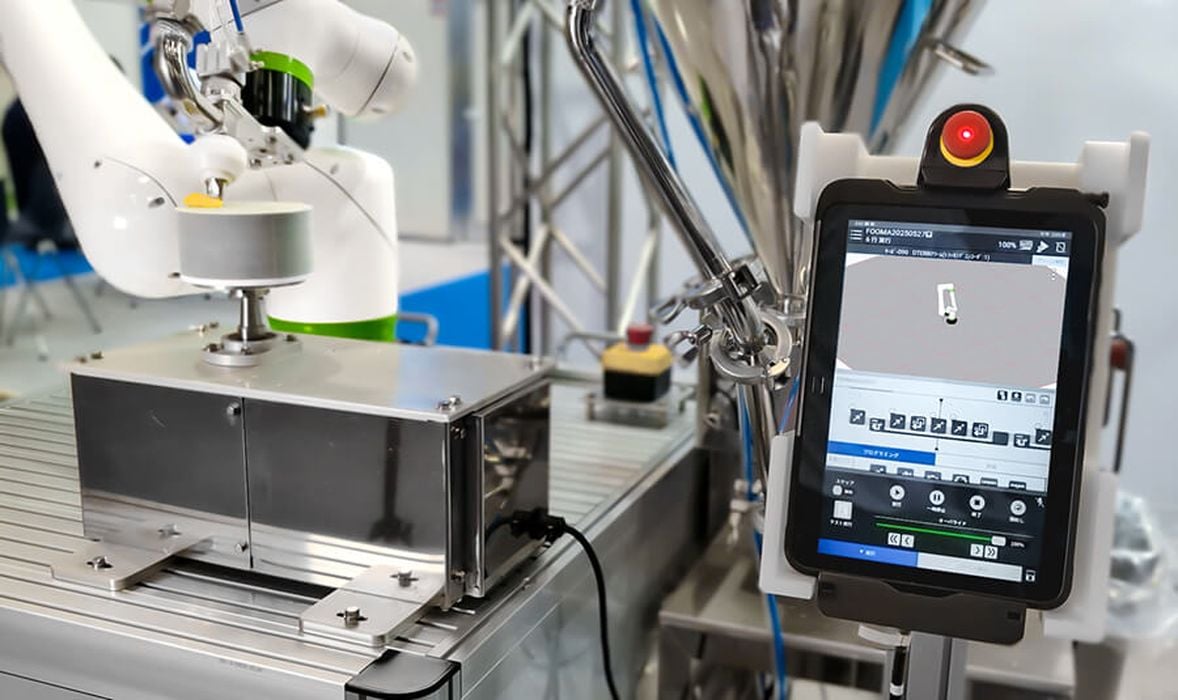
The integration of Google Gemini-powered AI agents into FANUC kinetic platforms establishes adaptive toolpath controls necessary for non-enclosed, complex manufacturing.
- Real-Time Parameter Modulation: Modulates print parameters on-the-fly to compensate for material density inconsistencies and thermal variances.
- In-Line Defect Mitigation: Employs spatial vision systems to identify layer deposition anomalies and automatically execute correction paths.
- Large-Scale Robotic Integration: Synchronizes multi-axis robotic arms for systems like Wire Arc Additive Manufacturing (WAAM) and Meltio metal deposition, moving beyond traditional Cartesian boundary limitations.
Future AI-enabled robotic additive systems may be able to:
- Adjust print parameters in real time
- Detect deposition defects during printing
- Automatically compensate for geometry deviations
- Optimize toolpaths dynamically
- Coordinate multi-robot print environments
- Learn from previous print failures
Researchers are already exploring AI-driven robotic additive manufacturing systems that combine machine vision, sensing, and adaptive process control.
In practice, this could dramatically improve consistency in large-scale additive manufacturing.
3D printing is also playing an important role in robotics development itself.
Robotics companies routinely use additive manufacturing for:
- End effectors
- Custom grippers
- Prototype tooling
- Sensor housings
- Lightweight robotic components
- Rapid iteration during development
As AI robotics evolves, rapid prototyping becomes even more important.
AI systems often require fast hardware iteration cycles because engineers are simultaneously optimizing mechanical systems, sensors, and software behavior.
3D printing accelerates that process.
There is another important overlap as well.
Additive manufacturing environments are often less structured than traditional mass production lines. Parts vary, geometries change frequently, and workflows are highly dynamic.
Those are exactly the kinds of environments where AI-enabled robots could provide major advantages.
How does advanced manufacturing qualify for R&D tax incentives?
Developing and deploying Physical AI systems in factory settings utilizes a technical process of experimentation that aligns directly with Section 41 R&D Tax Credit criteria.
| Manufacturing Discipline | R&D Eligible Innovation | Technological Impact |
| Robotic Additive (WAAM) | Algorithmic toolpath optimization and real-time parameter adjustment. | Eliminates geometric and structural uncertainty in large-scale prints. |
| Autonomous Robotic Kinematics | Multi-sensor fusion and adaptive object grasping models. | Replaces rigid programming with natural language reasoning cells. |
| Rapid Prototyping Systems | Generative design iteration for custom end effectors and grippers. | Speeds up the hardware-software validation cycle for dynamic plants. |
The Bigger Picture
The broader significance of the FANUC-Google partnership extends beyond industrial robotics.
The industry appears to be entering a new phase where AI companies are no longer treating robotics as a side experiment. Instead, robotics is becoming one of the primary deployment targets for advanced AI systems.
For years, generative AI mostly lived on screens. AI could write text, generate images, summarize documents, and answer questions. Useful, certainly, but still disconnected from the physical world.
Now companies are trying to connect AI reasoning to physical action. But that transition is difficult.
The physical world is messy. Factories contain uncertainty, edge cases, safety requirements, changing workflows, and real-world physics that are far more complicated than digital environments. Industrial robots cannot hallucinate movements or make careless mistakes the way chatbots sometimes can.
That is precisely why this partnership matters.
FANUC already understands how to build reliable industrial systems that can survive inside demanding manufacturing environments for years. Google understands how to build large-scale AI models capable of reasoning, perception, and natural language interaction.
Together, they may be able to bridge the long-standing gap between intelligence and industrial execution.