
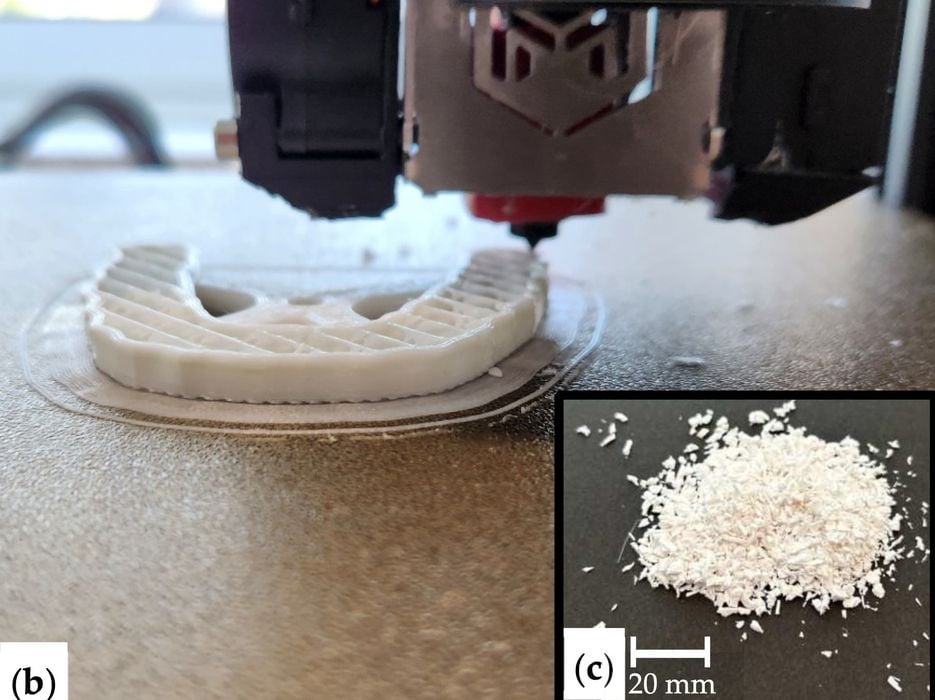
A new paper proposes that pellet-based Fused Granular Fabrication using recycled polymers, which could make dental and orthodontic models cheaper and greener.
Most labs that print dental arches today rely on photopolymer resins via SLA or DLP processes. They deliver excellent detail and smooth surfaces, which matter when you thermoform clear aligners or vacuum-form retainers over the model. The trade-offs are higher material cost, sticky post-processing with solvents, and waste streams that are a pain to manage.
Enter Fused Granular Fabrication (FGF), a variant of FFF that feeds polymer pellets directly through a screw extruder. The approach skips filament entirely, enabling the use of commodity or recycled pellets and typically pushing much higher flow rates. Pellets can be as much as 10X less expensive than filament, and certainly less costly then resin. Researchers examined whether their method could produce functional dental and orthodontic models from recycled polymers, while improving cost, throughput, and sustainability.
Pellet Extrusion Meets Dental Accuracy
Mechanically, FGF is pretty straightforward: a heated screw extruder digests pellets and pushes melt through a nozzle. Compared to filament FFF, it can run larger nozzles and higher deposition rates, but fine features and surface finish are harder to achieve: coarse surfaces are the usual result. For dental models, that is the problem. Arches include thin embrasures and sharp detail, and any layer lines can disrupt that detail.
The paper reports experiments using recycled polymers in the FGF process to print dental and orthodontic models, then evaluates them for factors that labs actually care about: dimensional fidelity, surface quality, print time, and material economics. While the researchers highlight sustainability benefits from pelletized recycled feedstocks, they also acknowledge the usual FGF issues — pellet drying, thermal shrink, and batch-to-batch variability in recycled blends. Specific printer models and exhaustive tolerance numbers are not the point here; this is a feasibility study rather than a replacement for today’s solutions.
Why This Could Matter For Dental Labs
The appeal is pretty clear: pellets are dramatically cheaper than resin, and they avoid toxic isopropyl alcohol washing and UV post-cure cycles. If FGF can consistently achieve the required dental tolerances, a medium-format pellet machine could crank out arches at low cost and high throughput. Then, material choice also opens up. Recycled PLA, PETG, or PP blends could be dialed in for stiffness or heat deflection to survive thermoforming without deforming the master model.
But there is still one big issue: finish. Aligners require very smooth and accurate surfaces. Layer lines would propagate through thin thermoformed sheets, which means FGF parts would likely need an extra smoothing step — media tumbling, sanding, or a quick coating — all of which adds processing time. Smaller nozzles and thinner layers could help, but they also slow FGF printing. Accuracy is the other challenge. Resin workflows routinely deliver sub-100 micron repeatability across arches; pellet systems will need tight calibration, stable temperatures, and dry pellets to keep up.
But the economics and environmental angle are hard to ignore. Eliminating resin waste and solvent handling simplifies compliance and may reduce total cost per model. For high-volume orthodontic houses outputting hundreds of arches daily, a hybrid approach might be plausible: keep SLA/DLP for intricate cases and move bulk models to an FGF cell tuned for dental geometry.
This is a very interesting move toward sustainability for an application that prints a lot and throws away a lot.
Via Bioengineering
