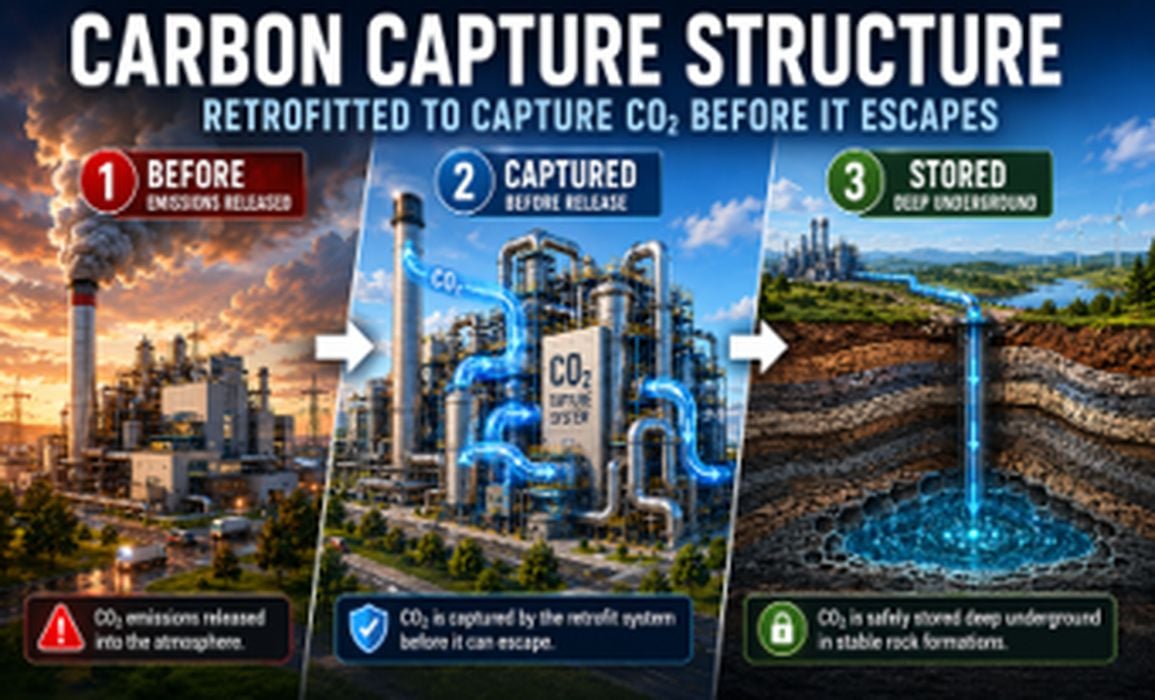
Charles G. Goulding investigates how industrial data center developers deploy modular carbon-capture technology beside gas turbines to overcome environmental permitting roadblocks and secure federal tax incentives.
Carbon capture entered public debate with enormous ambitions. The technology was expected to help reduce atmospheric carbon dioxide on a global scale. The physical requirements proved difficult. Large facilities consumed significant amounts of energy, water, and capital. Deployment moved more slowly than many early advocates expected.
A different use case emerged alongside the growth of AI infrastructure. A 500 MW campus powered partly by on-site gas generation may include a carbon-capture module positioned beside the turbine. Exhaust enters one side. Captured carbon dioxide exits another. The equipment occupies a relatively small portion of the site, yet it influences permitting, emissions compliance, expansion planning, and project economics.
The module provides a useful way to understand where carbon capture stands today. The technology remains complex. The engineering challenges remain substantial. The discussion increasingly revolves around specific sites and specific operational problems.
The Carbon-Capture Module
From a distance, a carbon-capture facility often resembles a chemical plant. Tanks occupy large areas. Pipes run in every direction. Compressors hum continuously. The systems were designed for industrial sites where space was available and size was accepted as part of the job.
Newer modules, now appearing alongside AI infrastructure, pursue a different goal. Next to the turbine sits a rectangular capture unit. The objective is to lower emissions at the site, all while occupying as little of the site as possible.
That physical footprint shapes many decisions that follow. Equipment that occupies too much space can eliminate otherwise attractive locations. Equipment that fits inside existing industrial layouts creates more options. Carbon capture modules therefore influence site selection long before anyone starts measuring capture rates.
The Permitting Problem
Many AI infrastructure and data center projects fail quietly. They are never rejected after construction. In fact they never reach construction at all. The project looks promising until it encounters a permitting obstacle that cannot be solved economically.
Technologies often succeed because they help something else get built. Water-treatment equipment made industrial sites easier to approve. Pollution-control systems expanded the range of viable projects. Carbon capture increasingly occupies similar territory. Many developers are not searching for carbon capture. They are searching for a way to build a facility that would otherwise face greater resistance.
To that end, carbon capture has become useful in part because it addresses permitting obstacles. A developer may have access to land, power, and customers; nevertheless, local emissions requirements can still stop the project from moving forward. The module beside the turbine changes that calculation because it changes the emissions profile of the site itself.
The result is a larger inventory of buildable sites. A parcel that appears difficult under one emissions scenario may become viable under another. More sites enter consideration. More expansion paths remain open. More projects move from concept to construction.
Replicating Fifty Modules
A row of completed carbon-capture modules waiting for shipment looks very different from a prototype sitting inside a laboratory. The prototype requires intensive engineering. By contrast, the row of completed modules needs manufacturing capacity. Materials must arrive on schedule. Components must fit together consistently. Installation crews must encounter the same equipment every time they arrive at a site.
By way of historical precedent, shipping containers changed global logistics through repetition. All ports ended up handling the same dimensions. Same with trucks and railroads. Standardization allowed the surrounding system to become faster and simpler.
Carbon-capture developers pursue similar advantages. A module that can be deployed repeatedly creates fewer surprises than a module that must be redesigned for every project. Engineering effort shifts toward improving the design itself rather than reinventing it.
Oak Ridge National Laboratory demonstrated one version of that approach through a 3D printed device that combined carbon-capture and thermal-management functions within a single structure. The design removed interfaces, reduced complexity, and compressed more functionality into less hardware. Every eliminated component removes assembly work, maintenance requirements, and potential failure points. Those savings become more noticeable when one module becomes fifty.
Inside the Module: Heat Exchangers
Heat occupies far more of a carbon-capture engineer’s attention than most people realize. Thermal management consumes a remarkable amount of the equipment surrounding the capture process. Much of what appears inside a carbon-capture module exists because temperatures must be controlled before the chemistry can work efficiently.
Heat exchangers perform that work quietly. Fluids enter at one temperature and leave at another. The equipment itself often looks unimpressive from the outside. The engineering effort is hidden within the internal passages, channels, and surfaces where thermal energy moves from one place to another.
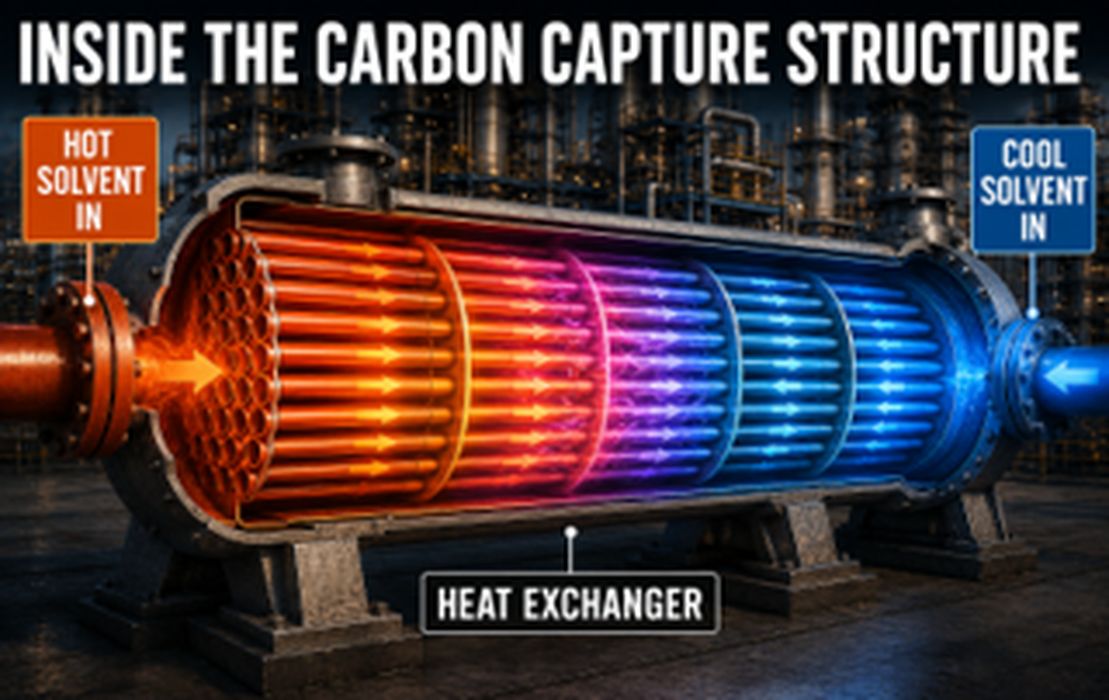
Those internal geometries have become a natural target for additive manufacturing. Engineers want more surface area without dramatically increasing footprint. They want heat moving efficiently through the system while avoiding unnecessary pressure losses. Traditional manufacturing imposes limits on how those internal structures can be shaped. Industrial 3D printing expands those options.
To shrink the physical footprint of carbon-capture hardware, engineers utilize industrial 3D printing to redesign critical components from the ground up:
- Intricate Heat Exchanger Geometries: Additive manufacturing allows leaders like EOS and Velo3D to print complex internal fluid channels, maximizing surface area for solvent cooling while preventing critical pressure drops.
- Monolithic Component Consolidation: As demonstrated by Oak Ridge National Laboratory, 3D printing combines carbon-capture and thermal-management functions into a single structure, eliminating mechanical interfaces and potential failure points.
- Scalable Replicability: Transitioning from bespoke laboratory prototypes to repetitive industrial manufacturing ensures that rows of identical modules can be rapidly deployed across high-volume infrastructure projects.
EOS has highlighted additive manufacturing for heat exchangers where compactness and thermal performance drive design decisions. Velo3D has pursued similar opportunities involving complex metal components and internal flow paths. In both cases, the attraction is the ability to design a different one.
A small improvement inside one component can reduce energy consumption across the surrounding system. A more compact design can reduce the footprint of the module around it. Carbon capture often advances through these kinds of incremental gains. The individual changes appear modest, but their effects accumulate across the facility.
Shrinking the Module
Many carbon-capture facilities resemble compact industrial districts. Towers rise above pipe racks. Tanks occupy large footprints. Compressors, pumps, and supporting equipment spread across large areas. The huge scale reflects decades of engineering focused primarily on performance.
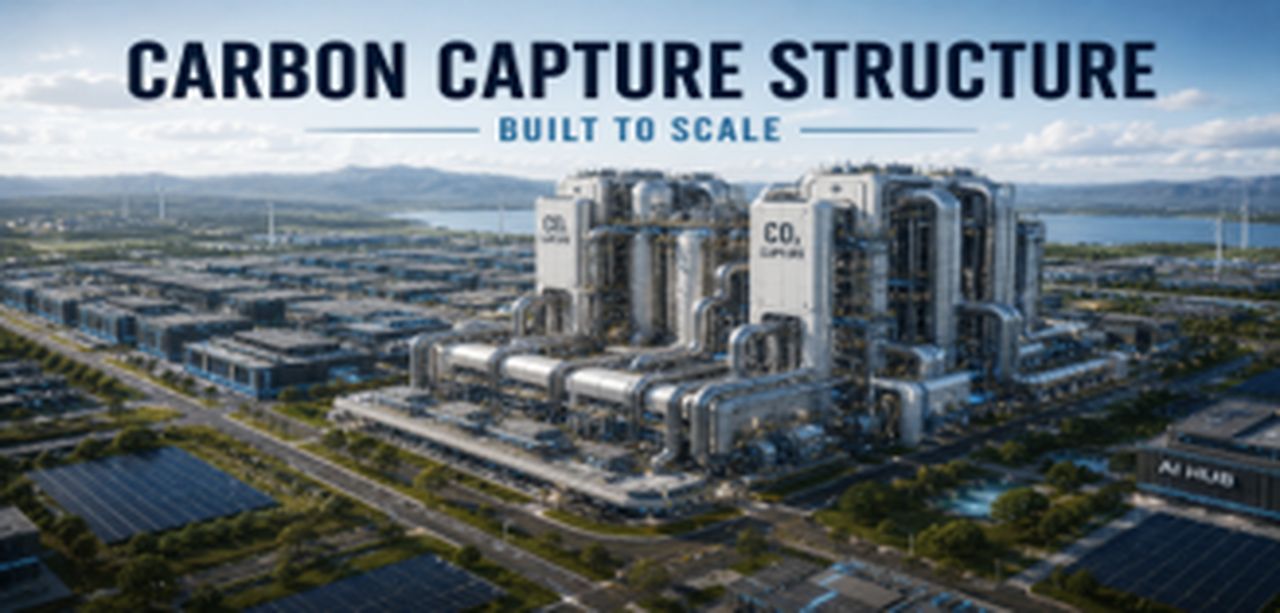
Smaller systems will create different possibilities. Equipment that arrives largely assembled requires less site work. Likewise, equipment that occupies less space fits more locations. Equipment that integrates more functions into fewer structures reduces the amount of supporting hardware surrounding it.
Carbon Clean built much of its recent strategy around that objective. CEO Aniruddha Sharma described the effort succinctly: “We needed to rethink carbon capture from the ground up.” CycloneCC reflects a broader effort to compress more capability into less physical space while maintaining commercial performance.
The easiest path to a smaller facility is often removing equipment rather than shrinking it. A structure that performs several jobs at once can eliminate piping, reduce assembly requirements, and simplify maintenance. Additive manufacturing attracts attention because it supports exactly that kind of consolidation.
Carbon as Feedstock
Waste streams often become supply chains.
Captured carbon dioxide is usually discussed in terms of storage; gas is separated, compressed, transported, and ultimately placed underground. That pathway remains important and will likely account for much of the industry’s growth.
Another pathway begins with the same carbon-capture module sitting beside the turbine. Instead of preparing carbon dioxide for storage, the equipment prepares it for use. Captured carbon can then enter the production of fuels, chemicals, building materials, and other industrial products.
Industrial history contains many examples of similar transitions. Natural gas was once flared because producers had few profitable uses for it. Refinery byproducts evolved into industrial feedstocks. Manufacturing systems regularly discover value in materials that were previously treated as waste.
The module beside the turbine therefore sits at the beginning of two different chains. One leads toward storage, the other leads toward production. Both begin with the same piece of, infrastructure.
Carbon Credits and Site Economics
A developer evaluating a 500 MW AI campus typically begins with a spreadsheet. Construction costs occupy one column. Operating costs occupy another. Power requirements, permitting expenses, financing costs, and projected revenue all compete for space on the page.
Federal carbon-capture incentives survived the One Big Beautiful Bill Act in stronger shape than many other clean-energy incentives. The revised 45Q framework preserved substantial value for qualifying projects. Captured carbon therefore enters the spreadsheet as more than an environmental consideration.
Im fact, a carbon-capture module influences several lines at once. Emissions exposure, tax-credit eligibility and permitting assumptions are all affected. A project that appears marginal under one scenario may look more attractive under another that includes carbon capture. Infrastructure projects rarely turn on a single number. Several smaller changes often push a project across the finish line.
| 500 MW AI Campus | Without Carbon Capture | With Carbon Capture |
| Local gas generation | Yes | Yes |
| Emissions target | Missed | Achieved |
| 45Q eligibility | No | Yes |
| Permitting posture | Exposed | Stronger |
| Site viability | Constrained | Expanded |
| Expansion path | Delayed | More Flexible |
The effects extend beyond economics. Carbon capture can expand the inventory of buildable sites by changing the emissions profile attached to a project. More viable locations create more development options.
How Do Carbon-Capture Engineering Processes Align with the R&D Tax Credit?
Overcoming fluid dynamics, material stress, and thermal management uncertainties across modular capture systems involves systematic experimentation that maps directly to Section 41 eligibility.
| Core R&D Technical Activity | IRS Four-Part Test Alignment | Financial Recovery Impact |
| Monolithic Structural Consolidation | Resolves engineering uncertainty regarding structural integrity, material bonding, and multi-functional performance in 3D printed assemblies. | Captures qualified internal engineering hours spent programming multi-axis laser toolpaths and printing monolithic prototypes. |
| Internal Flow Path Optimization | Conducts a systematic process of experimentation using fluid-dynamics modeling to maximize thermal exchange surface area. | Recovers the labor costs of computational design engineers and the direct expenses of raw metal or polymer powders consumed. |
| System Scalability & Stress Testing | Evaluates technical alternatives to ensure standardized modules operate reliably under high thermal and chemical duress next to a turbine. | Offsets internal labor costs spent executing pre-production testing, durability validation, and field trial simulation. |
Strategic Insight for CFOs: While federal incentives like the Section 45Q tax framework reward ongoing carbon storage and utilization volumes, the Section 41 R&D Tax Credit provides immediate cash flow during the asset design and fabrication phase. Capital expenditures allocated to inventing smaller, more efficient capture hardware like Carbon Clean’s CycloneCC generate immediate, compounding tax savings long before the physical infrastructure begins active operations.
What Comes Next
Many existing facilities still resemble industrial complexes. Towers, tanks, compressors, and supporting infrastructure take up much space. Engineers continue searching for ways to compress more functionality into smaller systems. Future designs will face pressure to reduce both physical footprint as well as water use.
Progress rarely arrives through a single breakthrough. A smaller heat exchanger can reduce footprint. A more efficient component reduces energy use. A redesigned structure eliminates supporting hardware. Individual improvements can accumulate across a facility until the overall system begins to look noticeably different.
Nevertheless, carbon capture appears to have found a lasting home. Such modules do not need to alter the atmosphere as originally hoped. They need to reduce emissions at a specific site, support permitting, improve project economics, and help keep expansion plans on schedule. This narrower mission is sustainable.
Charles G. Goulding is a practicing attorney.