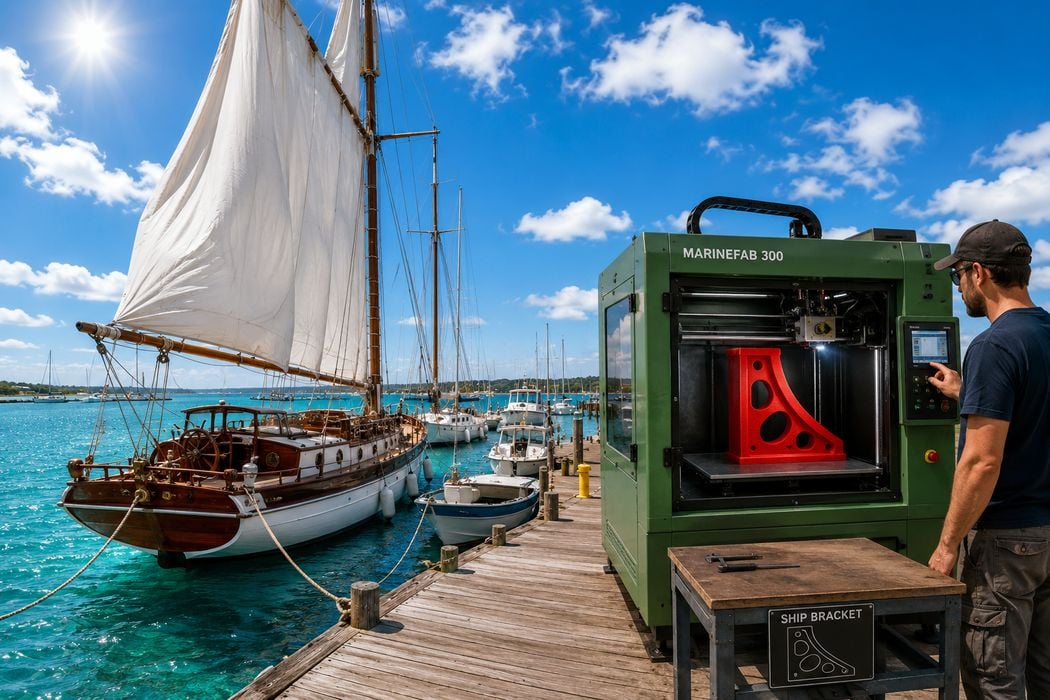
Charles R. Goulding and Preeti Sulibhavi examine how West Marine’s bankruptcy could accelerate the rise of 3D printing micro factories across marinas, repair yards, and coastal boating communities.
The bankruptcy filing of marine retail giant West Marine may end up doing more than reshaping the boating supply business. It could also accelerate the adoption of distributed manufacturing and 3D printing throughout marinas, repair yards, and boatbuilding operations across North America.
West Marine filed for Chapter 11 protection in May 2026, citing mounting debt, lease obligations, and broader financial pressures. The company stated that stores would remain open during restructuring, but analysts already expect closures and a reduced retail footprint.
That matters because West Marine has long been a critical supply node for coastal communities, marinas, charter operators, and independent boat owners. For decades, the retailer functioned as the “last-mile warehouse” for emergency replacement parts, maintenance items, fittings, and marine hardware. West Marine operates approximately 200 stores.
If that network shrinks, a vast gap emerges.
Increasingly, additive manufacturing may be one of the technologies best positioned to fill it.
In fact, we explored this scenario years ago. In a 2020 article examining marina consolidation, rental platforms, and digital manufacturing, we suggested that marinas could evolve into localized production hubs supported by 3D printing technologies. The conditions that made that idea plausible then are even stronger now.
The marine industry faces several structural problems that make conventional supply chains difficult:
- Thousands of unique – part geometries
- Aging vessels with obsolete components
- Corrosion-sensitive environments
- Seasonal repair surges
- Remote coastal locations
- Expensive inventory storage
Traditional retail works poorly under those conditions because many marine components are low-volume parts that sit on shelves for years waiting for occasional demand. Maintaining inventory for every cleat insert, hatch latch, pump bracket, or navigation housing is expensive.
That is precisely the type of manufacturing challenge where additive manufacturing performs well.
Instead of warehousing every component, marinas and repair shops can increasingly manufacture parts on demand.
This does not mean entire boats will suddenly be printed overnight. Although large-scale marine additive manufacturing is advancing rapidly, the more immediate impact will occur in replacement parts, tooling, jigs, molds, and emergency repair components.
Several marine companies already use additive manufacturing extensively. Caracol describes how large-format additive manufacturing is being deployed for hull structures, molds, custom yacht components, and replacement parts. The company specifically highlights how 3D printing can reduce downtime for marine repairs and simplify production logistics.
West Marine owes US$65 million to its unsecured creditors.
Some of West Marine’s creditors also have integrated some level of 3D printing into their operations as well. For instance, Garmin, a creditor owed US$8.57 million international uses 3D printing for rapid prototyping, concept validation, and custom engineering internally. For consumers, Garmin relies on third-party suppliers that often include 3D printed accessories.
Xylem is a Fortune 1000, American water technology company that is striving to change the future of water with technological innovation. Xylem is a major player in sustainability and has worked on developing new techniques for water filtration and disinfection which help to fight water scarcity by allowing new methods for recycling drinking water. We covered Xylem, another creditor owed US$1.41 million, in a previous article titled, “The Water Problem: How 3D Printing Can Help Fight Water Scarcity « Fabbaloo.”
Lippert is a global leader in the manufacturing and supply of highly engineered products and customized solutions that are dedicated to re-shaping and growing the Recreational Vehicle (RV), marine, automotive, commercial vehicle and building components industries. Lippert Components, is a boat component supplier that we also previously covered in our “Lippert, the Boat and RV Replacement Parts Business, and 3D Printing « Fabbaloo” article and it is owed US$3.58 million from West Marine’s bankruptcy.
3D printing will become particularly important if West Marine locations disappear from smaller coastal markets.
Consider a typical marina repair scenario.
A 20-year-old cruiser arrives needing a broken bilge pump mounting bracket. The OEM part no longer exists. Previously, that marina might have searched West Marine’s inventory network, attempted a substitute component, or waited several days for specialty suppliers.
With additive manufacturing, the process changes dramatically.
A technician can:
- Scan the broken component with a handheld 3D scanner
- Rebuild the geometry in CAD
- Print a replacement in a marine-capable polymer
- Install the part within hours
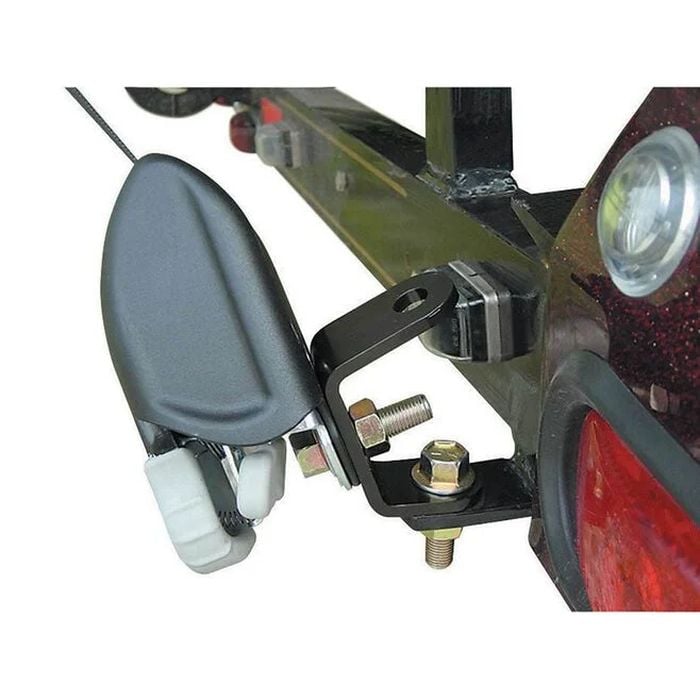
For non-load-bearing components, this workflow is already practical today.
Materials such as ASA, PETG, nylon, carbon-fiber nylon, and polycarbonate are increasingly suitable for marine environments because they resist UV exposure, saltwater corrosion, and temperature cycling far better than earlier consumer-grade materials.
That matters because corrosion itself is one of the biggest challenges in marine maintenance. Traditional metal parts frequently fail due to saltwater exposure. In some applications, polymer replacements can actually outperform the originals.
Boat repair operations are already moving in this direction. Recent reporting on marine additive manufacturing noted that 3D printing is becoming attractive for producing actuator brackets, latches, lighting fixtures, molds, and stainless-steel replacement components. The economics are compelling.
Instead of tying up capital in inventory, marinas could maintain digital inventories.
A marina might store thousands of printable part files rather than physical stock. When a repair request arrives, the part is printed locally.
That model fundamentally changes supply logistics.
It also creates opportunities for regional manufacturing cooperatives. Multiple marinas in a coastal region could share part libraries and printing capacity. A repair designed in Florida could be transmitted instantly to a marina in Maine or California.
This becomes especially valuable for older vessels where OEM support vanished years ago.
There is another important factor here: speed.
During boating season, downtime is extremely expensive. Charter operators, fishing fleets, and rental services lose revenue immediately when vessels remain docked awaiting replacement parts.
West Marine’s reduced footprint could increase those delays.
3D printing reduces dependence on centralized inventory systems by moving production closer to the point of use.
This is one reason this technology increasingly appeals to the maritime sector.
The U.S. Navy has already experimented extensively with additive manufacturing aboard ships and at remote logistics hubs because transporting specialized parts globally is slow and costly. Commercial marine operations face similar constraints, albeit at smaller scale.
Marinas may eventually operate compact “microfactories” equipped with:
- Industrial FDM systems
- Resin printers
- CNC finishing tools
- 3D scanners
- Digital part repositories
Such facilities could fabricate emergency components on-site while also supporting customization work for boat owners.
Customization itself is another major opportunity.
Boat interiors and deck layouts often require highly specific mounting systems, instrument housings, cable guides, cup holders, and storage accessories. Traditionally, these are labor-intensive custom fabrication projects.
Additive manufacturing enables rapid production of low-volume customized parts without tooling costs.
That flexibility aligns well with modern boating trends, particularly rental fleets and modular vessel designs.
The concept may also reshape smaller marina business models.
As marina consolidation continues, independent operators need differentiated services to compete. Offering rapid digital fabrication and same-day replacement parts could become a meaningful competitive advantage.
Some marinas may even evolve into hybrid service centers combining repair operations with localized additive manufacturing.
And importantly, this transition is no longer prohibitively expensive.
A capable engineering-grade FDM printer suitable for many marine repair applications now costs a fraction of what industrial systems required a decade ago. The software ecosystem has matured as well, making reverse engineering and short-run production increasingly accessible to smaller operators.
Of course, there are limitations.
Critical structural components still require certification, testing, and engineering validation. High-load hardware exposed to significant mechanical stress may still require machined metal parts.
But many marine repair needs are not structural.
They are small, exasperating items in need of repair:
- Broken knobs
- Cracked housings
- Missing brackets
- Cable retainers
- Vent covers
- Instrument mounts
- Trim pieces
- Pump adapters
Those are exactly the kinds of components that additive manufacturing excels at producing.
Fresh off the boat…
The collapse or downsizing of major retail supply networks may ultimately accelerate adoption of distributed manufacturing in marine environments faster than the industry previously expected.
For years, 3D printing for boating was viewed as experimental or niche.
West Marine’s bankruptcy may help turn it into a regular repair service.