Charles R. Goulding and Preeti Sulibhavi take a technical look at the emerging world of 3D printed batteries, where advanced manufacturing is enabling entirely new energy architectures beyond the limits of conventional battery production.
For decades, battery innovation has largely been a chemistry story. Researchers have chased higher energy density through new cathode materials, safer electrolytes, and alternative chemistries ranging from sodium-ion to solid-state systems. Yet a quieter revolution is now emerging in manufacturing itself.
A recent Wall Street Journal article by Christopher Mims highlighted the growing interest in 3D printed batteries and noted that researchers published approximately 25,000 papers related to 3D printed batteries and battery components in 2025 alone. That figure reflects an extraordinary level of activity in a field that has moved far beyond laboratory curiosity.
From the perspective of additive manufacturing, the most important development is not merely the ability to print a battery. It is the ability to redesign what a battery can be.
Traditional batteries are manufactured in standardized cylindrical, pouch, or prismatic formats. Designers build products around those constraints. Additive manufacturing flips that relationship. Instead of fitting a product around a battery, the battery can be manufactured to fit the product.
The result could be lighter drones, more efficient aerospace systems, integrated wearable electronics, and eventually entirely new device architectures.
What Are Researchers Actually Studying?
The explosion of academic literature in 2025 was not focused on a single technology. Instead, researchers concentrated on several major additive manufacturing approaches for energy storage.
1. Architected Lithium-Ion Batteries
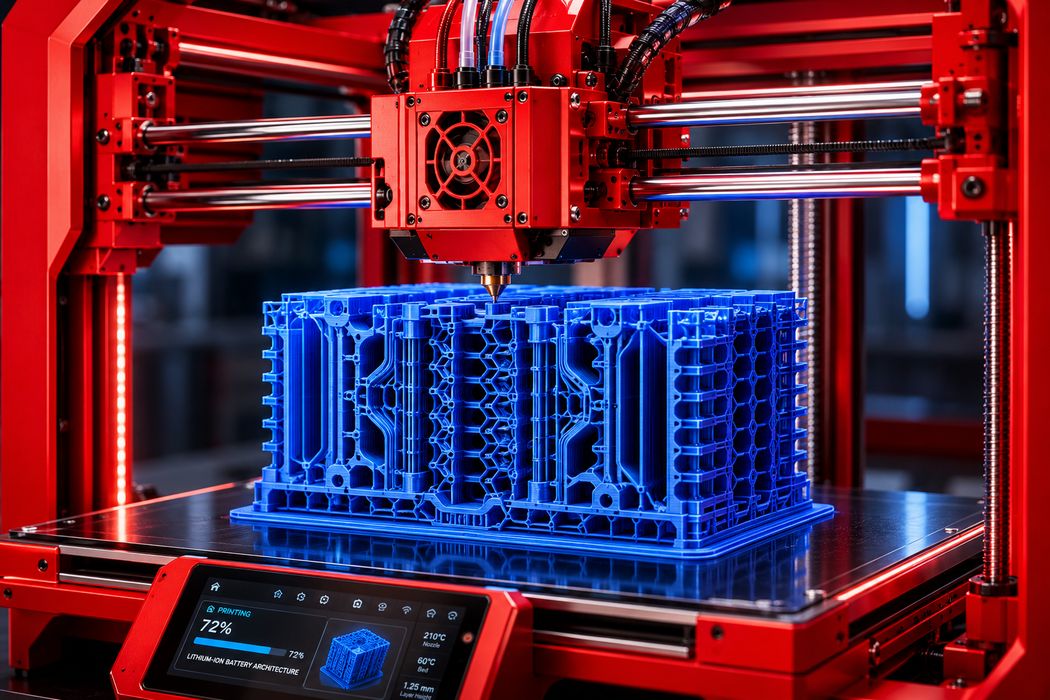
One of the largest research areas involves using additive manufacturing to create complex three-dimensional electrode structures that cannot be produced using conventional roll-to-roll battery manufacturing.
Researchers have shown that carefully designed lattice structures can improve ion transport, increase active surface area, and reduce internal resistance. Rather than treating the battery as a stack of flat layers, additive manufacturing allows engineers to optimize geometry itself as a performance variable.
A 2025 review in the Journal of Power Sources identified high-energy-density lithium batteries as one of the most active areas of 3D printing research, particularly where electrode architecture and interface engineering can be tailored to improve electrochemical performance (Journal of Power Sources, 2025).
2. Printed Solid-State Batteries
Another major focus has been additive manufacturing for all-solid-state batteries.
Solid-state systems eliminate flammable liquid electrolytes and promise improved safety and energy density. However, manufacturing them remains difficult because multiple materials must be deposited with extremely high precision.
Researchers are increasingly exploring additive manufacturing techniques that allow solid electrolytes, electrodes, and supporting structures to be fabricated together. A 2025 review in Materials Science and Engineering: R: Reports concluded that 3D printing offers a promising route for rapid prototyping and fabrication of next-generation all-solid-state battery designs.
For additive manufacturing companies, this is particularly interesting because the same geometric freedom that enables complex aerospace components may also solve long-standing battery manufacturing challenges.
3. Multi-Material and Fully Printed Batteries
Perhaps the most ambitious research area involves printing complete battery systems.
Several research groups are investigating inkjet, extrusion, and hybrid additive processes capable of depositing anodes, cathodes, separators, and electrolytes in a single manufacturing workflow. A 2025 study demonstrated multilayer lithium-ion batteries produced through inkjet drop-on-demand printing, while broader reviews have highlighted growing interest in fully integrated printed energy devices.
This category moves beyond printing battery components. The goal is printing the battery itself.
If successful, battery manufacturing could become much closer to additive electronics production, with energy storage integrated directly into products rather than assembled as separate modules.
Startups Move Beyond the Laboratory
While academia has generated thousands of papers, commercialization has remained limited.
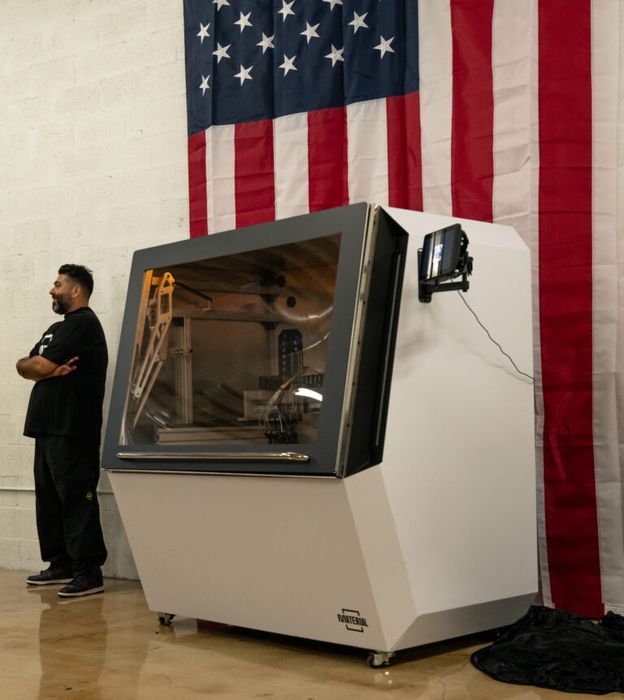
One of the most visible entrants is Miami-based Material Hybrid Manufacturing, Inc. Founded by former Formula One engineer Gabe Elias and scientist Christopher Reyes, the company has developed a manufacturing platform known as HYBRID3D.
Unlike many academic projects that focus on individual battery components, Material aims to manufacture complete conformal batteries. According to the company, its process can print full battery stacks while allowing batteries to adopt shapes dictated by the surrounding product rather than traditional cylindrical or pouch-cell constraints.
Material describes its technology as chemistry-agnostic and claims batteries can occupy up to 90% of a product’s available internal volume. In early 2026, the company announced a US$7.1 million seed financing round and disclosed a US$1.25 million U.S. Air Force contract supporting validation of its technology.
The military interest is understandable. Defense platforms often prioritize performance over manufacturing scale, making them ideal early adopters for emerging battery technologies.
Defense Applications Are Driving Early Adoption
Military systems represent a particularly attractive market for 3D printed batteries because they frequently require customized geometries, lightweight structures, and mission-specific designs.
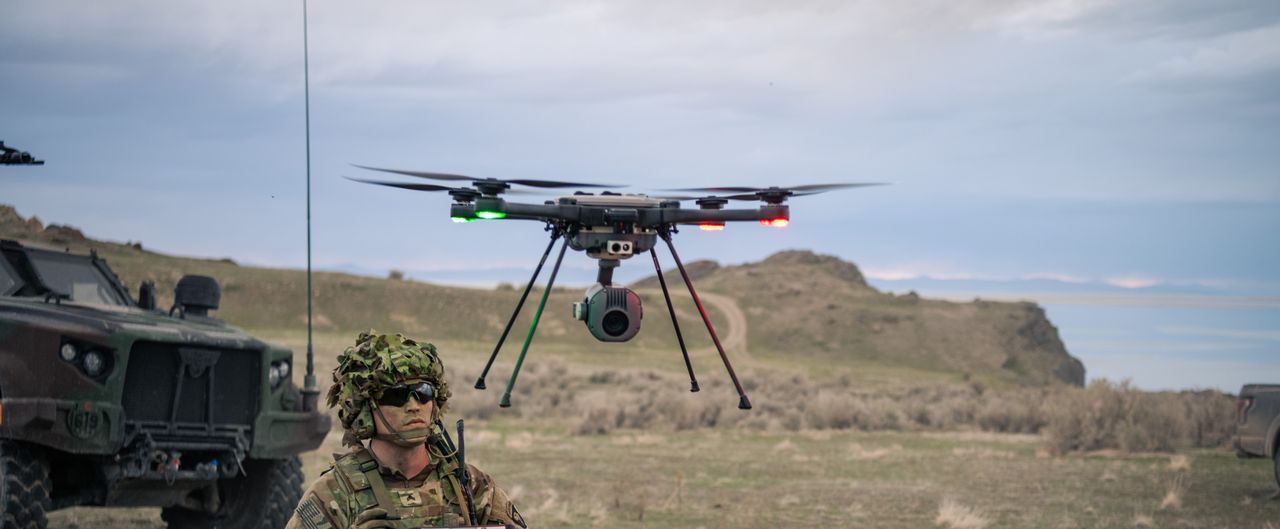
One example involves Teledyne FLIR Defense’s SkyRaider unmanned aerial system family. The SkyRaider platform has become a key military drone platform for chemical, biological, radiological, and nuclear sensing missions. Recent defense contracts have paired the SkyRaider with advanced sensor payloads for autonomous threat detection.
For drone operators, every cubic centimeter matters. Batteries often occupy a substantial percentage of vehicle volume and weight. Conformal battery technologies developed by companies such as Material could eventually enable future drone designs to use previously wasted internal spaces, increasing endurance without increasing platform size.
Although today’s SkyRaider systems still rely on conventional battery technologies, defense applications illustrate precisely why additive manufacturing is attracting attention. Customized energy storage can become a structural design element rather than a packaged component.
The military has historically served as an early validation environment for emerging manufacturing technologies, and battery printing may follow the same path.
Wright Electric’s Aluminum-Air Battery Program
Perhaps the most technically intriguing example comes from New York-based Wright Electric.
The company is best known for electric aviation initiatives, but it has also been developing aluminum-air batteries for military applications.
Unlike rechargeable lithium-ion batteries, aluminum-air batteries generate electricity through the reaction of aluminum with oxygen from the atmosphere. Because oxygen is supplied externally rather than stored within the battery, aluminum-air systems can theoretically achieve much higher energy densities than conventional rechargeable batteries.
The drawback is that they are generally primary batteries rather than rechargeable systems.
For military operations, however, rechargeability is not always the primary requirement. Long endurance and high energy density can be more important.
According to reporting cited by the Wall Street Journal, Wright Electric used additive manufacturing as a key enabling technology during development of its aluminum-air battery systems.
This makes sense from an engineering standpoint. Aluminum-air batteries involve complex fluid pathways, air management structures, and geometries that can be difficult to manufacture conventionally. Additive manufacturing allows rapid iteration of those structures while reducing tooling requirements.
Rather than waiting for molds or specialized manufacturing equipment, engineers can quickly prototype airflow channels, reaction chambers, and supporting structures. That capability significantly shortens development cycles, particularly for low-volume aerospace and defense projects.
The Wright example demonstrates one of the most important realities of battery printing. In many cases, additive manufacturing’s value is not simply printing the electrochemical materials themselves. The greater advantage may be enabling entirely new battery architectures that conventional manufacturing cannot economically produce.
R&D Tax Credits and the 3D printed Battery Opportunity
As 3D printing pushes battery innovation beyond chemistry and into design and manufacturing, it can also open the door to valuable U.S. federal research and development tax credits. Under IRC Section 41(d), the key question is whether a company’s work is aimed at creating or improving a product or production process through a disciplined effort to solve technical uncertainty. In practical terms, that often fits the reality of additive battery development: teams are not simply making aesthetic changes, but working to improve performance, reliability, quality, and manufacturability in ways that conventional fabrication may not allow.
At a high level, the credit generally applies when four things are true. First, the work must be intended to create a new or improved product or process, For example, a conformal battery that better uses internal device space, an architected electrode that improves power delivery, or a printable solid-state design with better safety or cycle life. Second, there must be real uncertainty at the outset: the company may not know which geometry, material formulation, print path, or post-processing method will actually achieve the target electrochemical and mechanical results. Third, the team must work through that uncertainty by evaluating alternatives—using modeling, simulation, prototype builds, and structured testing rather than guesswork or routine production steps. And fourth, the work must rely on engineering, materials science, chemistry, or other hard-science disciplines, which is typically the case in advanced battery printing.
For companies operating in the areas highlighted in this article, that can include a wide range of qualifying activities. Iterative design and testing of architected or conformal battery geometries may qualify when teams are trying to determine how shape and internal structure affect conductivity, thermal management, durability, or energy density. The same is true for developing printable electrode inks, binders, and solid-electrolyte formulations; tuning layer thickness, deposition paths, curing or sintering conditions; and printing and evaluating multiple prototypes to see which combinations deliver the required battery performance and mechanical integrity. In other words, when a battery developer is using additive manufacturing to work through unresolved design or process questions, that effort often aligns closely with the kind of qualified research Section 41 was designed to encourage.
Just as importantly, the rules draw clear boundaries. Activities such as ordinary quality control, routine validation of a known process, troubleshooting after commercial production has begun, adapting an existing battery design for one customer’s specifications, or copying an existing design generally do not qualify. That distinction matters in a field moving from lab success toward scale. A company may be eligible for credits while experimenting with print architectures, materials, and process settings to meet performance targets, but not for the later-stage work of simply implementing a proven setup on the factory floor.
One especially important point for battery innovators is that the battery itself and the underlying 3D printing production process can each be evaluated separately for credit eligibility. That means a company developing a new printed battery platform may have one set of qualifying activities tied to the product—such as cell architecture, materials, and performance—and another tied to the manufacturing process, such as printer configuration, deposition techniques, or post-processing methods, so long as each effort independently involves technical uncertainty and experimentation. For an industry balancing breakthrough design freedom with the hard realities of manufacturability, that makes the R&D credit more than a tax benefit: it can be a meaningful source of support for the experimentation required to move 3D printed batteries from promising prototypes to commercially viable products.
New 3D printing battery start-ups should be excellent candidates for the US$500,000 annual Payroll Start-up R&D Tax Credit cash rebate. Eligible start-ups have the potential for US$2,500,000 in cash rebates over five years.
The Road Ahead
Despite the excitement, fully printed batteries remain an emerging technology.
The gap between publishing 25,000 research papers and producing millions of commercial batteries remains enormous. Challenges involving manufacturing speed, quality control, material consistency, certification, and cost still must be addressed.
Yet the direction is becoming increasingly clear. Research activity is accelerating. Venture-backed startups are entering the market. Defense organizations are funding development programs. And battery design is beginning to move beyond the constraints imposed by traditional manufacturing.
We are not quite ready to 3D print replacement batteries for our TV remotes just yet. But the military may provide exactly the environment needed to mature the technology. Defense programs can help establish quality standards, qualification procedures, and repeatable manufacturing processes that eventually make broader commercial adoption possible.
As has happened with many advanced manufacturing technologies before it, the path to the consumer market may begin on the battlefield.