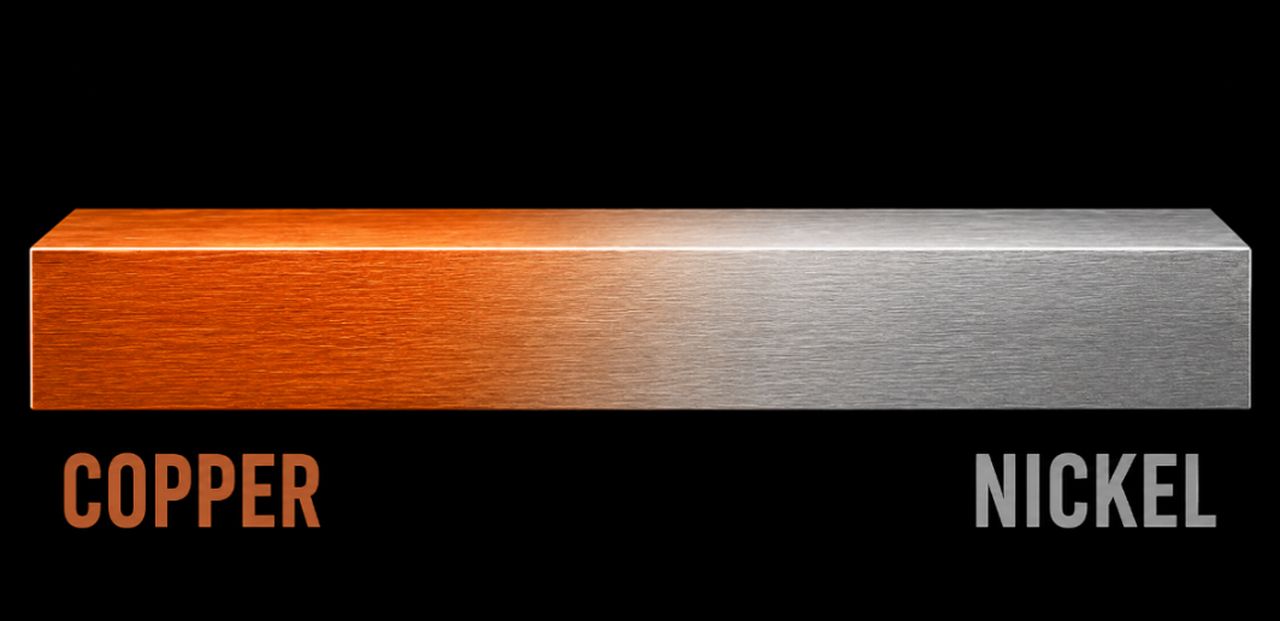
Charles G. Goulding explains how breakthroughs in 3D printing are ending the era of one-alloy parts, allowing engineers to design materials that change composition within a single component for unprecedented performance.
The One Alloy Default
Traditionally, industrial parts have been made from one alloy only. One alloy is easier to manufacture, test, and certify. Aerospace engineers know exactly how a particular alloy behaves because it has been studied for years. Every batch of powder can be tested before printing begins, and every finished part can be compared against well-established specifications. That predictability is one reason modern aircraft and rocket engines are as reliable as they are.
The drawback appears only after engineers begin designing the part. Real components rarely experience the same conditions everywhere. One region may need to move heat as quickly as possible, while another must resist wear, corrosion, or extreme mechanical loads. Manufacturing has traditionally solved that problem by adding welds, coatings, inserts, or separate components after the main part was built. Those solutions work remarkably well, but they all reflect the same underlying limitation: the material itself remains largely unchanged.
NASA Alloy Example
In 2015, a machine at NASA’s Marshall Space Flight Center spent more than ten days printing a copper rocket-engine combustion chamber. Inside, it contained more than 200 tiny cooling channels built directly into its walls. During flight, one side of that wall would face combustion gases hotter than 5,000 degrees Fahrenheit. Just a few millimeters away, however, super-cold fuel would race through those hidden passages, carrying heat away before the chamber could melt. At its thinnest point, the wall separating those two environments was only about as thick as a pencil mark.
Copper made that design possible because it removes heat exceptionally well. It also made the chamber extraordinarily difficult to manufacture. Every time the laser melted a small pool of copper powder, the metal immediately carried heat away, making it difficult to maintain a stable printing process. NASA spent years learning how to print copper reliably before attempting a full-scale chamber. Even then, the finished part solved only one half of the problem. Copper could survive the heat, but it was not the ideal material for containing the enormous pressures generated inside a rocket engine.
NASA’s solution was surprisingly simple: stop asking one metal to do everything. In 2019, NASA and Virgin Orbit tested a combustion chamber built from two different materials. The inner liner was printed from GRCop-84, a copper alloy developed specifically for rocket engines. Around that liner sat an outer jacket made from Inconel 625, a nickel-based superalloy that remains strong under extreme heat and pressure. During nearly two dozen hot-fire tests, the chamber produced more than 2,000 pounds of thrust while each material handled the job it performed best. Copper removed heat. Inconel provided strength.
Building that chamber, however, created another engineering challenge. The copper liner and the Inconel jacket could not simply be pressed together. NASA first printed the copper liner, then deposited the Inconel around it while carefully controlling temperature throughout the process. Engineers paused between layers to prevent excessive heat buildup and varied where each new layer began so small imperfections would not accumulate in one location. Every decision focused on one objective: making two very different metals behave as though they were one continuous part.
Even with those advances, the boundary between the two alloys remained one of the chamber’s most demanding features. During one investigation, cracks developed near the interface as the two materials expanded and contracted at different rates. Engineers were no longer studying only copper or only Inconel. They also had to understand the narrow transition zone where the two materials met, because that region developed its own manufacturing profile.
NASA has continued improving these designs through its Rapid Analysis and Manufacturing Propulsion Technology (RAMPT) program. The program has reduced production times for some nozzles from years to months—or even weeks. Modern manufacturing has become much better at dealing with that boundary, but boundary itself has never disappeared.
Teaching Lasers to Stir
Researchers at the National Institute of Standards and Technology (NIST) believe that these complicated metal boundaries – between, say, copper and Inconel – may not always have to exist. Ho Yeung and his colleagues approached the problem from an unexpected direction. Rather than redesigning the printer or inventing an entirely new alloy, they rewrote the software that controls the laser.
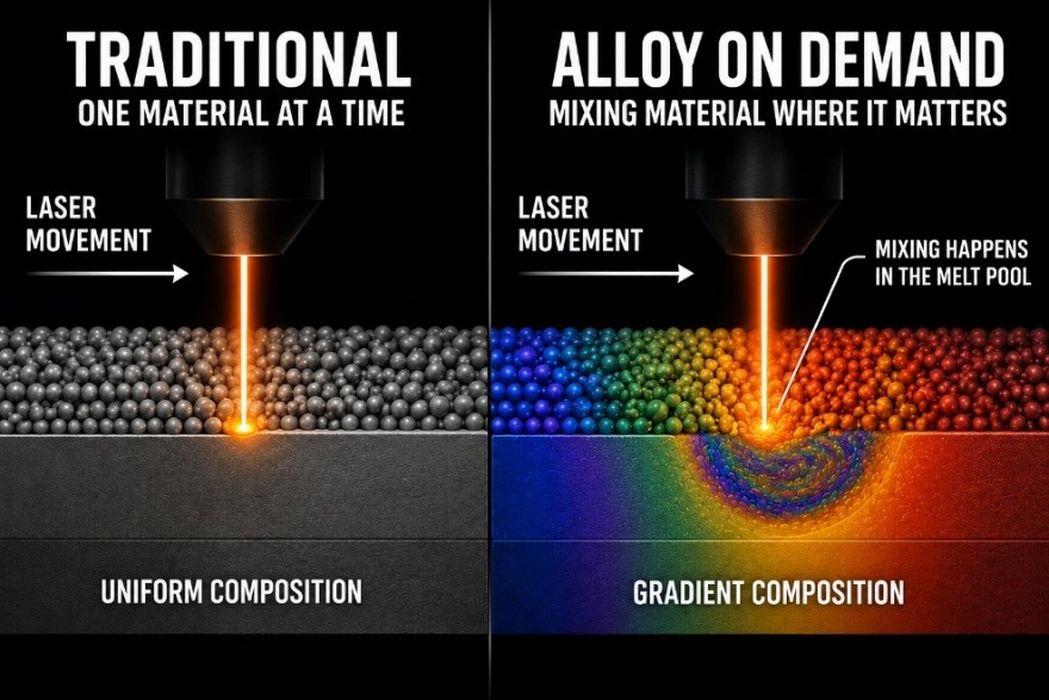
Their goal was ambitious but surprisingly straightforward. Imagine a rocket combustion chamber that no longer has a distinct copper liner joined to an Inconel jacket. Instead, the printer gradually changes the material as it builds the part. The wall closest to the flame remains rich in copper because rapid heat transfer is essential there. As the build moves outward, the composition slowly shifts toward greater strength until the outer wall behaves like a nickel superalloy. Rather than joining two separate materials, the printer creates a smooth transition between them.
How the Design Process Can Change
| Today | Alloy-on-Demand Printing |
| Engineers choose a certified alloy before the build begins. | Engineers define how composition changes throughout the build. |
| Material changes require separate parts, welds, or bonded assemblies. | Material transitions can occur gradually inside one printed component. |
| Software controls geometry. | Software controls geometry and local chemistry. |
| Interfaces become engineering problems. | Gradients become another design variable. |
Making that happen is far more difficult than it sounds. During laser powder-bed fusion, the laser creates a molten pool only slightly larger than the tip of a pencil and only a fraction of a millimeter deep. That pool remains liquid for less than a second before it freezes into solid metal. If engineers hope to change an alloy during printing, every atom has to mix inside that tiny puddle before it solidifies. That brief moment determines whether the finished part develops a smooth material gradient or a collection of microscopic weak spots.
The challenge is that molten metals do not mix as easily as they appear to. Different elements melt at different temperatures, flow at different rates, and cool at different speeds. Some separate before they freeze, leaving tiny regions with different compositions and weaker properties. The problem becomes even more difficult when the materials have dramatically different characteristics, such as titanium alloys and refractory high-entropy alloys. Simply placing two powders beside one another does not guarantee they will become one uniform material.
Yeung’s team suspected the answer might lie in the way the laser moved rather than the materials themselves. Commercial powder-bed systems generally sweep the laser across the powder bed in long, overlapping scan lines. The NIST researchers instead wrote software that guided the beam through a series of tiny looping paths, actively stirring the molten metal before it solidified. The printer itself changed very little. The motion of the laser changed the behavior of the melt pool.
Proof of Concept
To test the idea, the researchers deliberately selected a difficult combination of materials: RHEA-19, a refractory high-entropy alloy containing several principal metallic elements, and a titanium alloy with very different melting and flow characteristics. Using powerful X-rays at Argonne National Laboratory’s Advanced Photon Source, they watched the molten pool solidify in real time. Compared with conventional scan patterns, the looping laser path produced significantly more uniform mixing between the two materials.
Perhaps the most intriguing part of the research is what it did not require. NIST did not build a radically different printer or add complicated mixing hardware above the powder bed. Yeung’s group simply developed software because existing commercial printers could not generate the laser paths they wanted. If similar scan strategies prove practical outside the laboratory, many of today’s metal 3D printers could potentially gain new capabilities through software updates rather than entirely new hardware.
Consequently, NIST’s work points toward an important shift. Until now, software has largely controlled geometry—where material goes and what shape it takes. If alloy-on-demand printing matures, software could begin controlling chemistry as well, directing not only the shape of a part but also how its material evolves from one layer to the next.
Rocket Alloys on Demand
Getting back to the rocket chamber, NIST’s research hints at a different way to design the part. Today, an engineer decides where the copper liner ends and the Inconel jacket begins. That decision becomes part of the drawing, and the manufacturing process is built around it. If alloy-on-demand printing matures, the drawing could become much simpler. The engineer would still specify where heat needs to move quickly and where the chamber must be strongest. Instead of drawing a sharp boundary between two materials, however, the design file could simply tell the printer how the alloy should gradually change as the chamber is built.
The chamber itself would still solve the same engineering problems. Cooling channels would still carry cryogenic fuel past the hottest regions. Copper-rich material would still line the inside because it removes heat so efficiently. As the build moved outward, the composition could gradually shift toward greater strength, oxidation resistance, and long-term durability until the outer wall behaved like a nickel superalloy. The difference is that the transition would become part of the printing process instead of another manufacturing step.
That is why the research matters beyond this one experiment. Historically, engineering software has mainly answered one question: What shape should this part have? Work like NIST’s suggests it may eventually answer a second one: What should this part be made of at each point? Geometry would still matter, but material composition could become another design variable rather than a choice locked in before printing began.
The Research & Development Tax Credit
Enacted in 1981, the now permanent Federal Research and Development (R&D) Tax Credit allows a credit that typically ranges from 4%-7% of eligible spending for new and improved products and processes.
Qualified research must meet the following four criteria:
- Must be technological in nature
- Must be a component of the taxpayer’s business
- Must represent R&D in the experimental sense and generally includes all such costs related to the development or improvement of a product or process
- Must eliminate uncertainty through a process of experimentation that considers one or more alternatives
Eligible costs include U.S. employee wages, cost of supplies consumed in the R&D process, cost of pre-production testing, U.S. contract research expenses, and certain costs associated with developing a patent.
On December 18, 2015, President Obama signed the PATH Act, making the R&D Tax Credit permanent. Since 2016, the R&D credit has been used to offset Alternative Minimum Tax (AMT) for companies with revenue below US$50 million. Also, pre-profitable and pre-revenue startup businesses can also obtain up to US$500,000 per year in payroll tax offsets and cash rebates for up to five years.
Further Applications
Rocket engines are a natural proving ground for programmable alloys because almost every property matters at once. A combustion chamber has to survive extreme temperatures, enormous pressure, violent thermal cycling, and relentless demands to become lighter without becoming weaker. If engineers can gradually change an alloy inside one of the harshest environments ever built, the same approach is likely to find its way into far less demanding products.
Turbines:
Turbine blades illustrate the same principle on an even more demanding scale. Although they appear to be simple metal components, different regions of a blade perform fundamentally different jobs. The root must withstand enormous mechanical loads, the airfoil endures extreme temperatures, and the leading edge faces constant oxidation and erosion.
Today’s manufacturers address those competing demands with sophisticated cooling channels, ceramic coatings, and even single-crystal manufacturing because the underlying alloy remains largely the same throughout the blade. If the NIST approach develops, future blades could gradually transition from one chemistry to another as they are built, placing greater toughness where mechanical loads dominate and greater heat or oxidation resistance where temperatures are highest. The hottest portions of the airfoil could slowly transition toward compositions that favor oxidation resistance without introducing abrupt material boundaries or additional manufacturing operations.
Injection Molds:
Injection molds present a different opportunity because the competing requirements are separated by only a few millimeters. The cavity surface must resist wear through hundreds of thousands or even millions of molding cycles, while the cooling channels just beneath that surface determine how quickly each finished part can be removed from the mold. Manufacturers currently solve that problem with premium tool steels, coatings, inserts, and careful thermal design.
A graded material offers another option. The mold surface could gradually become harder where abrasion is greatest while the surrounding metal shifted toward greater thermal conductivity, removing heat more quickly without sacrificing durability where it matters most.
Heat exchangers:
Heat exchangers reveal the same pattern from another direction. Additive manufacturing has already transformed their geometry, allowing engineers to print intricate flow passages that conventional machining cannot produce. The surrounding metal, however, generally remains one alloy even though temperatures, pressures, and corrosion conditions can vary dramatically along the path of the working fluid. If chemistry can evolve during printing, those changing operating conditions become another design parameter instead of another compromise.
Repairs:
The implications extend beyond new products. Today’s repair processes usually attempt to restore a worn component to its original condition by depositing material that closely matches the existing alloy. Future repair systems could instead rebuild only the damaged region with a composition chosen specifically for the way that area failed. A worn edge might emerge with greater wear resistance than the original component, while neighboring regions retained the toughness or thermal conductivity needed elsewhere in the part. Repair would become another opportunity to improve a component rather than simply restore it.
| Component | Today’s Solution | With Programmable Alloys |
| Rocket combustion chamber | Copper liner joined to an Inconel structural jacket | Continuous transition from maximum heat transfer to maximum structural strength |
| Turbine blade | One superalloy supported by cooling passages and ceramic coatings | Local chemistry tailored to temperature, stress, and oxidation |
| Injection mold | Premium tool steel with coatings and hardened inserts | Hard cavity surface combined with highly conductive cooling regions |
| Heat exchanger | Single alloy balances competing requirements | Composition changes with local temperature, pressure, and corrosion |
| Industrial repair | Replace worn material with the original alloy | Rebuild damaged regions with compositions optimized for actual failure modes |
Conclusion
The broader significance of alloy-on-demand printing reaches well beyond any one machine or industry. Computer-aided design has transformed geometry into something that can be optimized digitally. Additive manufacturing extended that freedom to internal structures that could never be machined. Research from NIST suggests that material composition itself may eventually join that list.
Engineers are beginning to treat chemistry the same way they already treat geometry—not as something fixed before production begins, but as another variable that can be designed, optimized, and controlled.
Charles G. Goulding is a practicing attorney.