
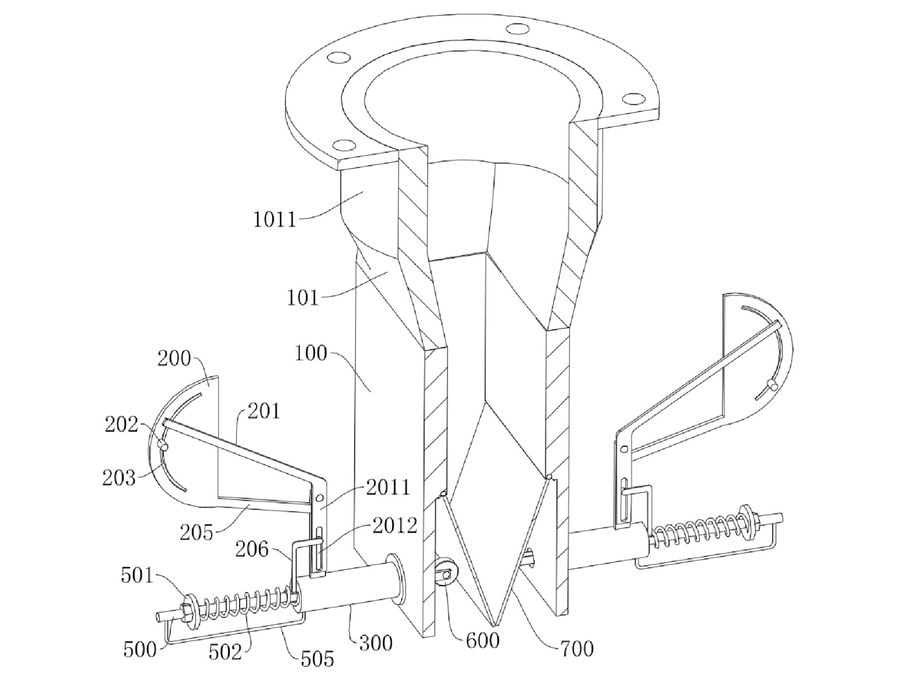
A Chinese patent proposes detecting extrusion failures without sensors, wiring or software.
Patent application CN122401889A, assigned to Nantong Institute of Technology, describes a mechanical shortage and breakage detector built directly into an extrusion printhead. The application was published on July 17, 2026.
In spite of describing the system as “FDM”, the system shown in the patent does not resemble a typical desktop filament hot end. It shows a large rectangular printhead connected by a flange to the outlet of a screw extruder, suggesting an industrial or large format FFF application using already molten thermoplastic. In other words, this is very likely about FGF systems, not FDM systems.
The device does not check whether pellets are present upstream. Instead, it attempts to determine whether molten material is actually flowing through the printhead.
Inside the lower portion of the printhead are two pivoting plates positioned on opposite sides of the material channel. Normal material pressure pushes these plates outward against spring loaded rods.
Each rod connects through a linkage to an external indicator. When material flows normally, the internal plates move and the indicators rotate into a corresponding position. If pressure disappears because of a material shortage or feed interruption, the springs return the plates and indicators to their original positions.
In other words, the material itself powers the detector.
The inventors argue that this approach avoids electronic components that could be affected by heat, dust or harsh operating conditions. There is also no digital signal delay because the mechanical movement responds directly to pressure inside the material path.
The assembly includes rollers between the rods and pivoting plates to reduce friction. The rods have rectangular cross sections to prevent rotation, while removable side panels provide access for maintenance.
An adjustable nut changes spring compression. This controls how much force the molten material must exert before moving the plates.
Interestingly, the patent also claims that adjusting the spring force changes the spacing between the two plates and therefore the thickness of the emerging material stream. The same mechanism could potentially act as both a flow indicator and an adjustable extrusion outlet.
However, combining those functions could also create problems. Any movable mechanism placed directly in a hot polymer flow path may accumulate degraded material, experience wear or become very difficult to clean. Different polymers, temperatures and extrusion rates would produce different pressures, requiring careful calibration.
There is another issue: the indicators appear to provide only a visual warning. A 3D printer operator would still have to notice the changed position and stop the machine. Connecting the mechanism to an automatic shutdown system would likely require a switch or sensor, partly defeating the patent’s electronics-free premise.
The concept may nevertheless be useful in equipment operating with abrasive compounds, high temperatures or large quantities of airborne particles. A simple mechanical pressure indicator could provide a backup to electronic monitoring, particularly on large format screw extrusion systems where a failed material supply can ruin a very expensive build.
This remains a patent idea rather than a commercial product, of course, and I’m not sure it is truly practical.
Via Espacenet
