
There could be a lot more to the business of 3D printed footwear.
Footwear is rapidly becoming one of the key 3D print applications. The introduction of new and powerful materials, software, and hardware has combined to enable multiple startups to launch custom 3D printed footwear operations. The most notable, at least so far, has been Germany-based Zellerfeld, which offers a huge range of fantastically designed shoes.
Today, there are basically two types of 3D printed footwear operations: fixed and custom sizes.
Fixed-sized operations simply produce a set of shoes in standard foot sizes, much like you’d see in a conventional shoe store. Pick your size and buy it. It may or may not fit well.
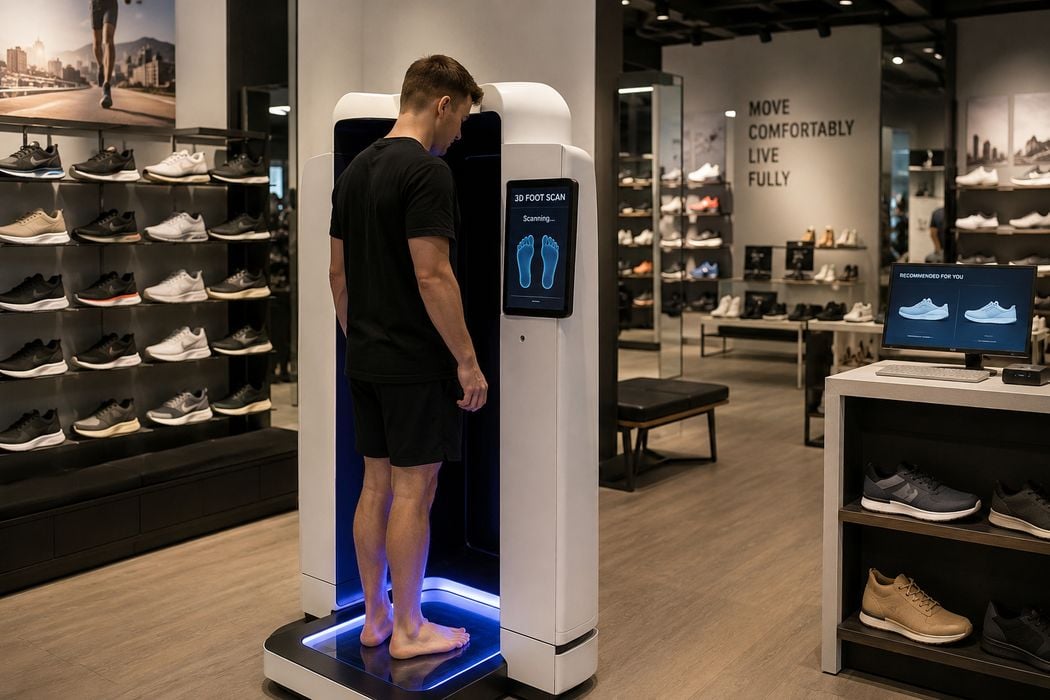
Custom-sized operations offer some way to customize the shoe sizing. This is done in several ways. One way is with a 3D foot scanner. Other approaches involve having customers print a calibration page and then photograph the foot on it. This info is then used to tweak a shoe 3D model, which results in a far better-fitting shoe. Zellerfeld is one of the companies doing this.
My thought previously was that the 3D printed shoe biz would evolve from fixed to custom over time, and that surely will happen.
But a recent LinkedIn post by 3D print entrepreneur Janne Kyttanen opened up a whole new world of possibilities. He said:
“A 3D scan of your foot may accurately represent its geometry, but using it as a simple master to make yourself a pair of shoes is only the beginning of the story.”
His point is that shoes are not static objects: they must flex and twist according to the wearer’s actions and preferences. Also, a person’s feet also change. What geometry are they when standing? Is that the same as when they are running? How can a shoe properly react in different action scenarios?
Even more complicated is this: how do you even figure out the scenarios for each individual? Kyttanen writes:
“I’m confident I could solve this in two or three iterations. But that raises a bigger question: How many consumers are willing to go through two or three rounds of experimentation to achieve the perfect digital fit and to what costs, versus simply walking into a store, trying on 20 or 30 pairs of shoes, and buying the one that feels best?”
As always, it’s a cost-benefit equation: how much time and money is someone willing to spend in order to get a good shoe fit?
This also presents another potential layer of automation. Could someone figure out a large range of foot configuration possibilities and develop an automated scanning/capture system that would quickly collect enough information to perform a “perfect” custom shoe generation?
Honestly, this sounds like an academic research project is required. Someone should determine what the actual factors are that require customization, and from there, customization software tools could be built.
If all that comes to pass in the future, we will hopefully be able to obtain perfectly fitting shoes after a brief but intense data collection procedure.
Via LinkedIn
