
Resin 3D printing usually treats excess material as a post-processing problem. Carbon’s latest patent application proposes dealing with it while the part is still inside the printer.
The application, filed by Carbon, Inc., describes a combination additive and subtractive process for light polymerizable resins. Its main idea is pretty straightforward to describe but probably challenging to engineer: cure each new resin segment, then use a second light source, potentially a laser, to remove unwanted material or modify the newly formed surface.
A Laser Works Beside The Resin Applicator
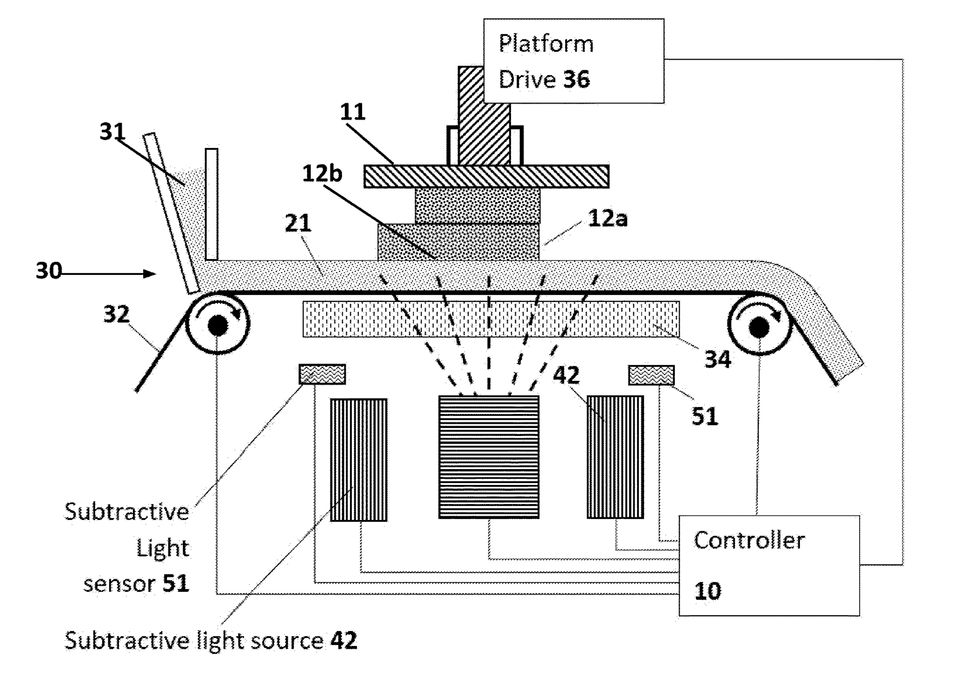
The drawings show a build platform and a moving film or roller applicator supplying resin to the growing part. Patterned light from a first source solidifies the resin and creates the next build segment. Because resin can collect around the edges as a meniscus, the new segment may emerge with a rim of excess liquid, partially cured resin, or fully cured polymer.
A second optical system then targets that unwanted material. Depending on the configuration, the laser could sit below the film, above the part, or to one side. The platform or applicator can move laterally so the laser reaches the edge of the new segment after it leaves the coating zone. In some variations, the beam passes through the moving film; in others, the part is moved away from the film before treatment.
That arrangement gives the machine a kind of in-process trimming operation. The patent claims cover repeatedly applying resin, curing it with patterned light, exposing the new surface or its edges to ablation light, and continuing the cycle. The ablation step can be skipped during some cycles, which would let the controller reserve cleanup for geometries or materials that need it.
The patent application, US20260241636A1, also describes feedback. A detector can monitor properties such as beam focus, wavelength, or intensity, while a controller adjusts the subtractive light source. That is a potentially useful feature for a process in which a slightly wrong focus could either leave resin behind or damage the part underneath.
Surface Treatment Could Change The Printed Part
Cleanup is only one use. The laser may also texture a cured surface to improve adhesion to the next layer, selectively remove polymer while leaving a filler behind, or alter the surface chemistry. The document also talks about resins containing glass, carbon, aramid, ceramic, and other fillers, along with dual-cure formulations whose second component can be activated later.
Those options point toward more than just sharper edges. A carefully chosen wavelength and dose might expose or modify a fiber-filled region, improve interlayer bonding, reduce anisotropy, or create different properties in selected areas of one part. Other variations use the light to melt or sinter an additive, expand a filler to counter shrinkage, or change internal stresses and final geometry.
Another proposed method uses laser energy to eject resin from a coated film onto an existing part. The filing mentions direct jetting as well as a “blister transfer” approach, in which a focused pulse creates a bubble whose emergence pushes a small quantity of resin across the gap. That could support patterned material placement without adding another conventional printhead.
The engineering challenge is substantial. Laser absorption must be controlled so the beam removes the edge buildup without attacking the film, the cured object, or the next layer. High-viscosity resins and fiber fillers complicate optics, contamination control, and calibration. A full-cross-section treatment could also reduce throughput, and laser ablation brings fumes or particles that may require extraction and monitoring.
For 3D printer operators, this setup could be quite attractive: less washing, sanding, and manual inspection after printing. Carbon’s filing appears to be protecting a machine architecture in which additive curing and localized laser processing share the same build cycle. If implemented successfully, the printer would spend less time making a part that later needs cleaning and more time controlling the surface it creates.
Via Espacenet
