
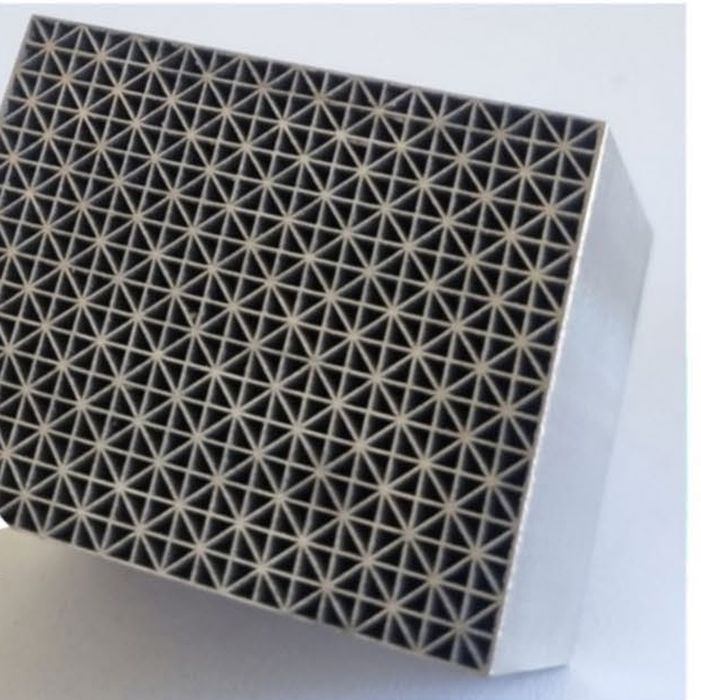
A single laser pass per wall produced 200µm aluminum lattices that behaved remarkably close to their computer models.
Researchers Martin Maier, Florian Hartl, Otto Huber and Holger Saage at the University of Applied Sciences Landshut investigated a plate lattice made from AlSi10Mg using laser powder bed fusion (LPBF). The structure is derived from a honeycomb, but is deliberately anisotropic: its stiffness and strength vary with direction.
Instead of designing an extremely complex lattice that behaves identically in every direction, an engineer can put more capability where the expected loads actually occur. The more open geometry can also avoid some of the enclosed spaces and awkward overhangs that make powder removal difficult in highly complex plate lattices.
Why Thin LPBF Walls Usually Misbehave
The difficult part is wall thickness. The researchers targeted only 200µm, well below the roughly 500µm region where LPBF lattice walls typically begin showing serious geometric errors, roughness, porosity and changes in the metal’s grain structure.
Previous work cited by the team reports very large gaps between the mechanical properties predicted from ideal CAD geometry and what printed lattices actually deliver.
The Landshut team attacked the problem by simplifying both geometry and laser exposure. Each thin plate was produced with a single laser track rather than filling a wall with the usual hatch pattern. The Aconity Midi system used a 160µm laser spot, so the intended wall was only about 1.25 times wider than the spot itself.
The build parameters included 550W laser power, 2000mm/s scan speed, 30µm layers and a 200C build plate. The walls were also oriented parallel to the build direction, avoiding overhangs after tests showed that 45 degree versions developed substantially larger geometric errors.
The result was unusually controlled geometry. Median measured wall thickness was 197µm, with 95% of measurements between 176 and 229µm. Porosity inside the thin walls was about 0.01%.
Printed Parts Behaved Like The Model
Mechanical testing produced the more interesting result. Once adjusted for how much solid material was actually present, axial stiffness and yield strength were close to values expected from dense LPBF AlSi10Mg. Average experimental properties were generally within about 5% of simulations based on ideal geometry.
In the axial direction, the normalized yield strength was about 270MPa, while transverse values reached roughly 30GPa for Young’s modulus and 117MPa yield strength. The lattice behaved much like bulk material until yielding, after which the thin plates eventually buckled.
A six hour ageing treatment at 160C produced no significant improvement. The researchers concluded that the as built thin walls had already reached a plateau in precipitation hardening. That could remove a post processing step for a suitably tuned process.
There was one remaining materials issue. Strong crystallographic texture formed along the build direction, reducing axial stiffness by as much as 5.5%. Interestingly, repeated laser exposure at plate intersections disrupted that texture locally.
The team also added tiny fillets at those intersections. They added mass, but improved transverse weight specific stiffness by about 7% and weight specific elongation at break by about 12%.
There is no claim here that every 200µm LPBF wall can now be printed perfectly. The process was carefully tuned around one alloy, one machine, one orientation and an overhang free geometry. The researchers specifically call for a more general way to select parameters for thin AlSi10Mg structures, which could be the next step in this research.
