
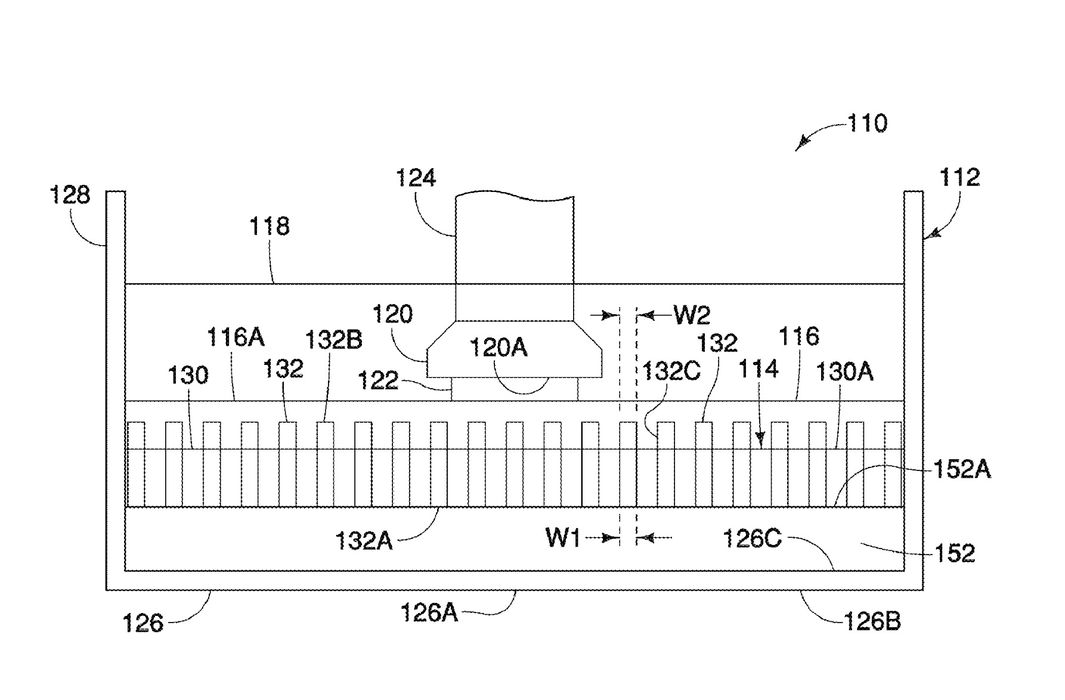
Here’s a rather strange idea from Nissan: put tiny magnetic pillars in the bottom of a resin 3D printer vat and wiggle them around to help release each layer.
That’s essentially what Nissan North America describes in recently published patent application US20260249545A1.
The concept is aimed at a typical problem in MSLA/DLP resin printing. After a layer is cured against the transparent window at the bottom of the vat, it has to be separated before the next layer can be made.
That separation step can slow everything down. Worse, too much adhesion can damage delicate prints or even cause a print failure.
Nissan’s solution is to make the bottom of the vat considerably more active.
Tiny Magnetic Pillars In The Vat
The proposed vat still has the usual transparent window, but on top of it is a thin polymer layer covered with an array of tiny pillars.
Those pillars could take several forms. Nissan describes cylinders, hollow tubes, tapered pillars, angled structures and other shapes.
The important part is that they contain magnetic material.
An external magnetic field can therefore make the pillars bend or tilt slightly.
There’s another ingredient involved as well. Nissan proposes placing a thin layer of inert fluid over the pillars, with the actual photopolymer resin sitting above that.
Possible fluids include fluorinated liquids and silicone-based materials.
The idea is that this intermediate layer would already reduce adhesion between the print and vat floor. But Nissan then takes things a step further by moving the magnetic pillars underneath it.
A magnet positioned outside the vat pulls on the pillars and causes them to move. That movement disturbs the fluid and creates flow underneath the freshly cured layer.
In theory, this could help peel the new layer away from the vat window. That could potentially increase overall print speed and reduce the possibility of print damage.
That’s quite different from the usual approach, where the build platform itself must move far enough to mechanically peel the layer away.
If the magnetic pillars can do some of that work instead, the platform might not need quite as much movement between exposures.
More Than Just Peeling
Interestingly, Nissan seems to be trying to get several jobs out of the same mechanism.
Moving the fluid could also help bring fresh resin into the gap underneath the part, preparing it for the next exposure.
The patent even describes using the system to help recover from failed prints. If a cured section becomes stuck to the vat floor, movement of the pillars could potentially force fluid beneath it and help lift it away.
There’s also heat to consider.
Resin polymerization generates heat, particularly when exposures happen rapidly in the same area. Nissan says the pillar structure provides additional surface area that could help move some of that heat away from the print zone.
The geometry can apparently be tuned as well.
Some pillars could be taller or shorter to reduce contact with the printed layer. Others could be angled so their movement encourages fluid to travel in a particular direction. Nissan also describes mixing movable magnetic pillars with rigid projections.
It starts to sound less like a simple vat window and more like a microscopic fluid-control system.
Of course, actually making this work reliably could be another matter.
The pillars would have to survive countless flexing cycles while remaining optically transparent enough for the projected image to pass through. The intermediate fluid must stay separated from the resin, and whatever magnetic system moves the pillars can’t interfere with the rest of the machine.
There’s also no performance data in the application showing how much faster this arrangement might make a printer.
Most resin printers treat the vat window as a passive surface and then spend considerable mechanical effort pulling each layer away from it.
Via Espacenet
