
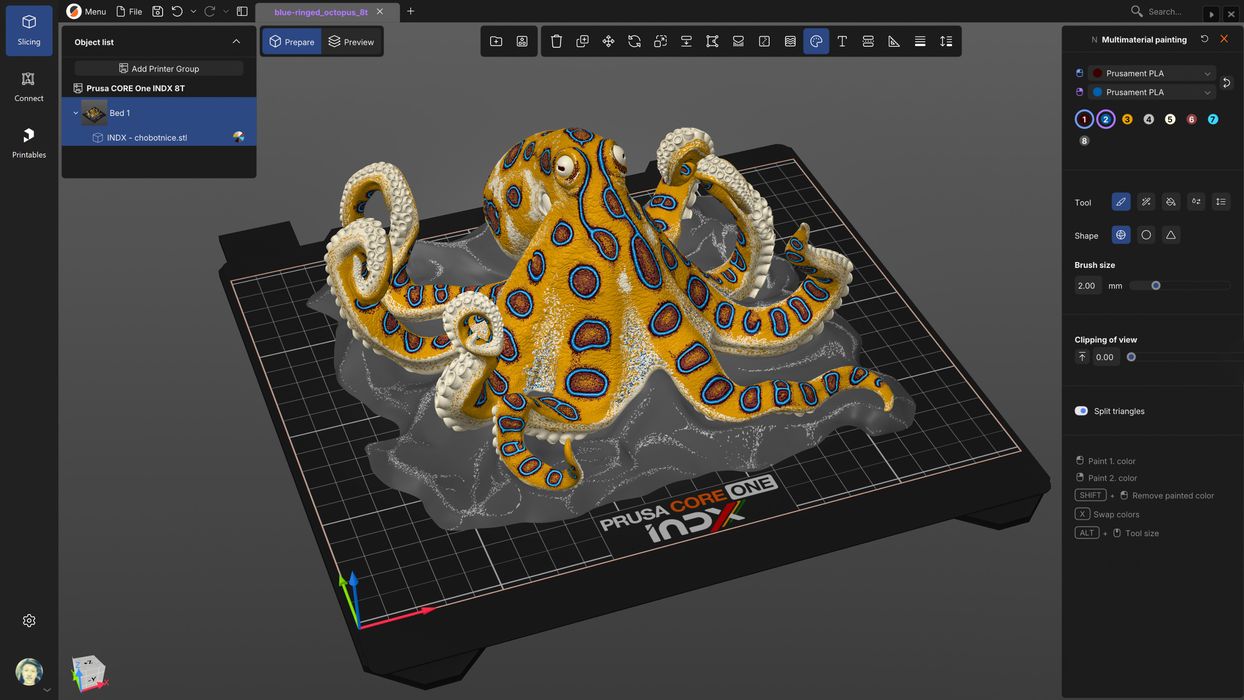
Prusa Research has released the first public preview of PrusaSlicer 3.0, and this one goes a lot deeper than just moving buttons around.
In fact, they basically threw away the old user interface and started again.
That sounds pretty dramatic, but there was a reason for doing so. PrusaSlicer has been around for a very long time, tracing its origins all the way back to Slic3r in 2011. Since then an enormous number of capabilities have been added, including multimaterial printing, multiple beds, painting tools, remote printer management and much more.
Eventually you reach a point where adding one more feature becomes increasingly difficult because the software underneath was never designed for it.
Prusa Research says they reached that point.
One example is multi-tool 3D printing. On a Prusa XL you could have several toolheads equipped with completely different nozzle diameters, but the old profile system wasn’t really designed to understand that arrangement. Different combinations could require different printer profiles, and things became awkward rather quickly.
PrusaSlicer 3.0 replaces that with a layered profile system. A printer can now be described more like the machine actually exists, with different tools having their own configurations.
That should make increasingly complex multi-tool machines far easier to handle.
There’s another major change involving projects. Multiple print beds appeared in PrusaSlicer 2.9, but they’re now much more deeply integrated. Each bed can have its own settings and even its own printer.
In other words, you could set up jobs for an MK4S and an XL in the same project, move objects between them and slice multiple beds in parallel.
That’s quite a change from the traditional slicer concept, where you’re basically preparing one plate for one machine.
But the most interesting addition might turn out to be plugins.
PrusaSlicer is open source, and that has resulted in a considerable number of forks over the years, including OrcaSlicer, SuperSlicer and others. The trouble with a fork is that someone has to maintain the entire thing indefinitely, even if they only wanted to add one interesting feature.
PrusaSlicer 3.0 introduces a Lua-based plugin system that could change that equation. Instead of maintaining another slicer, a developer could simply produce a plugin.
The first implementation is intentionally limited, mainly allowing plugins to generate items in a project. Prusa already includes temperature and flow calibration generators as examples, and they’re also preparing a plugin marketplace.
That could become a very big deal if the API expands over time.
Prusa has also thought about what happens when random plugins start appearing. Plugins are sandboxed by default, without general disk or network access, and marketplace submissions will be reviewed.
There’s a similar philosophy behind a new true offline mode. When enabled, PrusaSlicer doesn’t merely avoid contacting online services: the networking libraries aren’t loaded at all. That could make the software considerably more attractive in secure or air-gapped environments.
There are plenty of other changes, including faster startup and slicing, a redesigned 3D viewport, project tabs, automatic local backups and customizable favorite settings.
But I think the important part of PrusaSlicer 3.0 isn’t any of those individual features.
It’s that Prusa Research seems to have decided the old architecture had reached its limit and rebuilt enough of the software that they can now head in entirely different directions.
That’s probably why this release feels less like PrusaSlicer 3.0 and more like the beginning of whatever PrusaSlicer becomes over the next several years.
Just don’t replace your normal slicer with it quite yet. Prusa Research is very clear that this preview is unfinished, incomplete and likely full of problems.
For now, we’re getting a look at the foundation.
Via Prusa Research
