
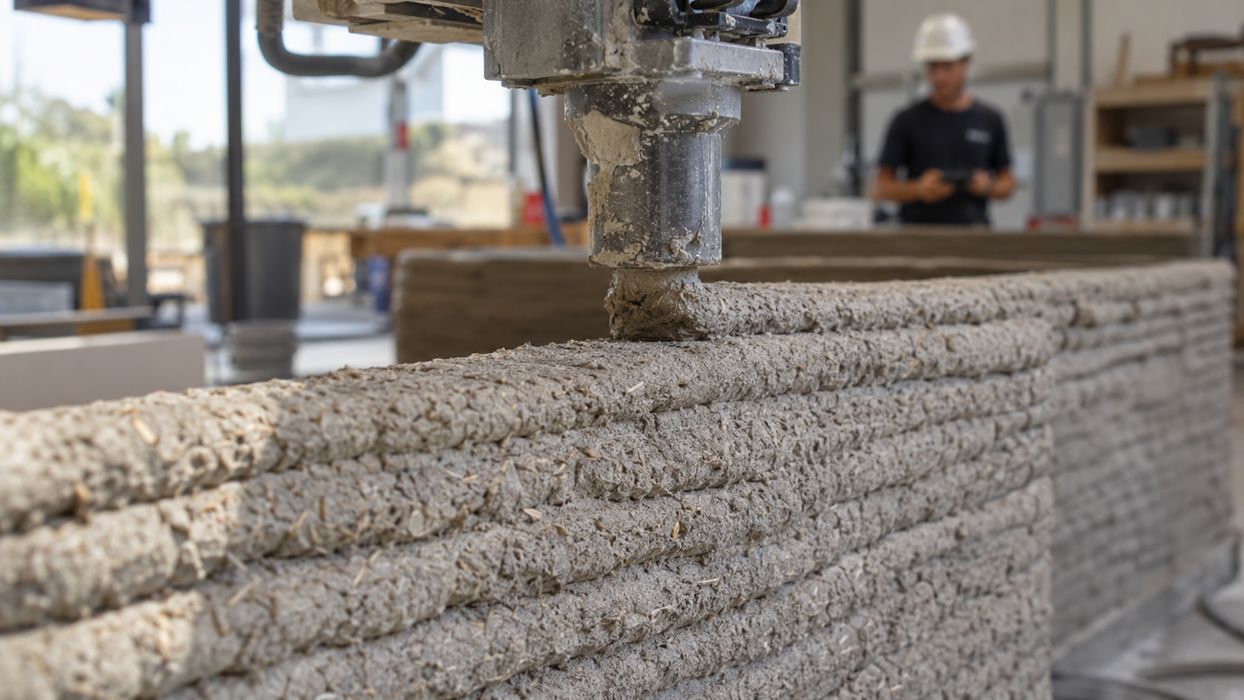
Could an old recipe for making classroom models turn into a material for 3D printed construction?
That’s the rather strange possibility raised by a new paper examining a composite made from waste paper, sawdust, gypsum and ordinary polyvinyl acetate white glue.
The material itself isn’t new. It was reportedly developed way back in 2008 for making inexpensive three dimensional embryology models for teaching. The wet ingredients were mixed into a plastic paste, shaped and then allowed to dry.
Apparently it was pretty tough stuff, too. The original researchers reported that models could survive drops of up to two metres without the central structure breaking.
Nobody was thinking about 3D printed buildings at the time.
Now researcher Tales Alexandre Aversi-Ferreira has revisited the material from a very different angle: perhaps something similar could be turned into a paste for construction 3D printing?
Turning Old Paper Into 3DCP Paste
There’s a reason the idea isn’t quite as crazy as it first sounds.
Fresh construction 3D printing material has to perform a specific trick. It must flow through a nozzle when pushed, but almost immediately become stiff enough to hold its shape after extrusion. Otherwise the freshly deposited lines slump, spread out or collapse when more layers arrive. Polymer extrusions in FFF technology do this because they cool, but construction 3D printing materials typically do not.
The old paper, sawdust and gypsum recipe already produced a thick, plastic mixture before drying. That gives the researchers a good starting point.
But simply stuffing the 2008 mixture into a construction 3D printer probably wouldn’t end well.
The first problem is the fibres. Coarse paper and sawdust particles can bridge inside an extrusion system and clog the nozzle, which is exactly the sort of problem you don’t want halfway through printing a wall.
The paper therefore proposes refining the cellulose into much smaller fibres, potentially including micro or nanofibrillated cellulose produced from eucalyptus sawdust.
Those tiny fibres do more than avoid nozzle trouble. Previous research cited by the paper suggests cellulose micro and nanofibres can increase yield stress and thixotropy in printable cement materials. In other words, the material can become easier to extrude under pressure yet recover enough stiffness afterwards to keep the freshly printed geometry standing.
That is exactly the behaviour construction 3D printing operators want.
Gypsum brings another interesting complication. It sets fairly quickly, which is useful after extrusion because each deposited line needs to support the next one. Unfortunately, material that hardens quickly inside pumps, hoses and nozzles is not good news.
The researchers suggest that binder formulation and retarders would have to be tuned to provide enough working time for continuous printing. Fibre size, extrusion behaviour, layer stability and hardened properties would all need testing as well.
The paper is a review that brings together results from several areas and proposes a research path. The researchers see the likely 3DCP applications as non structural printed infill, cores and insulating elements rather than load bearing walls. That makes sense because earlier testing of related paper, sawdust and gypsum composites produced compressive strengths of 2.5–8.5 MPa, along with some uncomfortable sensitivity to moisture.
Construction 3D printing materials are usually approached from the concrete side: start with cement and then modify it until the printer is happy.
Here the direction is almost backwards. Start with waste paper, sawdust and gypsum, then engineer the mixture until it behaves like construction printing material.
That could turn two very ordinary waste streams into something considerably more interesting than another trip to the landfill.
Via Artefactum
