
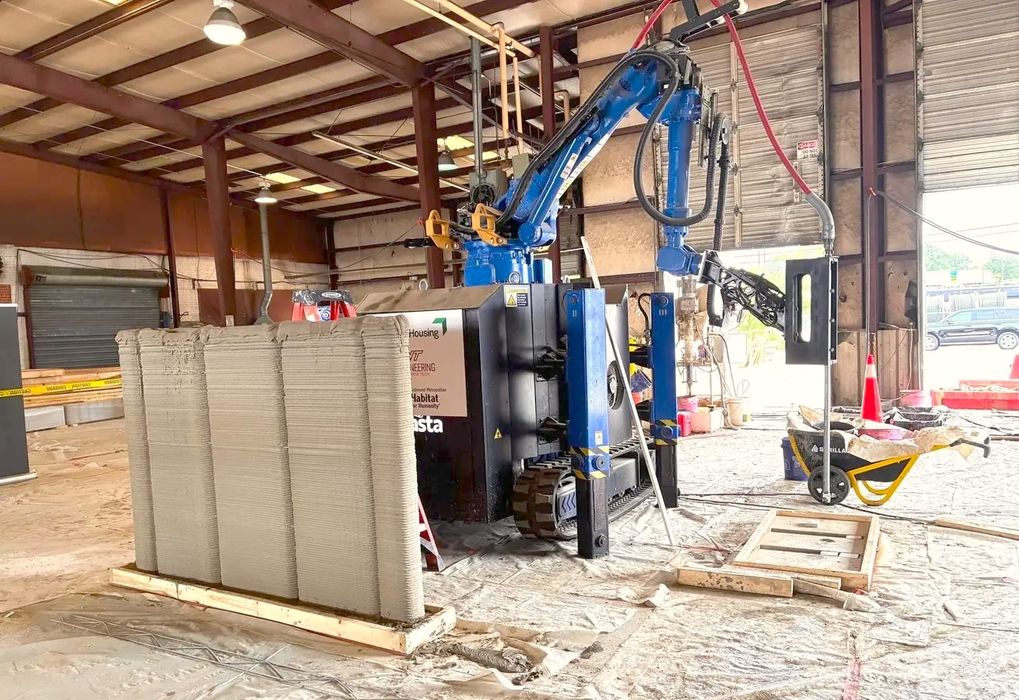
Habitat for Humanity is experimenting with 3D printed construction, but there’s an interesting question about where this might eventually lead.
The nonprofit organization is well known for building affordable homes using volunteer labor, including contributions from the families who will eventually occupy them.
This participation is a fundamental part of Habitat’s approach. Future homeowners contribute what the organization calls “sweat equity”, working alongside volunteers to construct their homes or those of other families.
But what happens when robots start doing the construction?
A recent project in Henrico County, Virginia, provides an interesting example of where this might be going.
Richmond Metropolitan Habitat for Humanity is working with Indian 3D printer manufacturer Tvasta and researchers from Virginia Tech to investigate 3D concrete printing (3DCP) for affordable housing.
The project involves five homes at the Carter Place I development, where a mobile robotic arm will print structural walls using a geopolymer mixture containing approximately 90% recycled material, including fly ash.
The printer extrudes successive layers of material to form walls that would otherwise require conventional masonry construction. According to Habitat officials, a typical masonry operation might require five or six skilled workers, while the printing process can operate with two or three people handling materials.
That’s potentially a substantial reduction in labor.
The organization also expects improved durability, flood resistance and thermal performance, although those benefits have yet to be fully demonstrated in occupied homes. But a technically better home is always a good result.
Virginia Housing provided a US$1.1M innovation grant to support the project, while Virginia Tech is investigating material properties, environmental impacts and construction standards.
Interestingly, the homes aren’t necessarily cheaper. Habitat estimates its conventional construction costs at US$155–215 per square foot, with the printed homes expected to fall toward the upper end of that range.
So why do this?
One reason is the shortage of skilled construction workers. Automating masonry operations could allow Habitat to build more homes without requiring as many trained tradespeople.
And that brings us back to Habitat’s unusual construction model.
Habitat doesn’t just give houses away. Families typically purchase their homes through affordable mortgages and contribute labor or other approved activities as part of the arrangement. For the Virginia project, participating families must complete 100 hours of sweat equity during construction.
There are still plenty of opportunities to participate. The organization has already used volunteers to construct interior partition walls and prepare the foundations, and is actively recruiting volunteers to assist with the printing operation.
So the immediate project doesn’t appear to undermine Habitat’s participation model. But consider what might happen over the next decade.
Today, 3DCP automates concrete wall construction. Other emerging construction technologies could eventually automate additional activities, including interior finishing, roofing, painting and installation work.
If these technologies become sufficiently reliable and economical, the amount of manual labor required to construct a home could shrink considerably.
That would be wonderful news for construction productivity, but it presents Habitat with an interesting dilemma.
Part of the organization’s philosophy involves homeowners participating in creating their own homes. The experience helps establish ownership, teaches skills and builds relationships with the volunteers and community supporting the project. If machines increasingly perform the construction, some of those opportunities disappear.
Of course, Habitat already allows sweat equity to include activities beyond physical construction, such as volunteering at its ReStores and attending homeowner education classes. Participation doesn’t necessarily require swinging a hammer.
Perhaps future Habitat homeowners will instead help operate automated construction equipment, prepare digital building plans or participate in other parts of the process? But that may require skills and training they don’t have. It’s one thing to swing a hammer around, but quite another to operate a COBOD BOD2 3DCP system.
There’s also the possibility that automation enables Habitat to build considerably more homes, expanding the opportunities for families to participate even as labor requirements per home decline.
I suspect the organization will eventually have to think carefully about what sweat equity really means in an increasingly automated construction environment. After all, the objective is to provide affordable housing, but the process of building that housing has always been part of the organization’s mission.
Via Henrico Citizen
