Resin 3D printers are easy to install. The ventilation for them isn’t as simple.
An interesting example has emerged at the Fayetteville Public Library in Arkansas, where resin 3D printers in its Center for Innovation have apparently been offline for nearly two years following safety concerns.
According to the Northwest Arkansas Democrat-Gazette, library management now intends to return the equipment to service. However, some former staff members reportedly remain unconvinced that their earlier safety concerns have been adequately addressed.
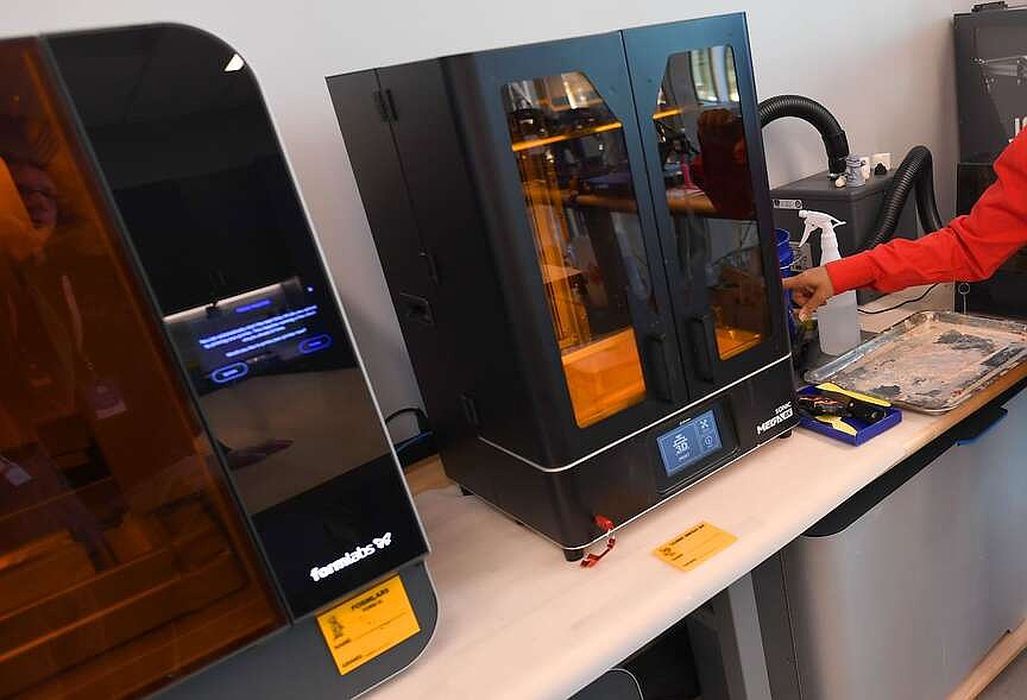
In 2024 the library was running classes covering both filament and resin equipment, including for both safety and post processing. Later classes focused only on filament equipment. The library’s current Center for Innovation page once again lists several resin machines, including a Formlabs Form 3L, Phrozen Sonic Mega 8K and Phrozen Sonic Mini 4K, along with a Resin Quick Start Guide and resin training.
This episode points to a problem I’ve seen repeatedly as resin 3D printing moves into schools, libraries, workshops, offices and homes.
People usually know they need “ventilation”, but what does that actually mean?
A room can have an entirely functional HVAC system and still not have a good setup for resin 3D printing. Fayetteville’s relatively new library addition, for example, has an elaborate ventilation system supplying outside air and adjusting airflow according to occupancy. That’s excellent for running an office building, but it isn’t necessarily the same thing as capturing resin emissions where they’re generated.
Resin printing involves several potential emission sources. There’s the liquid photopolymer itself, but there’s also washing, frequently performed with isopropyl alcohol, followed by UV curing. NIOSH notes that the curing stage can generate particles and gases, and solvent (IPA) cleaning creates more inhalation and skin exposure risks.
General room ventilation dilutes contaminants after they’ve entered the room, while local exhaust attempts to capture them near or even inside the printer / processing station before they spread. NIOSH has previously recommended things like local exhaust systems, snorkel-style extractors and enclosed ventilated printer installations exhausting outdoors. Filtration can also help, but only if it actually captures the particular emissions involved.
And simply adding a HEPA filter isn’t always the whole answer. HEPA filtration is intended for particles. Gaseous emissions require a matching gas-phase filtration system, typically involving activated carbon or similar media.
Even the equipment manufacturer recommendations can make the issue confusing. For example, Formlabs says its own resins don’t normally require special ventilation because they lack certain volatile chemicals, but nevertheless recommends freely circulating air and an HVAC environment providing at least three air exchanges per hour, possibly because operators might use different resins? The company also specifies good ventilation when handling IPA. So what do you really need?
None of this means resin 3D printers are truly unsafe for use in libraries or schools. Far from it.
A properly designed resin area has to consider the printer, the types of resin, washing, curing, frequency of use, room airflow and where any extracted air ultimately goes. What works for a single occasional machine may not be appropriate for several machines running frequently.
The Fayetteville situation is a good reminder that “the room is ventilated” isn’t really the end of the safety discussion. It might be only the beginning.