
Imagine making a concrete mold, using it once, then melting it down and 3D printing another one.
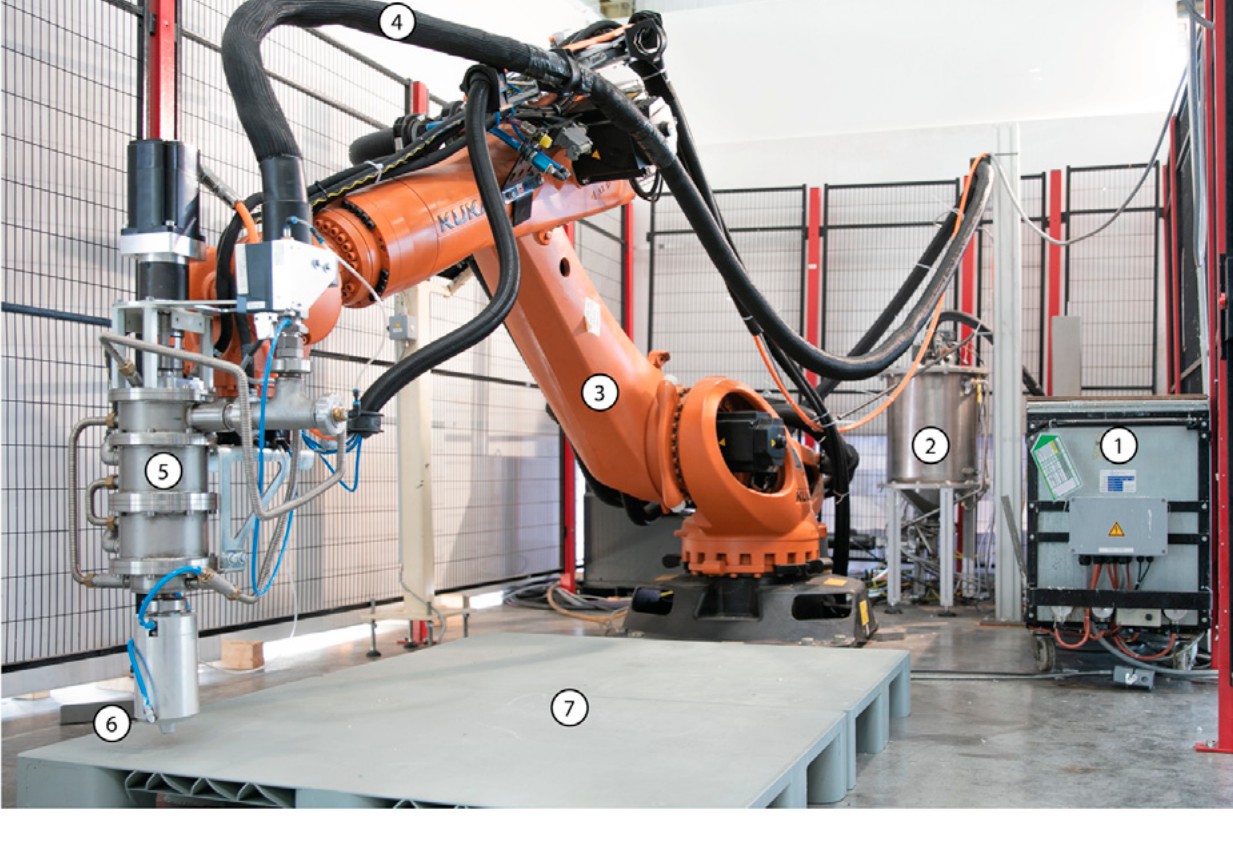
That’s the idea proposed by researchers at Technische Universität Braunschweig and German machinery company Herrhammer. They’ve developed a robotic system that extrudes foamed wax into large molds for complex precast concrete parts.
Why wax? Unusual concrete shapes often require custom molds made from plywood or machined polymer foam. These can involve plenty of manual work, and the resulting molds may be difficult to recycle. Solid wax molds are another possibility, but carving one from a huge block requires considerable machining time and a surprising amount of material.
The researchers tried combining three things: 3D printing to put wax roughly where it’s needed, CNC milling to produce the final smooth surface, and melting to recover the material afterward.
Their custom equipment heats a formulation called Tudastar, mixes air into it, and cools the mixture just enough for it to hold its shape as it leaves a 12mm nozzle. The resulting material contains around 20% air by volume. It’s lighter than solid wax, yet strong enough to survive the pressure of fresh concrete under the conditions tested.
A robot extrudes the wax in layers 6 mm high and around 20 mm wide. The team printed about 250 kg over eight hours and 45 minutes, producing a large mold section close to its intended shape. It was scanned and CNC milled to its final contours.
The test object was a curved concrete seating step, weighing around 650 kg. The completed casting mold combined the printed wax sections, used for the complex surfaces, with ordinary plywood for simpler ones. The team poured self-compacting concrete and removed the finished part after about 23 hours.
There was a substantial material saving, they report. A comparable mold machined from a solid wax block would have required approximately 1.13 tonnes of wax. The printed method used about 80% less. That comparison is with solid wax machining, not with conventional plywood or polymer foam molds.
Cooling was also faster. The printed wax needed nearly four days to cool, compared with more than two weeks expected for a corresponding solid wax block. That’s still a long wait, but the researchers believe future printing strategies using internal infill could reduce both material and cooling time further. Those improvements haven’t been demonstrated yet.
Unfortunately, wax foam turned out to have some very familiar 3D printing problems.
As it cooled, the large print warped upward by as much as 50mm! Some layers didn’t bond properly, causing cracks and separation during milling. The team had to fill gaps with melted wax, heat the surface, and mill it again. Those repairs alone consumed around eight hours of labor.
The concrete casting succeeded, but the surface wasn’t quite good enough for the intended architectural finish. Some areas showed discoloration, uneven texture, and marks associated with the printed layers.
Removing the mold required wooden wedges, which damaged the wax. So the same mold couldn’t simply be used for another casting. However, the damaged wax was melted, filtered, foamed and printed again, and the researchers report completing a further casting with the recycled material.
That’s one demonstrated recycling cycle, and did not attempt to prove that it can continue recycling endlessly. Earlier research demonstrated more than 200 remelting cycles with a different wax formulation, but the new material hasn’t undergone equivalent testing.
The coolest idea here is that 3D printing might change custom concrete construction without changing the concrete at all. Complex shapes could be made with familiar casting methods, while the specialized mold material is used on one job to the next
Their current process needs extensive manual repair and careful handling, as mentioned above. Until the wax layers bond reliably and the molds release without damage, melting and reprinting after every pour is not going to succeed in the commercial market. However, this is quite an interesting approach and perhaps they, or some entrepreneurs will improve it.