
With bacteria, less infill can make a stronger 3D printed part.
That’s the unusual finding from ETH Zurich, where researchers have developed a way to 3D print architectural components from sand and then use living bacteria to turn them into solid mineral structures.
The work, led by architect Karen Antorveza Paez, deals with a key part of the 3DCP process: the cement itself. Conventional cement production requires very high temperatures and releases massive amounts of CO2 both from the fuel used and from the chemical processing of limestone.
What if the printed sand could be hardened without manufacturing conventional cement? Could that CO2 be eliminated? Or at least reduced?
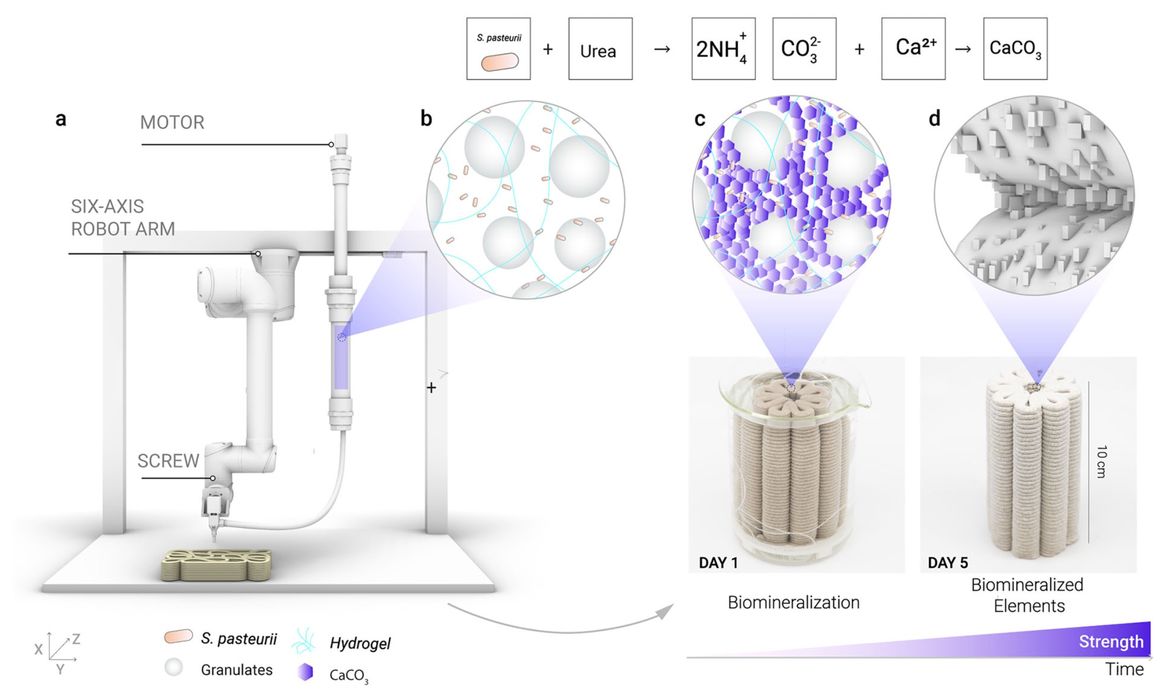
The team’s approach starts with a printable paste containing sand, water-based gels and the bacterium Sporosarcina pasteurii. A robotic extrusion system deposits the mixture in layers, much like other 3DCP processes.
The really interesting stuff happens after printing.
The component is immersed in a solution containing urea and calcium chloride. The bacteria break down the urea, creating conditions for calcium carbonate crystals to form. Those crystals grow around the sand grains and across adjacent extrusion lines, gradually locking everything together.
The process, called microbially induced calcite precipitation, takes several days. The researchers replaced the mineralization solution daily, then dried the parts. No cement kiln is required! The bacteria are effectively taking the place of the cement.
But their most surprising result came from experimenting with infill geometry.
The team printed 44mm test cubes with dense and sparse internal grids, testing three or four specimens per condition. The more open grids allowed the mineralization solution to travel deeper into the structure. Dense grids developed hardened outer regions while their interiors received less mineral reinforcement.
The sparse grids accumulated 31.4% calcium carbonate, compared with 22.4% for the dense grids. With bacteria, the sparse specimens showed compressive strength improvements of 61% to 86% over equivalent specimens without bacteria, depending on loading direction. Dense grids did not show comparable improvements.
That’s an incredible reversal of the usual solution: add more material to increase strength. In this new process, open space helps the chemistry reach the places where strength is needed. Less is more, it seems.
Could Bacteria Cut Construction Emissions?
There’s a potentially substantial environmental benefit here.
Portland cement production releases large quantities of CO2, including emissions that come directly from converting limestone into cement ingredients. Bacterial mineralization occurs at much lower temperatures, potentially avoiding much of that energy-intensive production process.
The research paper cites earlier life-cycle studies suggesting CO2 reductions of around 37–38% compared with Portland cement when favorable nutrient and calcium sources are used.
Nor are the bacteria pulling CO2 from the atmosphere. The carbonate in this process comes from the supplied urea, and producing the chemicals and growing the bacteria have their own environmental costs.
There’s also a rather serious waste problem. Breaking down urea generates ammonium, which cannot be easily released into the environment. The researchers did say that treatment or recovery of this ammonium will be essential if this is to work.
For now, this is a non-structural building material. Tested compressive strengths were roughly 0.5–2.2MPa, well below structural concrete. The researchers did successfully print a complex 30 x 20 x 20 cm architectural element, suggesting applications such as facade screens and partitions are possible.
If the environmental bookkeeping works out, the result could be a construction 3D printer that uses geometry and a low-temperature biological process create strong architectural pieces.
Via ETH Zurich and Nature