
A dead company has just published a pretty interesting patent application.
US20260346340A1, published on November 5, describes a way to make molten aluminum 3D printing more reliable. It was filed by Desktop Metal, a company that has disappeared following a torturous corporate collapse that took over a year to complete.
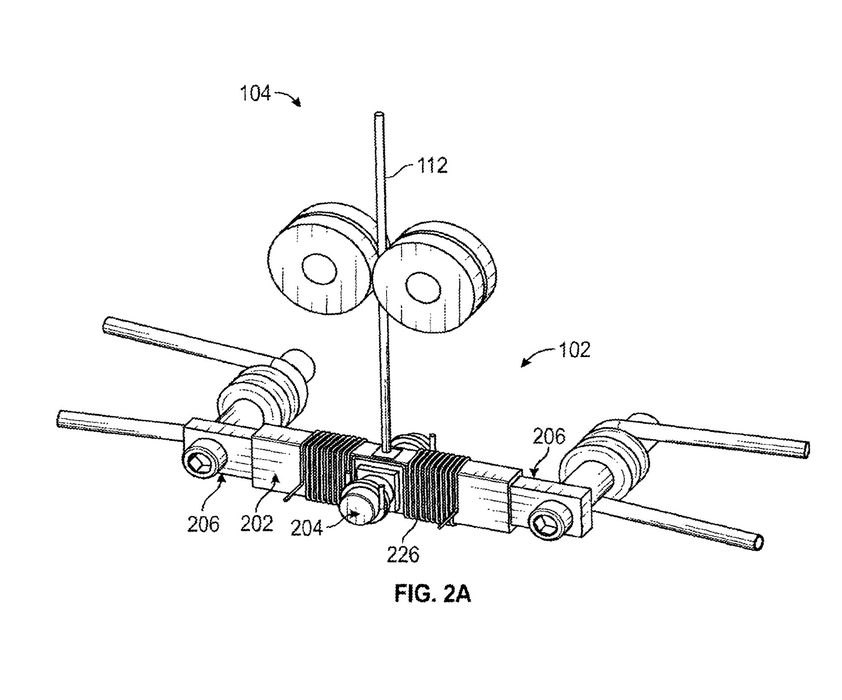
The idea concerns magnetohydrodynamic (MHD) printing. Metal wire enters a heated nozzle and melts. An electric current passes through the liquid metal while a magnetic field crosses it. The interaction generates a force that fires a tiny droplet from the nozzle. Repeat that rapidly while moving the nozzle or build surface, and a solid metal object is slowly built.
The issue is the electrodes that deliver that current.
They must contact molten aluminum, survive the heat and maintain consistent electrical resistance. Desktop Metal previously used aluminum electrodes, but their molten boundary could shift as the nozzle warmed during operation. That changed resistance and messed up droplet formation. Tantalum electrodes avoided some difficulties, but gradually dissolved into the aluminum.
Desktop Metal inventor Graham Cullen proposed titanium diboride (TiB2), a conductive ceramic that doesn’t dissolve in molten aluminum. There was another problem, however: connecting the ceramic electrodes to the rest of the electrical system without creating an unreliable joint.
The patent describes two solutions. One mechanically joins TiB2 to a tungsten-copper alloy containing 60–90% tungsten, chosen for its electrical conductivity and thermal expansion reasonably close to the ceramic. The other bonds the ceramic to a copper terminal using silver solder.
These are small changes buried inside a printhead, but their effect could be big.
According to the patent application, the new electrode connections allowed stable jetting above 150Hz, reduced oxide buildup around the nozzle opening and maintained more consistent current from startup through steady operation. Less oxide should mean fewer cleaning interruptions, while repeatable electrical pulses should produce more predictable droplets.
There’s already another approach to printing aluminum directly.
Belgian company ValCUN, which we’ve covered several times, uses aluminum wire in its Minerva printer and REMUS toolhead. Its Molten Metal Deposition process melts and continuously extrudes aluminum in a manner resembling FFF, with precise temperature control. Desktop Metal’s concept instead ejects electrically controlled droplets. Both avoid the powder handling and subsequent sintering associated with some other metal printing methods, but the resulting deposition behaviour and equipment are quite different.
https://www.fabbaloo.com/?s=valcun
ValCUN is already offering equipment based on its technology. Desktop Metal’s patent describes a component improvement to a process does not appear in any existing system as far as I know.
Nano Dimension acquired Desktop Metal in April 2025, but Desktop Metal filed for bankruptcy only months later. Arc Impact subsequently purchased selected Desktop Metal assets. Stratasys’s announced deal with Nano Dimension concerns Markforged, not Desktop Metal, so we don’t actually know who currently owns this particular patent application.
This patent is an example of how interesting technologies can get completely lost due to corporate shenanigans.
Via Espacenet