
Researchers report a wood based shape memory composite that self-assembles under sunlight, hinting at practical 4D printing without wired heaters.
The study explores shape memory materials — long a staple of 4D printing — but swaps petroleum-centric chemistries and plug-in heat for a renewable feedstock and ambient solar energy. In 4D printing, parts are fabricated in a programmed state and later triggered to reconfigure into a target geometry. Typical triggers include resistive heating, infrared lamps, solvents, or humidity; sunlight is abundant but tricky because it is diffuse and variable. A wood derived composite that reliably transforms under solar-thermal input would broaden deployment options in the field.
Conventional shape memory polymers (SMPs) in additive manufacturing lean on polyurethanes, epoxies, or thermoplastic copolymers, often doped with photothermal fillers for light-to-heat conversion. Wood brings stiffness, anisotropy, and sustainability, but also moisture sensitivity and batch variability. The paper positions a wood based route as a way to cut embodied carbon while enabling programmable morphing structures suitable for outdoor use.
Solar Triggered 4D From Renewable Feedstock
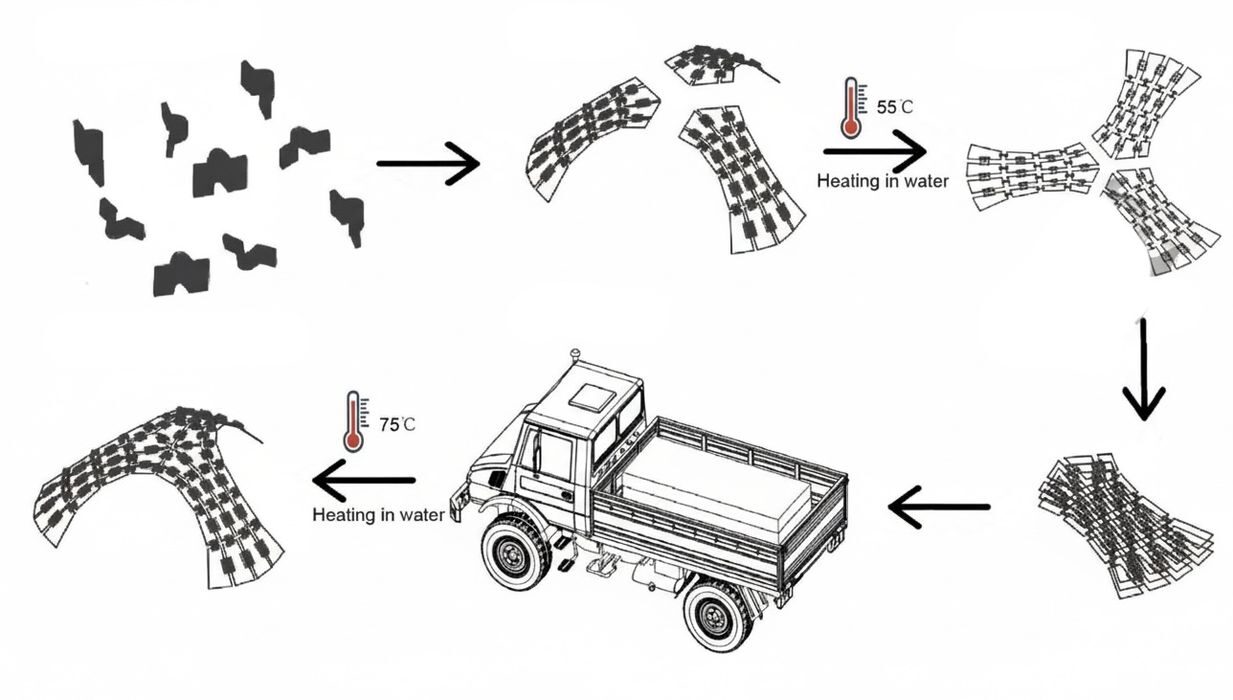
The authors report a composite that stores a temporary shape at rest and recovers its programmed form when sunlight raises its temperature past a switching threshold. In practical terms, a flat, additively manufactured laminate or extruded strip could be shipped compact and later deploy into curvature, twists, or shell-like forms under sun exposure. That self-assembly concept maps neatly to architectural shading, deployable sensors, and low power soft robotics.
While the paper focuses on materials science, the implications for additive are clear: the geometry programming can be encoded by print path, layer orientation, and local composition. Wood fiber orientation can bias bending, while resin segments set the glass transition temperature. In a single build, designers could place regions that fold first under mild irradiance and others that engage later, staging the transformation without active control.
Mechanism, Limits, And AM Fit
The mechanism is straightforward: solar photons are converted to heat in the composite and, once the matrix warms above its switching temperature, elastic energy stored during programming drives recovery. Wood reinforcement helps modulate stiffness and rate, and may improve shape fixity. The authors demonstrate self-assembly under solar-thermal conditions and report repeatable transformations, though the exact transition temperature, recovery ratio, and cycle life are not specified in the abstract.
For AM practitioners, several constraints matter. Sunlight is intermittent, and wind or convective cooling can stall actuation; part thickness and color will strongly affect heating rates. Wood based matrices can absorb moisture, shifting mechanical properties and the effective switching temperature, and long term ultraviolet exposure can embrittle many polymers. The paper does not list a specific printer platform, feedstock format, or processing window; adapting this to extrusion based printing, direct ink writing, or laminated object workflows will need rheology and drying controls. Pricing and supply details for the composite are not provided.
Compared to electrical or IR lamp triggers used by Formlabs, Stratasys research, and academic 4D setups, a passive solar trigger could cut wiring, reduce integration complexity, and enable outdoor deployment at scale. If the composite can be processed as a pellet for FGF or as a photocurable system for DLP or SLA, service bureaus and design labs could prototype morphing parts with lower material footprint. If not, the concept may live as a specialty laminate produced off-printer and integrated downstream.
What To Watch Next
Adoption will hinge on quantified data: switching temperature, actuation speed under one sun, recovery force, cycle count, humidity tolerance, and outdoor durability. Design tools that couple solar flux, thermal models, and anisotropic print parameters would make this practical for architects and product engineers. A pilot demo on a meter scale panel or a repeatable lab benchmark would move the conversation from intriguing to deployable.
If sunlight can be the fourth axis, we may soon design flat prints that pack small, ship cheap, and bloom into function when they meet the sky.
