
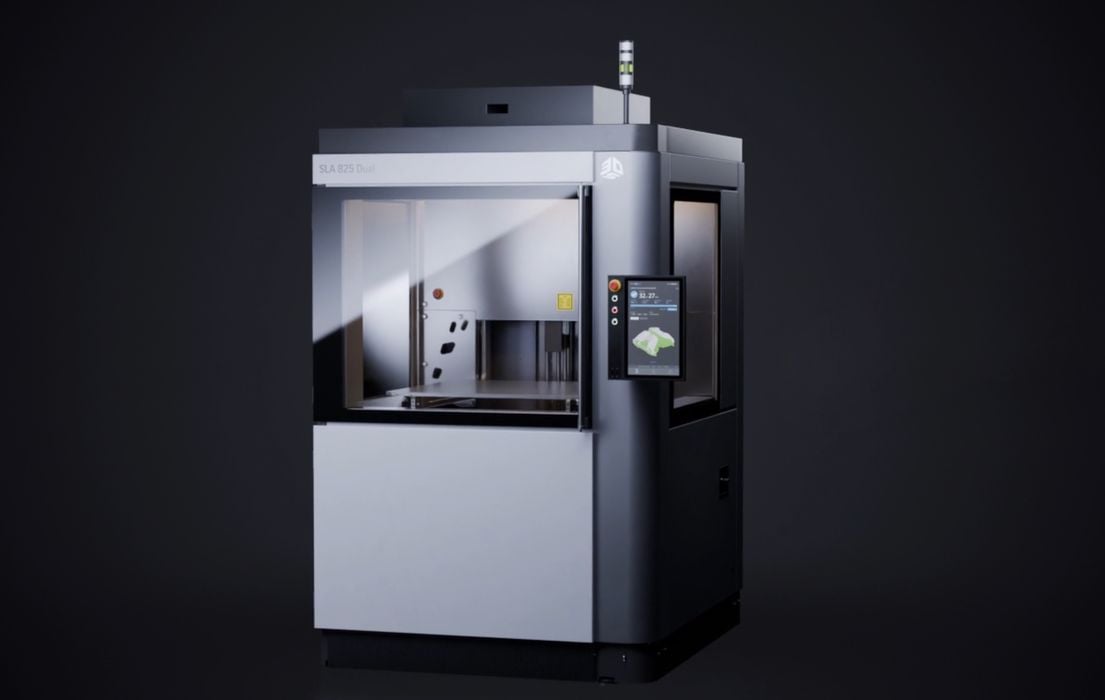
3D Systems just introduced a very interesting resin 3D printer, the SLA 825 Dual.
As you might guess from the product name, the device uses the traditional top-down laser approach long known as SLA. In this process, printing occurs on the top of the resin surface, with the print lowering on each layer. When done, the print rises up out of the resin for removal.
3D Systems has been making SLA systems, well, forever. In fact, they invented the process back in the 1980s, and it has been gradually refined from then until now. But the SLA 825 Dual has a feature that I don’t believe has been used in other SLA systems yet: dual lasers.
The SLA 825 Dual has two 4W lasers that can trace patterns on the resin surface simultaneously. This effectively doubles the print speed on most larger prints, since the two lasers work at the same time, but in different areas of the print surface.
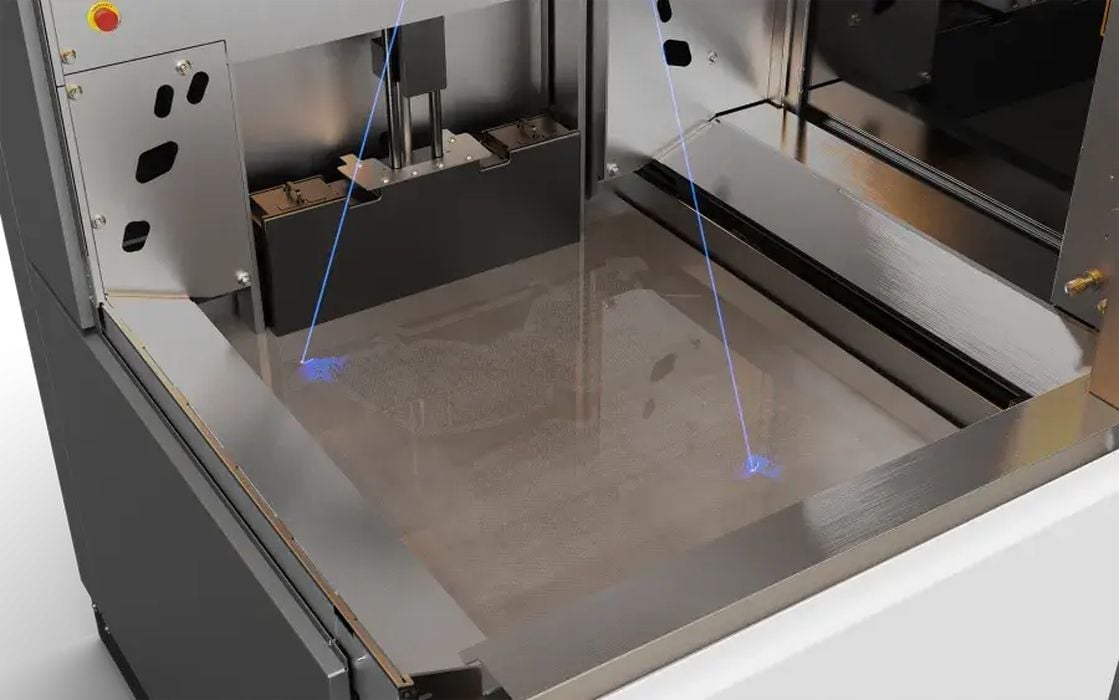
Using multiple lasers is not a new thing in 3D printing: metal LPBF systems have long used multiple lasers to speed up production. First, there were two, then four, then twelve, and now we’ve seen one system that can have up to 256 lasers for extreme productivity.
Now it seems that 3D Systems is taking that concept to SLA, and presumably there will be similar gains.
And there’s also another good reason for this: the SLA 825 Dual is a rather large machine. It has a build volume of 830 x 830 x 550 mm (why they didn’t call it the SLA 830 Dual, I’m not sure). This is said to be a 22% larger volume than their other machines.
When printing larger items as can be done on this machine, the print jobs can take a considerable amount of time. By adding another laser, those long jobs could be cut down significantly.
This could be especially important for service bureaus that hope to keep their machines running 24/7 to maximize revenue generation: with the SLA 825 Dual, you get more parts per week — and reduced turnaround time for orders.
How much faster is this machine? That’s actually hard to say because it depends on the size and geometry of the parts being printed. However, 3D Systems said the SLA 825 Dual has “up to 25% faster build speeds than previous models”.
This is a bit curious, because you’d think that two lasers would double the speed: one laser takes one side of the build area, and vice versa. But 25% seems like a modest gain for adding a second laser. What’s going on then?
It may be that 3D Systems decided to keep the cost of the system down by using two low-powered lasers instead of two high-power lasers. A low-powered laser would have to move more slowly to deliver the required amount of energy to each spot during a print job. That might explain why the SLA 825 Dual doesn’t double the print speed.
Nevertheless, it all comes down to cost. A service bureau looks at throughput and cost. Here, 3D Systems has improved throughput at a reasonable cost, so the system could prove quite attractive to production buyers.
Via 3D Systems
