
If there ever was evidence that 3D print technology is ready for mass manufacturing, Photocentric just presented it.
The UK-based company produces high-end and large-scale resin 3D printers, as well as the resin itself. They’ve been developing 3D printers for their resin for around a decade now, and each machine seemed to be larger than the last.
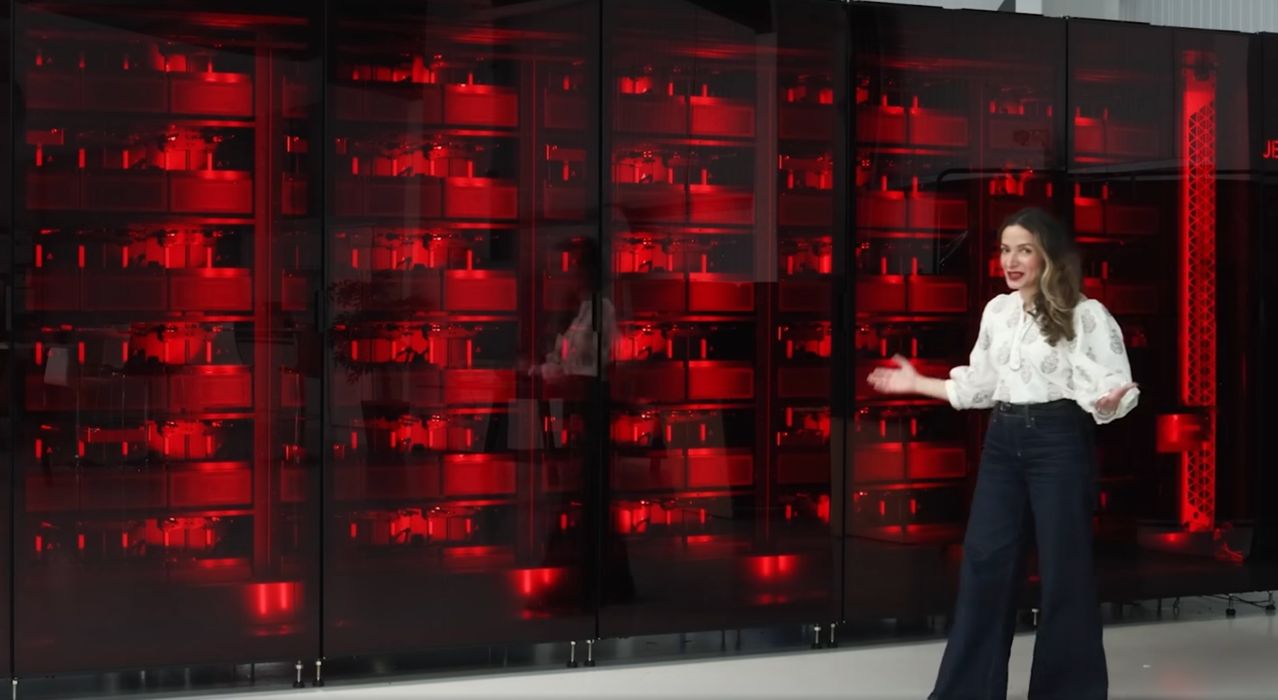
In 2024, they introduced something pretty amazing that they call “Jeni”. I still haven’t figured out the background on the name, but it is a system to run arrays of Photocentric resin 3D printers.
Jeni isn’t just a pile of printers. Instead, it’s printers AND modules for washing, rinsing, and curing. All of this is linked together in a completely automated fashion.
While the printers are pretty speedy on their own — up to 180mm in height every hour — the main gain is throughput through parallelization. Many machines working at the same time can produce a huge number of parts.
Initially, Photocentric released the system with the capacity to print two tonnes of material each 24 hours. Translating that to parts, a small part could be produced on average every 20 seconds.
That’s quite amazing, and allowed Jeni operators to produce tens of thousands of parts per week.
Now they have changed the equation.
They have expanded Jeni to now include seven modules that contain a total of 124 3D printers. That would obviously provide far more capacity, and Photocentric has some quite incredible statistics.
They say that the expanded Jeni can produce “over 1.2 million parts every 8 hours!”
That is … amazing. Of course, they are quoting the statistics for a small part, but many companies do print small parts. In a day, that would be 3.6M parts, and in a week, that would be 25.2M parts.
If operated continuously for a year, this “super Jeni” could theoretically produce nearly ONE BILLION parts.
Is there any application that actually requires a billion parts per year? If so, there can’t be very many of them.
That is certainly not what would actually be done with a Super Jeni, but I say it to make a point: This machine clearly reaches the throughput of almost any mass manufacturing system, at least for small parts.
Photocentric has hit a milestone here, where they seem to have caught up with mass manufacturing. And perhaps beyond, because in theory the Jeni can produce one billion UNIQUE parts in a year, something traditional approaches cannot do.
I think we just arrived at a new plane of existence in the 3D print world.
Via LinkedIn
